


Wladyslaw Hasior's art is inextricably linked with theater, perceived by him in terms of a performance outside of architecture. The artist's performances referred to the tradition of medieval theatrical troupes, itinerant jugglers, folk processions, carts with an elaborate stage structure; the props became works of art made of fabric, strings, springs, children's toys, watches, wood, hair or bread.
Combined together, they created a dynamic machine bursting with flames, predatory, threatening to the audience.
Dramatism was achieved not by the subject itself in the open space, but by the entire narrative wrapped around his movement: Hasior's performance, like a stage drama, had its climax, plot keys and elements that particularly attracted the audience's attention. The theater of the artist's imagination also had a poetic charge, prompting the viewer to read the piled-up metaphors that resulted from the relationships between the individual elements of the "living" structures. In "Polish Banners" these were symbols present in the national consciousness, stitched together in various configurations. In "Interrogation of an Angel," they resulted from the tension between the real hair of a character suspended upside down and the fire bursting toward them.
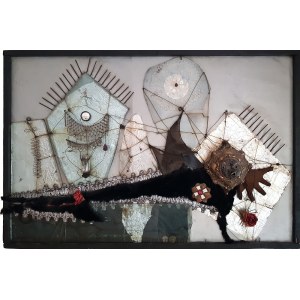
Theatrical and poetic themes also recur in the artist's assemblages, whose compositions evoke the scenographic arrangement of elements in puppetry art. "The Silver Prince" is one of them: stretched on strings, fragments of the composition appear as inert, motionless puppets. Only the fire is missing - or perhaps the composition bursts into flame at the least expected moment?


![Władysław Hasior (1928-1999), Koncelebrant, [1992]](https://img1.one.bid/img/366/53243_1w.webp)










Paskutiniai peržiūrėti
Prisijunkite, jei norite pamatyti pozicijų sąrašą
Mėgstami
Prisijunkite, jei norite pamatyti pozicijų sąrašą