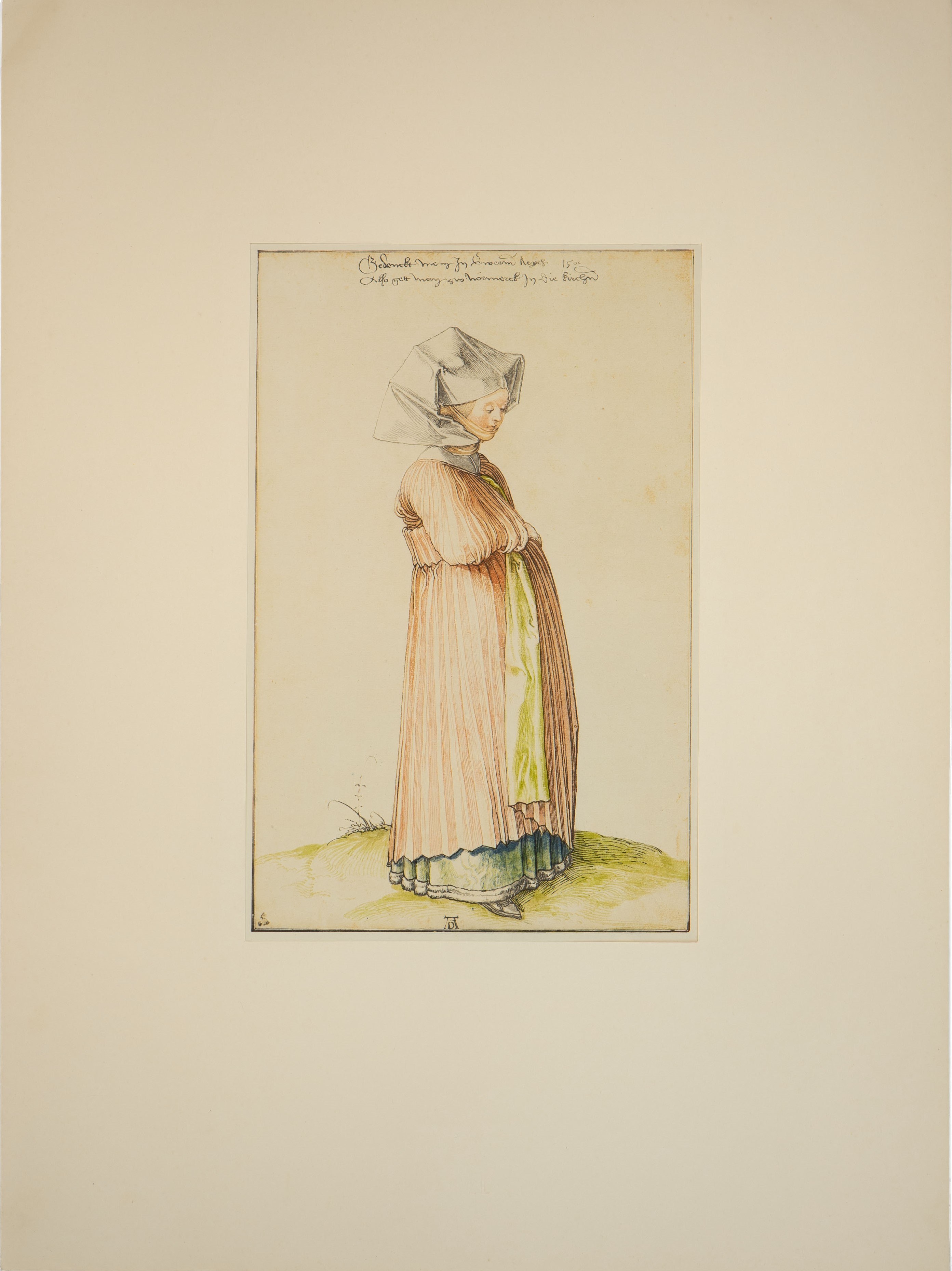
lithograph, paper, 32 x 21 cm in light of original passe - partout (sheet 60 x 45
cm); made in the 19th century by the museum office "Albertina Facsymiles" in
Vienna; signed by Dürer AD d. ; handwritten inscription g., unique print from the only,
unique edition of Durer's prints published at the end of the 19th century.
Albrecht Dürer was not only an outstanding painter, but also an excellent draftsman.
His pen drawing technique was extremely precise and influenced the development of the art of
graphic art.
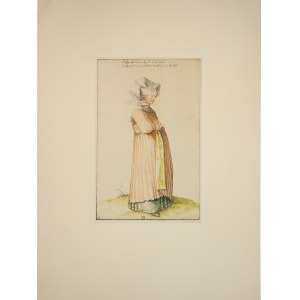
The model in the painting "Woman of Nuremberg dressed for church" was
probably the wife of the artist himself, Agnes Dürer. At the time this
work, Agnes was about twenty-five years old. The painting depicts a woman dressed for
Mass in Nuremberg. Her clothes are carefully rendered, and the delicate shades of water-based
paints create a harmonious effect. Dürer was fascinated by the woman's headdress.
It is exquisitely drawn, and the shadows created by the fine lines of the pen and
ink give it depth. The text on the painting informs us that this is how people
dress for mass in Nuremberg. Dürer used this study of costume in a
later woodcut "The Vow of the Blessed Virgin Mary," where a Nuremberg woman
appears as one of the seven virgins accompanying Mary.This fascinating
study of clothing represents an important contribution to the development of graphic art in the Renaissance
North
Albrecht Dürer's "Nuremberg Woman Dressed for Church" is made using the technique of
pen drawing. Dürer used precise lines to render the details of the costume of the
of the woman and the headdress. Dürer was a master at line control.
For Dürer, the pen drawing technique was not only a tool, but also an expression of
of his artistic vision and technical skill. His works in this technique are
still admired and are an inspiration for many artists and also significantly contributed to the
contributed to the development of printmaking as high art.