


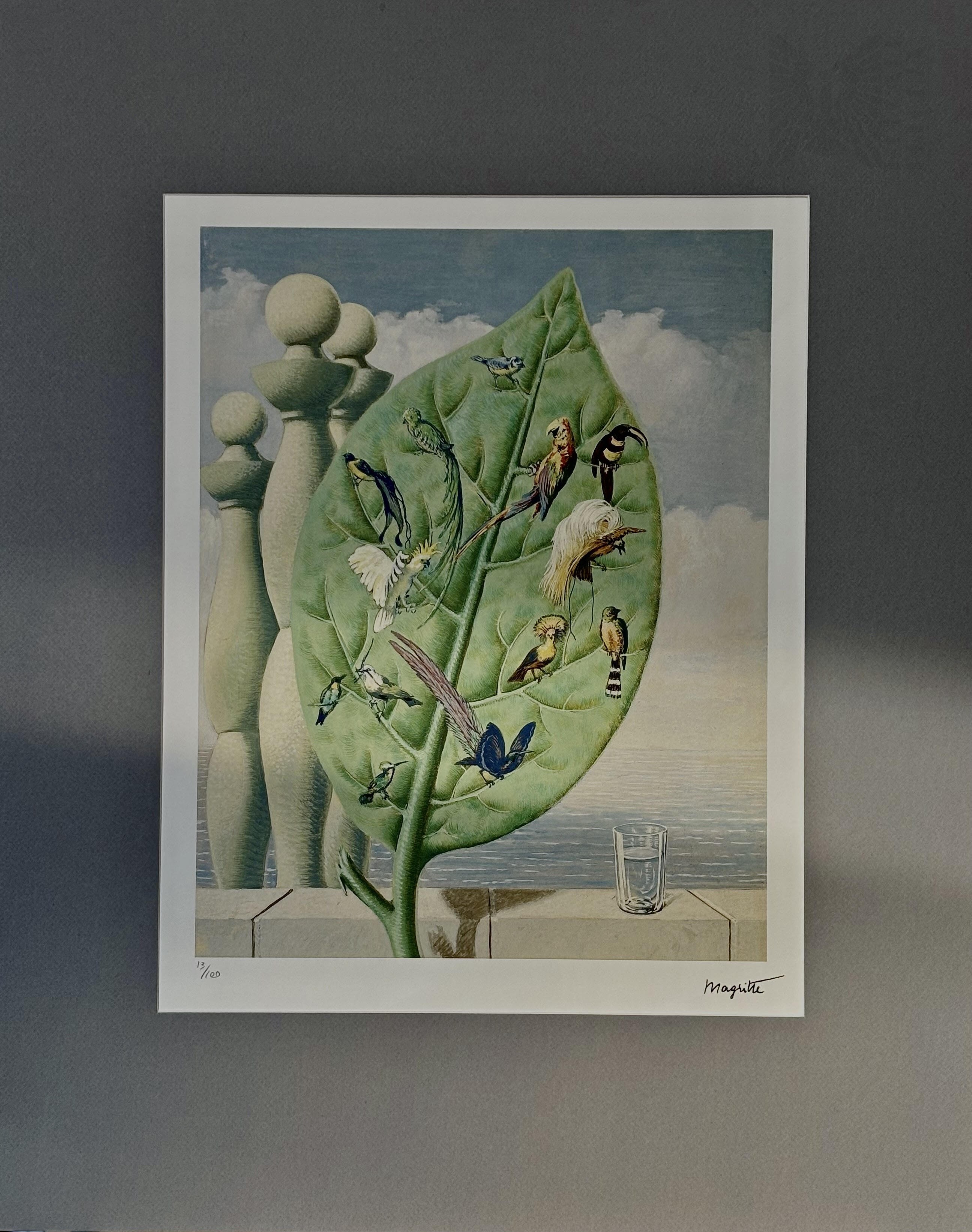
Lithograph, vellum paper, 52 x 42 cm (inside the mat), dimensions: 72 x 60; numbered in pencil 13/100, signed on the plate beneath the composition “Magritte,” publisher’s dry stamp: "EDIZIONI ARO D'ARTE"; Dry seal: “S.P.A.D.E.M. Paris” (SPADEM is the French equivalent of the Polish ZAIKS), “verification of authenticity” hologram on the reverse. Original certificate.
René François Ghislain Magritte—Belgian painter, Surrealist. Known as “the author of words and things.” His paintings shocked and sparked controversy; they are distinguished by their poetic atmosphere and precise draftsmanship. Painted in 1949, this work is considered Magritte’s surrealist manifesto.
A year after Magritte painted “Le regard intérieur,” his friend, the poet Louis Scutenaire, wrote the following commentary: “To be sure of killing them while hunting, man fired a hail of arrows at the animals he painted on cave walls. Today, he brings leaves back to life by showering them with birds.”
Magritte’s vision was based on extraordinary and unexpected associations that brought a deeper understanding of the mysteries of our own existence. Magritte presented mysterious juxtapositions of unlikely objects or impossible landscapes. Suddenly, inspired in part by a vision in which he saw a caged bird in the room where he was staying, replaced by an egg, he realized that by exploring the relationships between the elements of our universe, he could uncover their inner mystery. Thus, the tree leaf came into being, resolving the “problem” of the tree. In “Le regard intérieur,” he added a new dimension to this “problem” by depicting an impossibly exotic array of birds roosting on a giant leaf. Meanwhile, he also introduced another “selective affinity” between the water in a glass and the water in the sea. Although there is nothing “impossible” about juxtaposing these two elements, Magritte nevertheless managed to present them in such a way that they become all the more evocative of the mystery of the world. In this way, he challenges all the assumptions about our surroundings that we all too readily accept, encouraging us to look at the universe anew.
The painting was first exhibited in New York, at the Brooklyn Museum, as part of the International Watercolor Exhibition: The Fifteenth Biennial, May–June 1949, likely no. 26c (titled “The Inner Eye”).
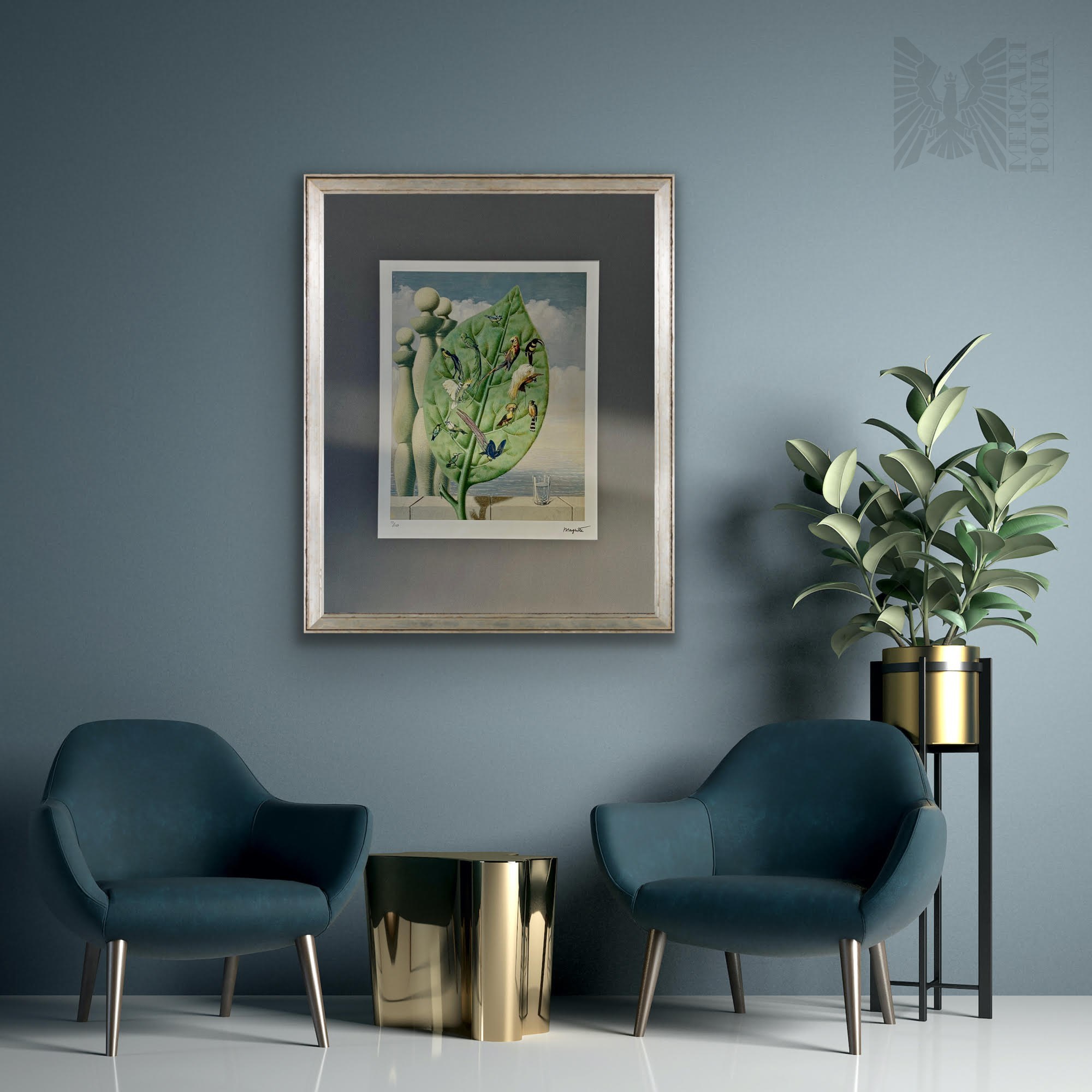
The frames shown in the renderings are for illustrative purposes only and do not constitute a commercial offer.











Paskutiniai peržiūrėti
Prisijunkite, jei norite pamatyti pozicijų sąrašą
Mėgstami
Prisijunkite, jei norite pamatyti pozicijų sąrašą