


Egdar Degas (Paris, July 19, 1834 - September 27, 1917)
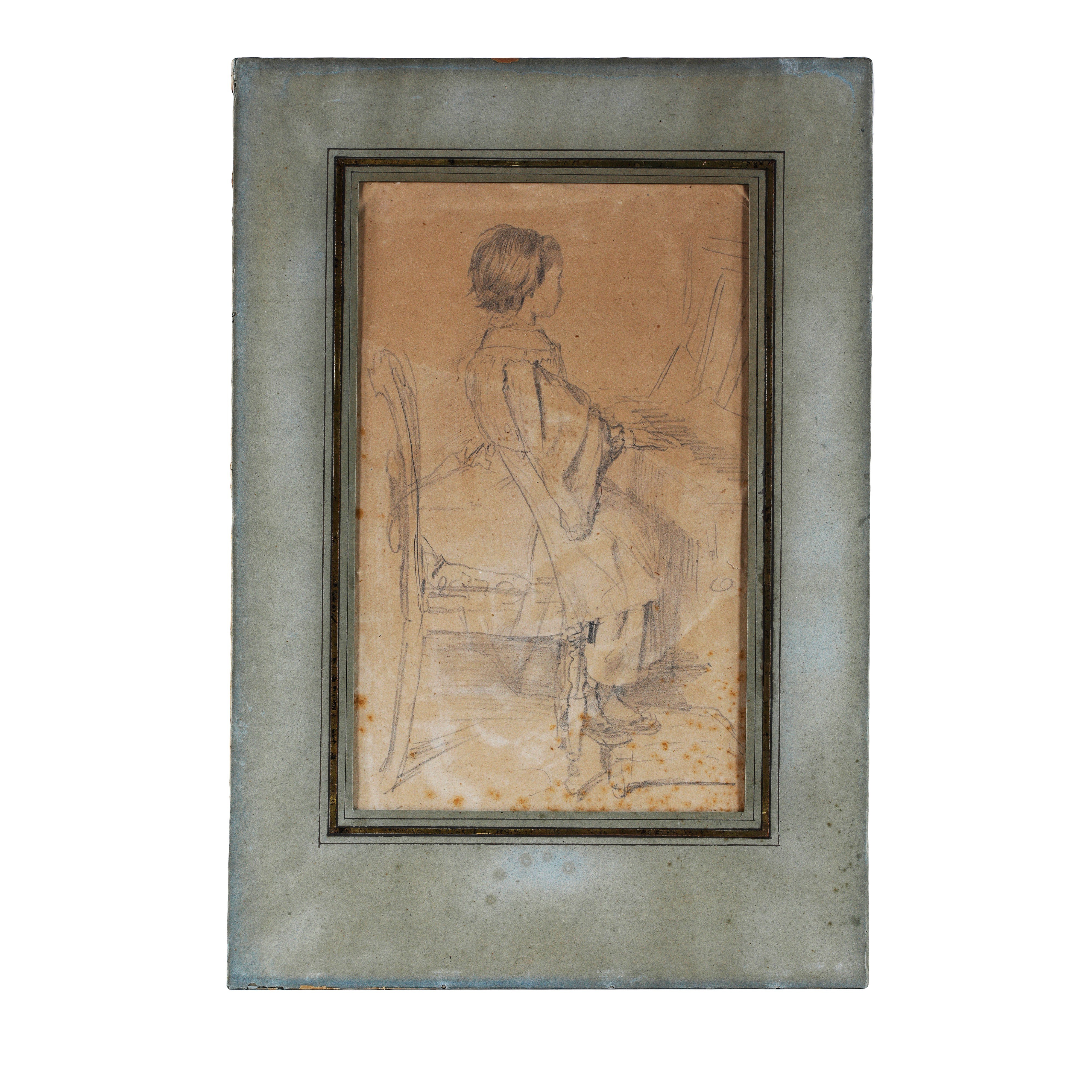
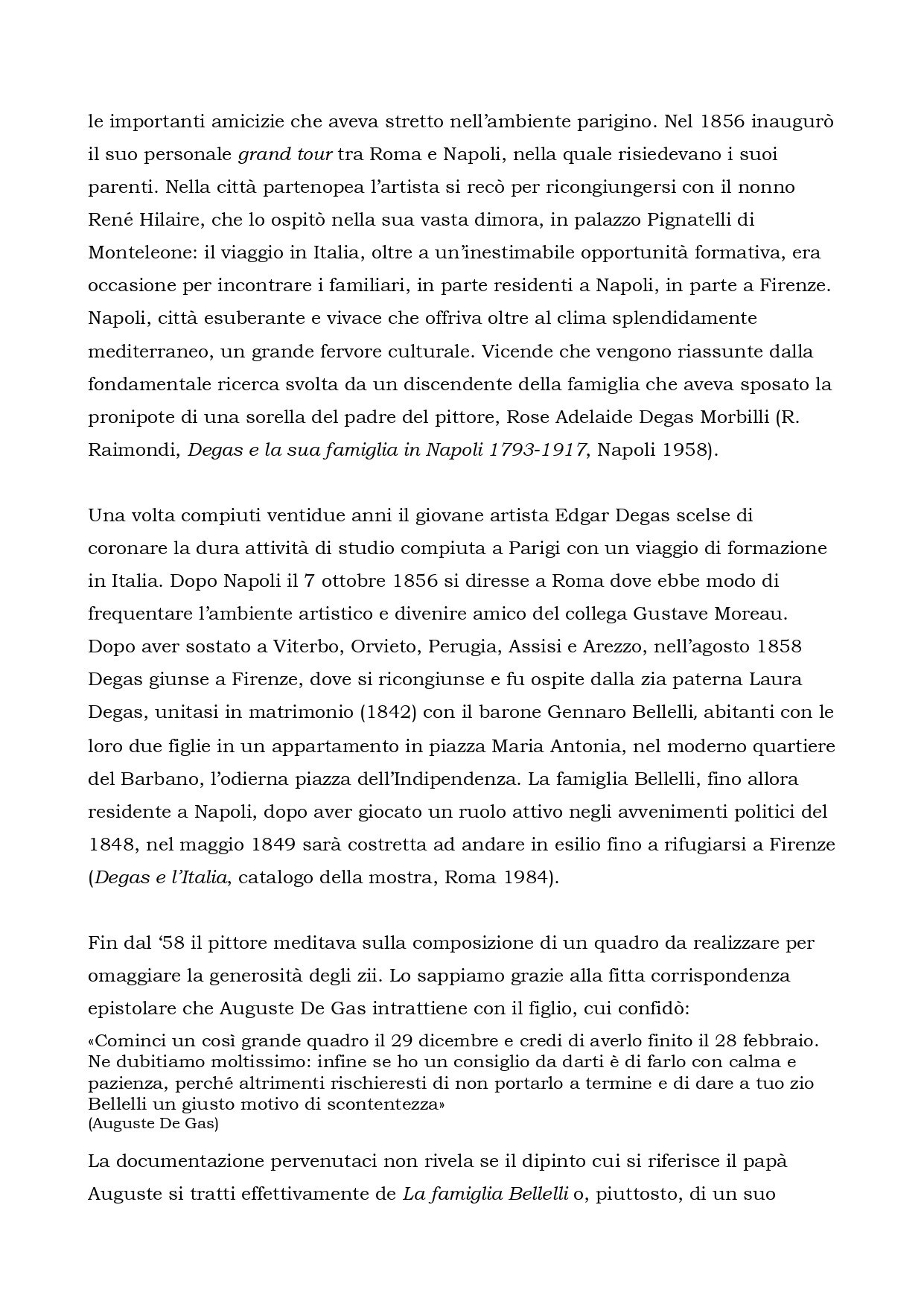
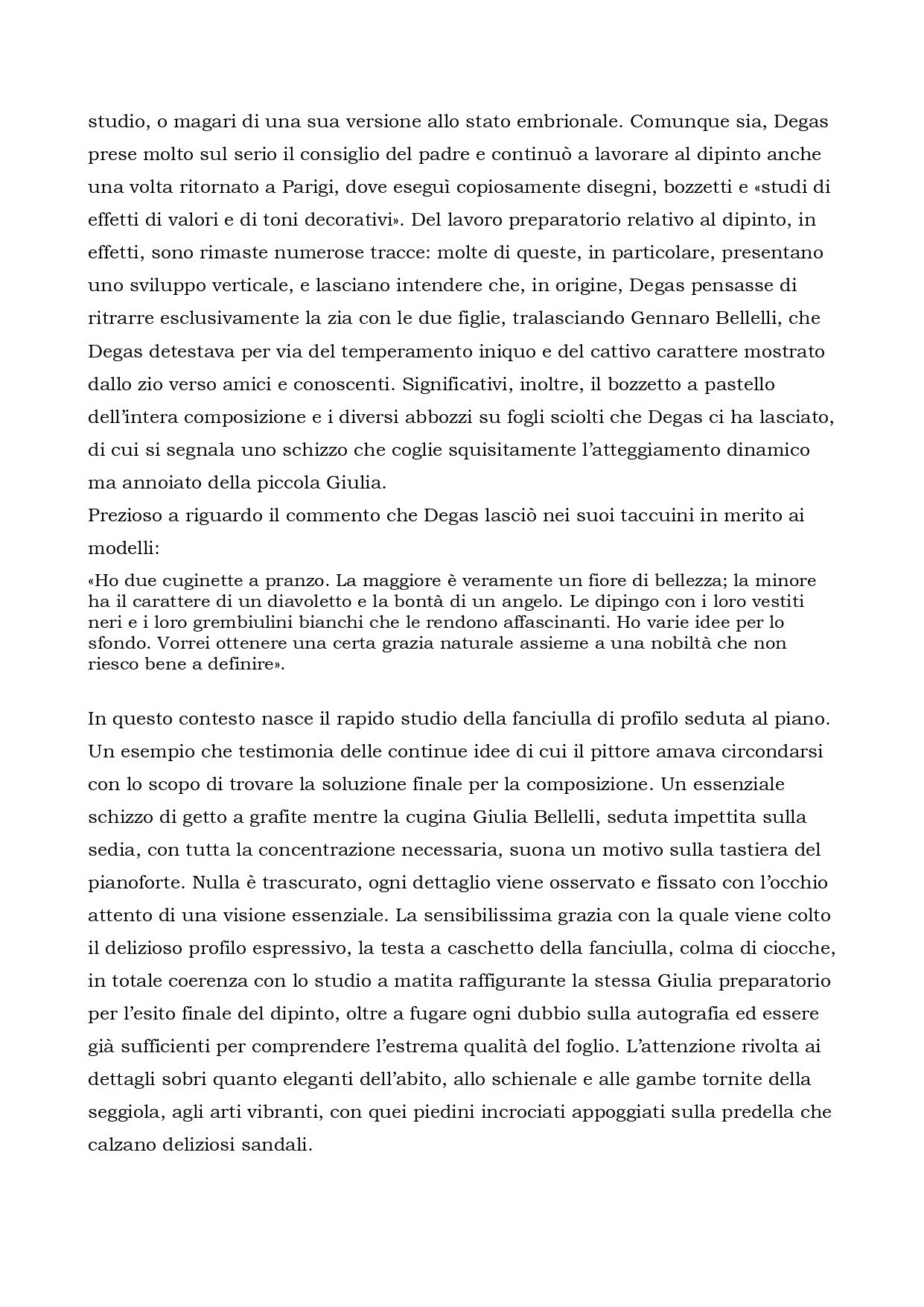
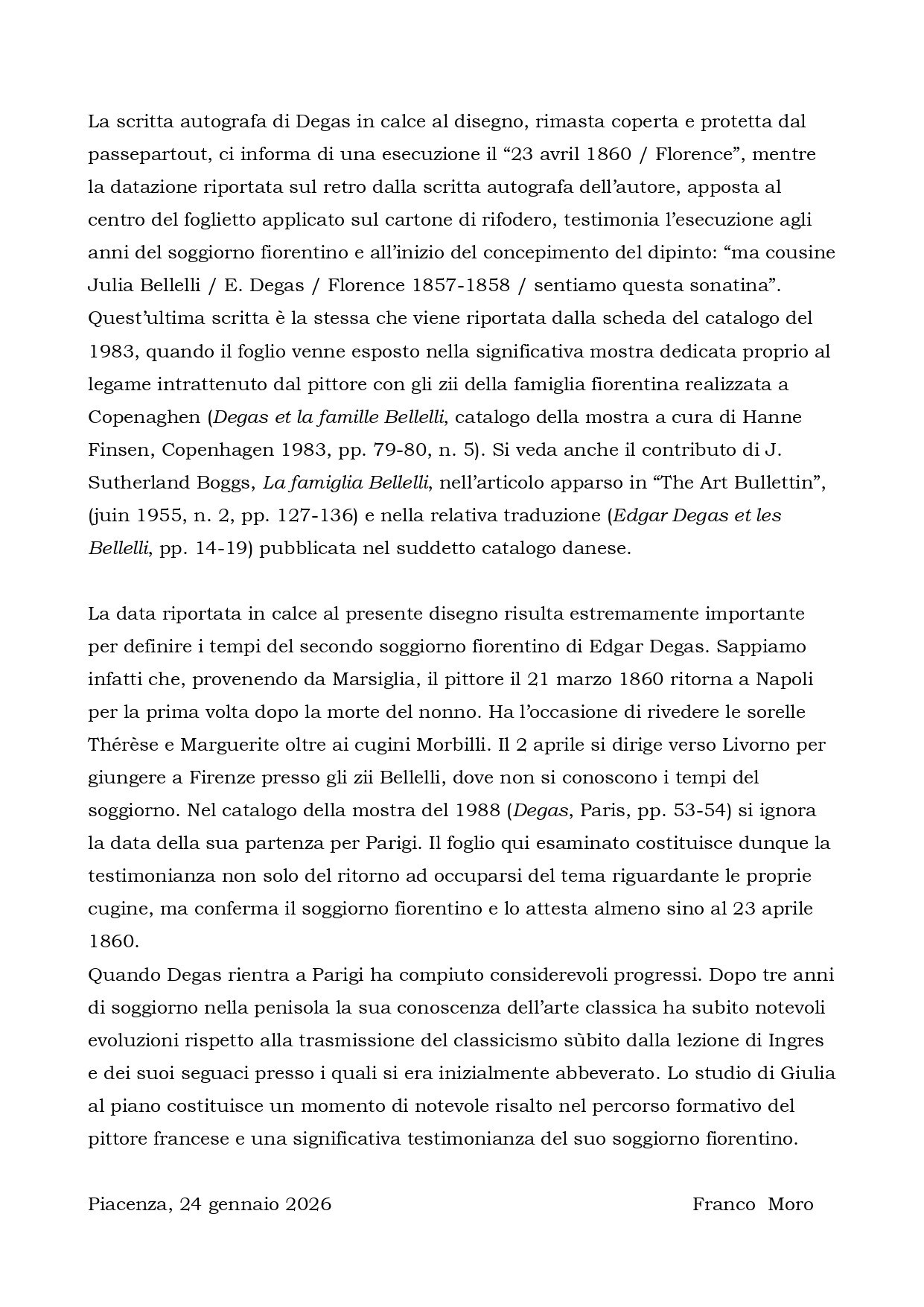
Giulia Bellelli at the piano
pencil on paper mounted on light cardboard with passpartout, measures 417x262 mm
At lower right autograph inscription: "23 avril 1860 / Florence"
Provenance: since 1860 it has belonged to the family of the heirs of the painter's descendants
Bibliography: Degas et la famille Bellelli, exhibition catalog edited by Hanne Finsen, Copenhagen 1983, pp. 79-80, no. 5.
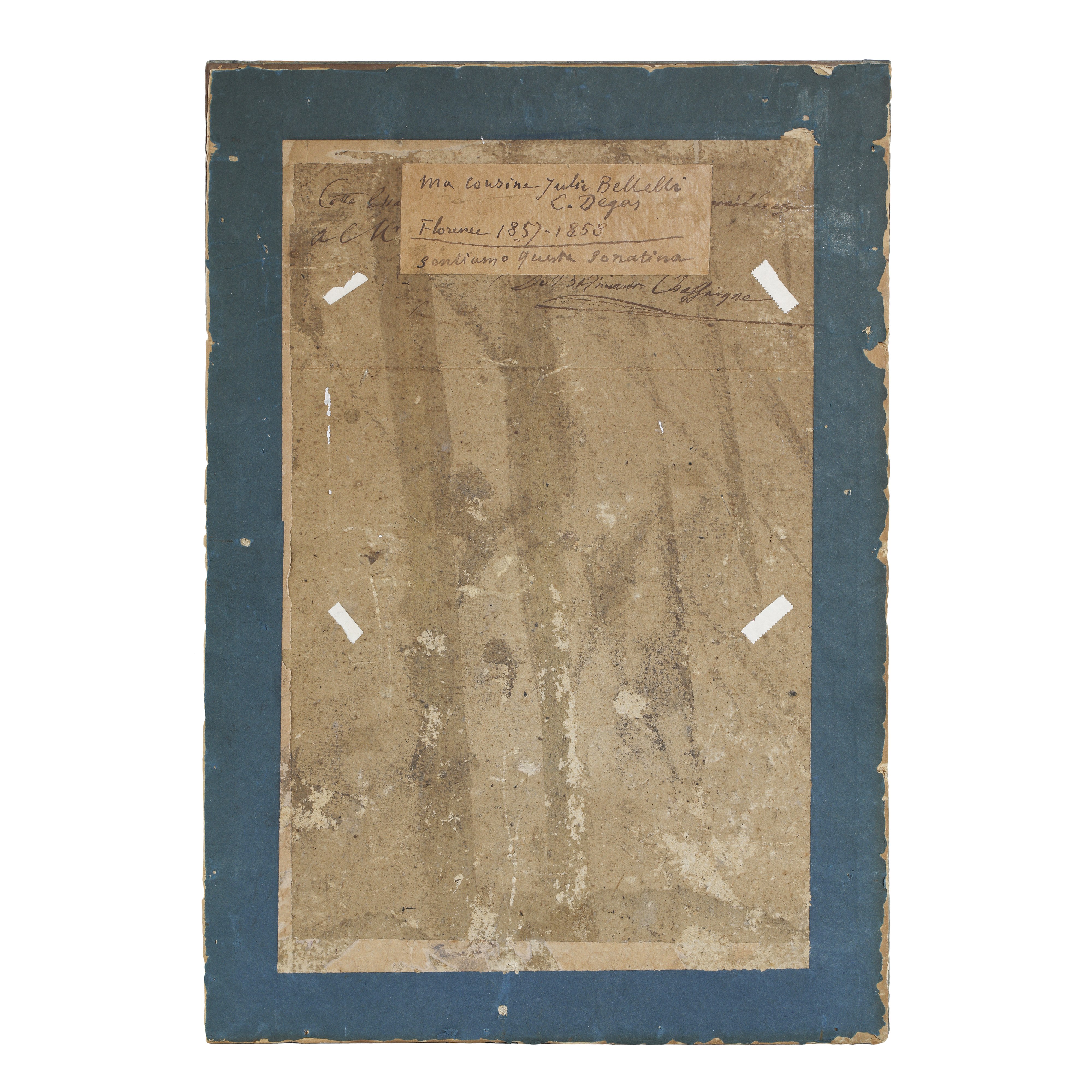
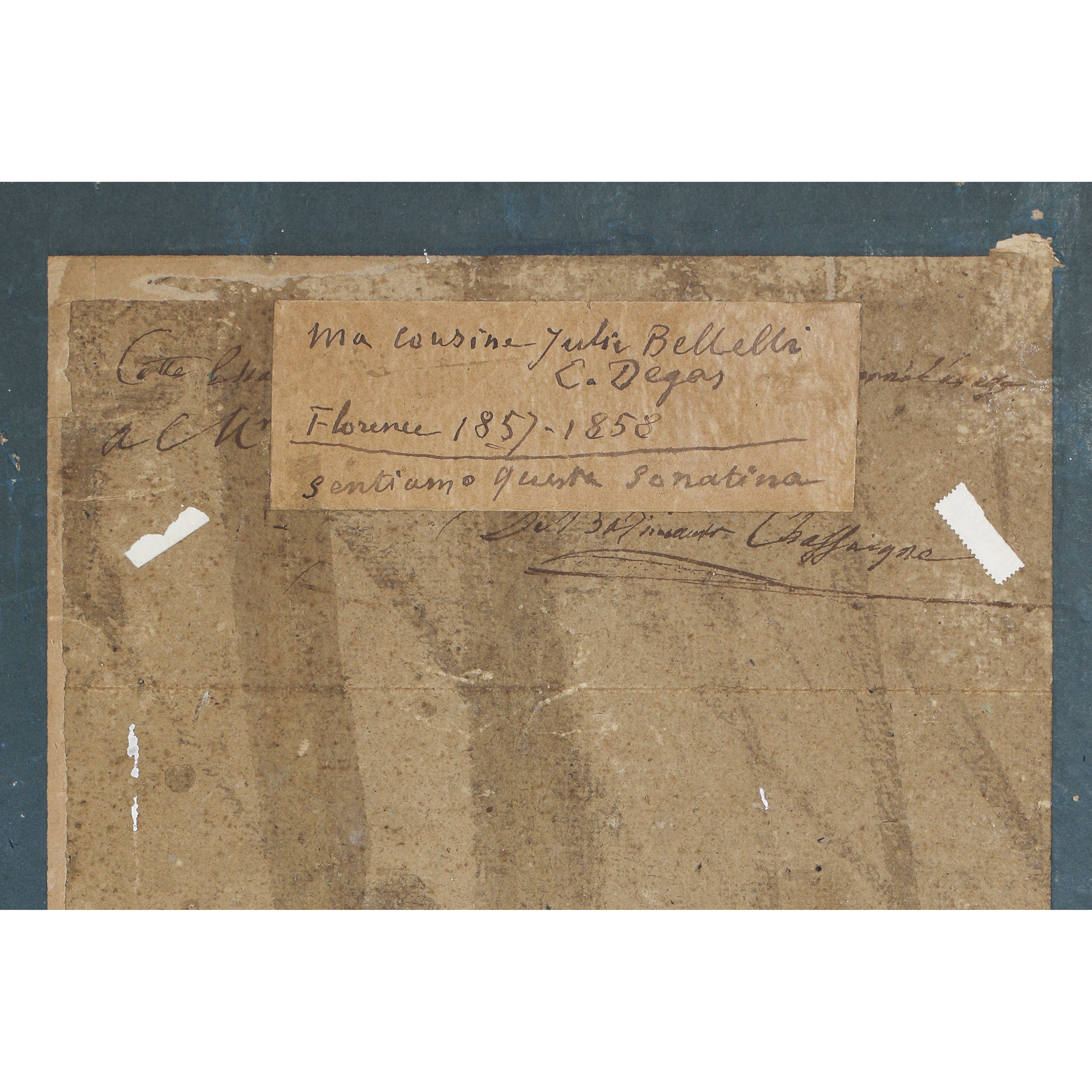
An important drawing by Edgar Degas, which testifies to his second presence in Italy, where in addition to visiting relatives, he came to enrich himself through the study of the great masters of Renaissance painting. It was precisely during one of his visits to the family of his father's sister, who had married Baron Bellelli, that he imprinted on the sheet the image of one of the two cousins, Giulia, seated before the piano, as can be guessed from the inscription on the back of the pencil "ma cousine Julie Bellelli / E. Degas / Florence 1857-1858 / let us hear this sonatina." The drawing is of undoubted interest not only because of the important signature of its executor, but also because it is a document attesting to Degas' second presence in Italy, on "23 avril 1860 / Florence" as written by the artist at the bottom of the drawing to suspend his own memory, and for stopping an intimate moment in the affective life of this extraordinary artist "I have two little cousins at lunch. The elder one is truly a flower of beauty; the younger one has the character of a little devil and the goodness of an angel. I paint them in their black dresses and white pinafores that make them charming. I have various ideas for the background. I would like to achieve a certain natural grace along with a nobility that I cannot quite define." Incidentally, it should be noted that the above inscription, does not appear in the 1983 catalog entry, when the sheet was exhibited in the significant exhibition devoted precisely to the painter's connection with his aunt and uncle's family in Florence held in Copenhagen (Degas et la famille Bellelli, exhibition catalog edited by Hanne Finsen, Copenhagen 1983, pp. 79-80, no. 5). See also the contribution of J. Sutherland Boggs, The Bellelli family, in the article that appeared in "The Art Bulletin," (juin 1955, no. 2, pp. 127-136) and the related translation (Edgar Degas et les Bellelli, pp. 14-19) published in the above Danish catalog.
The drawing is accompanied by Franco Moro's study made having seen the sheet in the original. See attached sheet from which these remarks are taken.
A drawing by Degas in Italy
It is well known and historically documented the blood relationship that Hilaire Germain
Edgar de Gas, more easily and famously known as Edgar Degas,
entertained with Italy. A rather intense and deep-rooted relationship, which developed
through frequenting Italian relatives, leading him to visit the peninsula more
than once (P.A. Lemoisne, Degas et son oeuvre, 4 vols. Paris 1946-48).
The young talent's artistic interests were intertwined with ties of affection, in
particular towards his paternal Neapolitan grandfather, Hilaire Degas, but also
towards his father's sister, his aunt married to the Florentine baron
Bellelli, and his cousins Giulia and Giovanna.
The quick pencil study, barely impressionistically sketched, reproduces the
profile of the figure of the painter's little cousin, Giulia Bellelli at the piano. It is
significant evidence of Degas's youthful presence in Florence.
It constitutes an example taken from life, a useful snapshot in the realization of
that painting that Degas intended to paint as a tribute to his aunt and uncle who hosted him,
decisive piece in the reconstruction of the creative path to arrive at the
realization of the first demanding painting made in Florence between 1858 and '60,
likely completed in Paris.
Edgar was the eldest son of Pierre Auguste Hyacinthe and Célestine Musson, born
in Paris on July 19, 1834 where he died on September 27, 1917. In 1847 his
mother died while his father, who initially hoped to launch Edgar into a career as
a magistrate, opposed his artistic vocation. In a short time he changed
attitude by indulging and enthusiastically supporting his son, provided he
dedicated himself to it. Degas could hope for no better; he spent long
afternoons at the Louvre museum admiring the masters of the Italian Renaissance,
a rare case for artists of his generation. Degas carefully studied the
masters of the past, and among the contemporaries in particular Ingres was the object of a
genuine veneration by the young man, who admired their formal purity
and elegance of line. Once he had acquired familiarity and mastery he did not
delay in feeling stifled by the sterile rigidity of academic drawing, considered
inadequate and mortifying. For this reason he stopped taking classes despite
the important friendships he had made in Parisian circles. In 1856 he inaugurated
his personal grand tour between Rome and Naples, in which his
relatives resided. In the Neapolitan city the artist went to be reunited with his grandfather
René Hilaire, who hosted him in his vast mansion, in the Palazzo Pignatelli of
Monteleone: the trip to Italy, in addition to an invaluable educational opportunity, was
an opportunity to meet family members, partly residing in Naples, partly in Florence.
Naples, an exuberant and lively city that offered not only a splendidly
Mediterranean climate, but also great cultural fervor. Vicissitudes that are summarized by
fundamental research carried out by a descendant of the family who had married the
great-granddaughter of a sister of the painter's father, Rose Adelaide Degas Morbilli (R.
Raimondi, Degas and His Family in Naples 1793-1917, Naples 1958).
Once the young artist Edgar Degas turned twenty-two, he chose to
crown the hard work of study accomplished in Paris with a training trip
to Italy. After Naples on October 7, 1856, he headed to Rome where he was able to
frequent the artistic environment and become friends with fellow artist Gustave Moreau.
After stopping in Viterbo, Orvieto, Perugia, Assisi and Arezzo, in August 1858
Degas arrived in Florence, where he rejoined and was hosted by his paternal aunt Laura
Degas, who had been united in marriage (1842) with Baron Gennaro Bellelli, living with
their two daughters in an apartment in Piazza Maria Antonia, in the modern
Barbano district, today's Piazza dell'Indipendenza. The Bellelli family, until then
residing in Naples, after having played an active role in the political events of
1848, would be forced into exile in May 1849 until taking refuge in Florence
(Degas and Italy, exhibition catalog, Rome 1984).
Since '58 the painter had been pondering the composition of a painting to be made to
pay homage to the generosity of his uncles. We know this thanks to the dense correspondence
epistolary that Auguste De Gas kept with his son, to whom he confided:
"You begin such a large painting on December 29 and you think you have finished it on February 28.
We doubt it very much: finally if I have one piece of advice for you, it is to do it calmly and
patiently, because otherwise you would risk not finishing it and giving your uncle
Bellelli just cause for dissatisfaction."
(Auguste De Gas)
The documentation that has come down to us does not reveal whether the painting referred to by his father
Auguste is actually The Bellelli Family or, rather, a
study of it, or perhaps an embryonic version of it. Whatever the case, Degas
took his father's advice very seriously and continued to work on the painting even
once he returned to Paris, where he made copious drawings, sketches and "studies of
effects of values and decorative tones." Numerous traces remain of the preparatory work related to the painting, in
effect: many of them, in particular, present
a vertical development, and suggest that, originally, Degas thought of
portraying exclusively his aunt with his two daughters, leaving out Gennaro Bellelli, whom
Degas detested because of the iniquitous temperament and bad temper shown
by his uncle toward friends and acquaintances. Also significant are the pastel sketch
of the entire composition and the several sketches on loose sheets that Degas left us,
of which we note a sketch that exquisitely captures the dynamic
but bored attitude of little Giulia.
Valuable in this regard is the comment that Degas left in his notebooks about the
models:
"I have two little cousins for lunch. The eldest is really a flower of beauty; the youngest
has the character of a little devil and the goodness of an angel. I paint them in their
black dresses and white pinafores that make them charming. I have several ideas for the
background. I would like to achieve a certain natural grace along with a nobility that I cannot
quite define."
In this context comes the quick study of the maiden in profile sitting at the piano.
An example that testifies to the continuous ideas the painter liked to surround himself with
with the aim of finding the final solution for the composition. An essential
graphite jet sketch while his cousin Giulia Bellelli, sitting strutting in the
chair, with all the concentration required, plays a tune on the keyboard of the
piano. Nothing is overlooked, every detail is observed and fixed with the
attentive eye of an essential vision. The sensible grace with which
the delightful expressive profile is captured, the helmeted head of the maiden, filled with locks,
in total consistency with the pencil study depicting the same Giulia preparatory
to the final outcome of the painting, in addition to dispelling any doubt about the autograph and being
already sufficient to understand the extreme quality of the sheet. The attention paid to the
sober as well as elegant details of the dress, to the back and turned legs of the
chair, to the vibrant limbs, with those crossed feet resting on the predella that
fit delightful sandals.
Degas's autograph inscription at the foot of the drawing, which remained covered and protected by the
passepartout, informs us of an execution on "23 avril 1860 / Florence," while
the date given on the back by the author's autograph inscription, affixed to the
center of the leaflet applied to the refacing board, testifies to execution at
the years of the Florentine sojourn and the beginning of the painting's conception: "ma cousine
Julia Bellelli / E. Degas / Florence 1857-1858 / let's hear this sonatina."
The latter inscription is the same as the one quoted from the catalog card of
1983, when the sheet was exhibited in the significant exhibition devoted precisely to the
connection the painter had with the Florentine family's uncles held at
Copenhagen (Degas et la famille Bellelli, exhibition catalog edited by Hanne
Finsen, Copenhagen 1983, pp. 79-80, no. 5). See also the contribution of J.
Sutherland Boggs, The Bellelli family, in the article that appeared in "The Art Bulletin,"
(juin 1955, no. 2, pp. 127-136) and its translation (Edgar Degas et les
Bellelli, pp. 14-19) published in the above Danish catalog.
The date given at the bottom of this drawing is extremely important
for defining the timing of Edgar Degas' second Florentine sojourn. We know
in fact that, coming from Marseilles, the painter on March 21, 1860 returned to Naples
for the first time after the death of his grandfather. He has the opportunity to see his sisters
Thérèse and Marguerite again in addition to his Morbilli cousins. On April 2 he heads for Livorno to
arrive in Florence at his aunt and uncle Bellelli's, where the timing of his
stay is unknown. The 1988 exhibition catalog (Degas, Paris, pp. 53-54) ignores
the date of his departure for Paris. The sheet examined here thus constitutes
evidence not only of his return to deal with the subject concerning his own
cousins, but confirms the Florentine sojourn and attests to it at least until April 23
1860.
By the time Degas returned to Paris he had made considerable progress. After three years
of sojourn in the peninsula his knowledge of classical art had undergone remarkable
evolutions from the transmission of classicism sùbito from the lesson of Ingres
and his followers at whom he had initially imbibed. Giulia
's studio on the piano constitutes a moment of notable prominence in the French painter's
training and a significant testimony to his Florentine sojourn.
Piacenza, January 24, 2026 Franco Moro











Paskutiniai peržiūrėti
Prisijunkite, jei norite pamatyti pozicijų sąrašą
Mėgstami
Prisijunkite, jei norite pamatyti pozicijų sąrašą