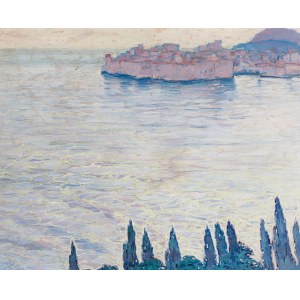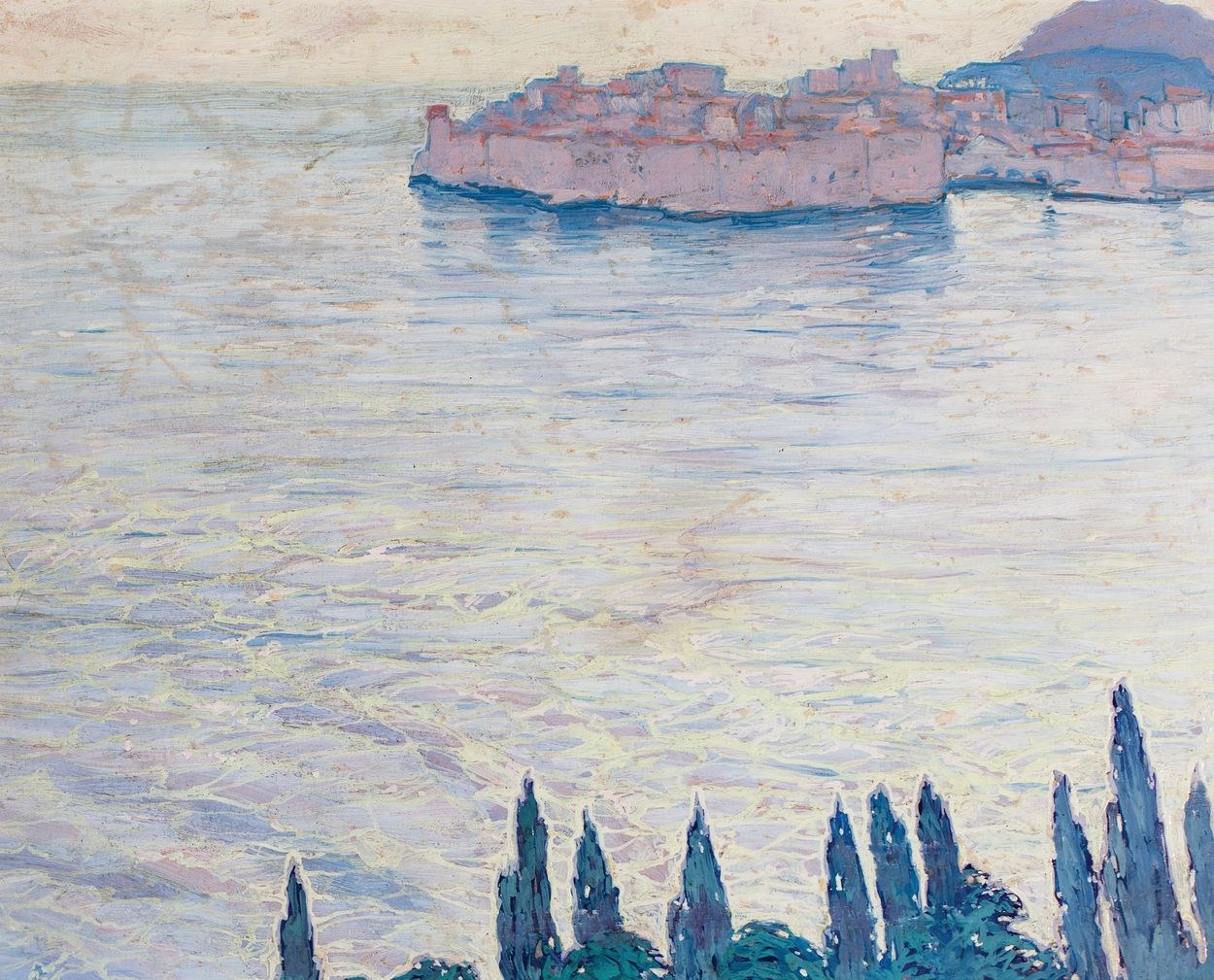
Oil, cardboard; 36 x 45 cm
Expert opinion by Dr. Aleksandra Melbechowska-Luty in 1987.
Asking price 3500
Estimate 7000 - 8000
Louis de LAVEAUX
1891 Fryštak- 1969 London
He shared great-grandparents with Stanislaw Ludwik (1868 - 1894), a well-known painter who did not use the name Stanislaw either in everyday life or in signatures. In 1910, he began studying architecture at the Lviv Polytechnic Institute, and during this period established close contacts with Jozef Pilsudski. From August 1914 he fought in the Legions in the 4th Infantry Regiment, where he reached the rank of lieutenant. In his spare time he painted wartime landscapes and genre scenes. He had an undoubted talent for painting. Being a distinguished professional officer, he remained a valued amateur painter in his surroundings and in his family. He painted landscapes, preferably of the Podhale region, military scenes, as well as portraits. He used watercolor and oil techniques. After the Oath Crisis, he was arrested and sent to the Italian front. He escaped from the transport and made his way to Stryj, where, under a false name, he initially served as POW commander. From November 1918 to January 1919 he commanded a section in the defense of Lviv, and then the "Gródek Jagielloński" group. From January 1919 he was commander of the 1st battalion of the 4th infantry regiment of the Legions. In June 1919 he is promoted to captain. He fights in the Bolshevik war. In December 1919 he is appointed chief of staff of the 5th infantry division in Lviv and promoted to major. From 1922 to 1926 he is chief of staff of the 1st Mountain Infantry Division in Bielsk with the rank of lieutenant colonel. From 1926 to 1929 he is the chief of staff of the 1st DOK of Warsaw. From 1929 to 1936 he commands the 2nd infantry regiment of the Legions. In 1932 he is promoted to the rank of colonel qualified. In 1936 he was transferred to Modlin to command the 8th Infantry Division's divisional infantry. In the September campaign he fights in the defense of Modlin. He spends the war in German captivity. The Polish government-in-exile promoted him to the rank of brigadier general in 1966. He exhibited his works in Poland at exhibitions of legion art and in Cracow, Zakopane and at "Zachęta" in Warsaw, and after the war also in London.