


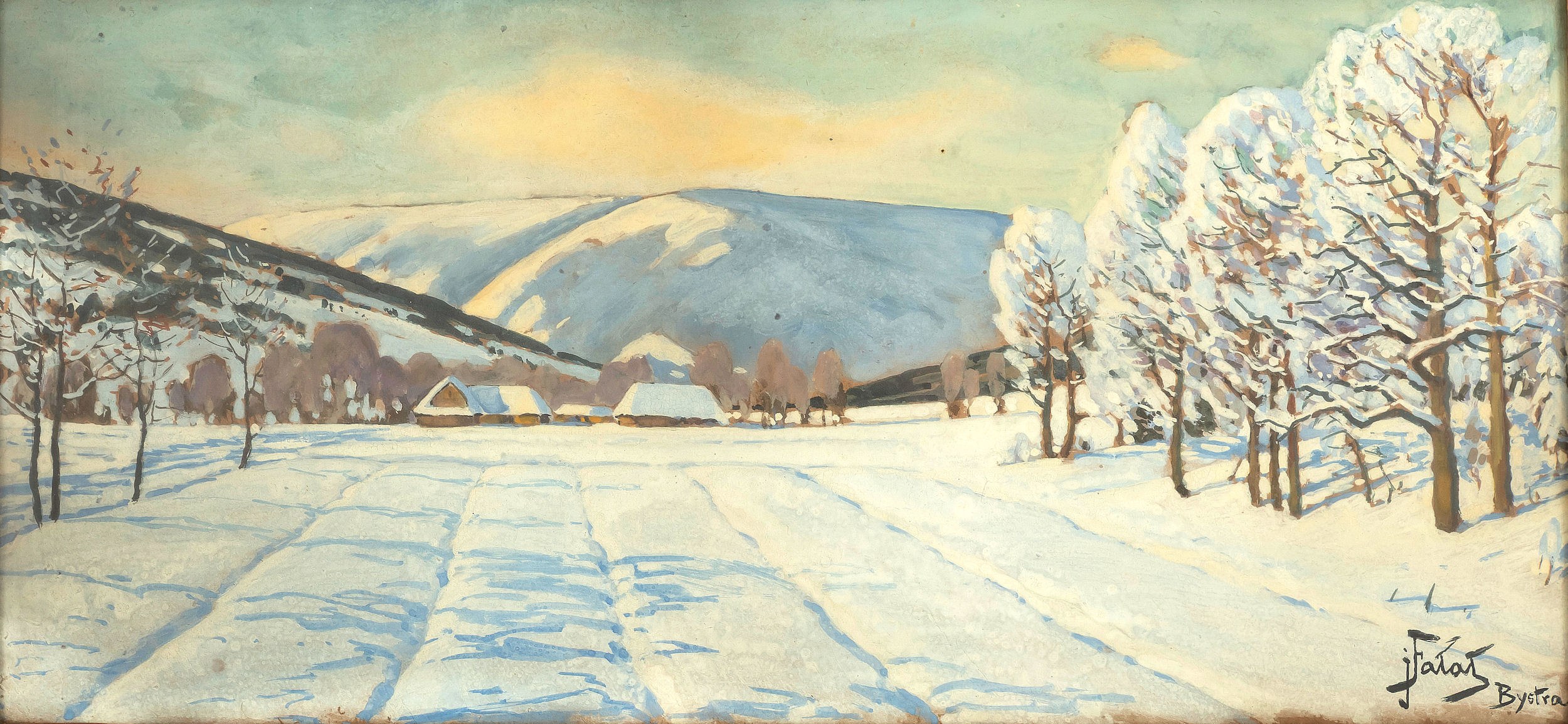
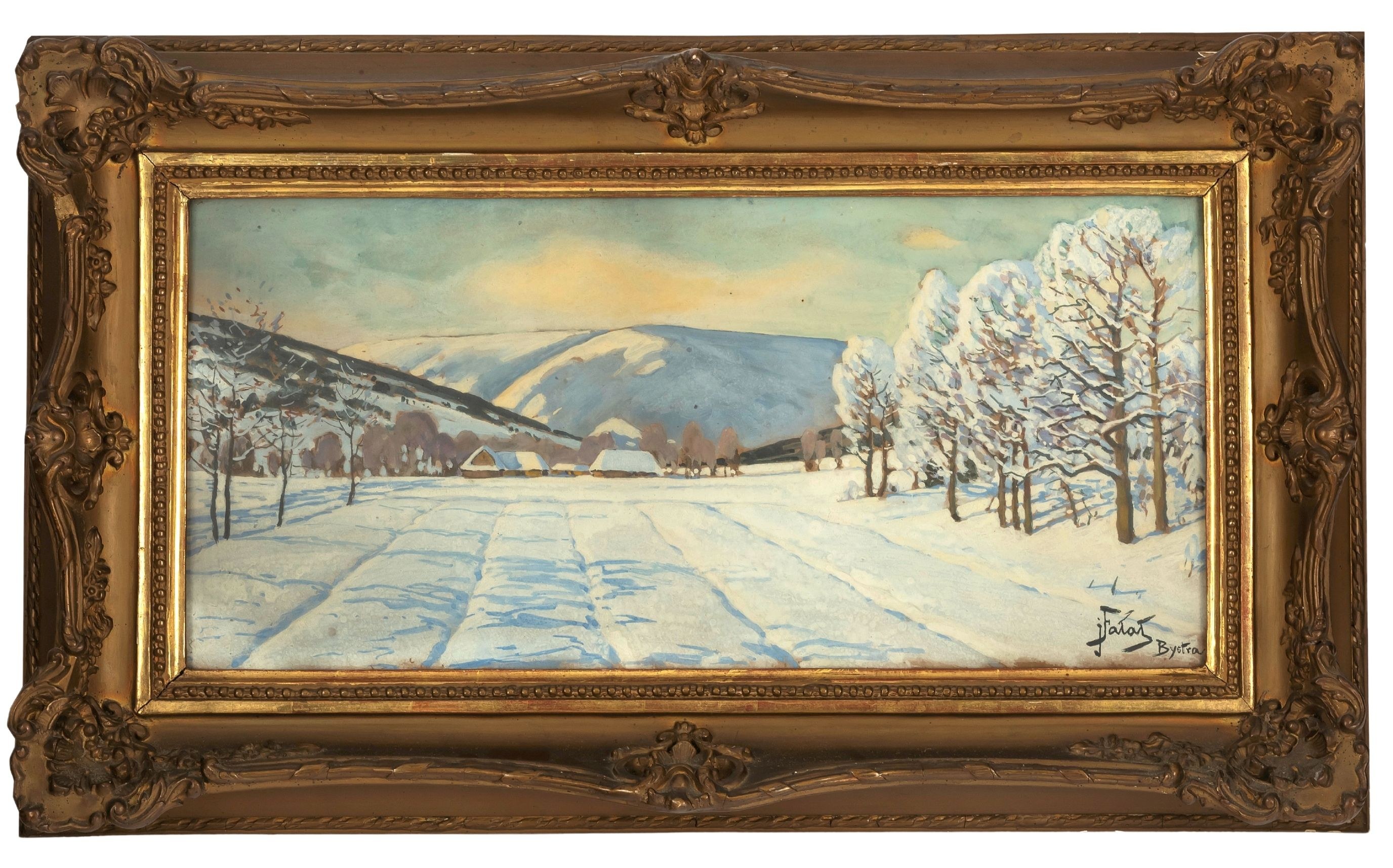
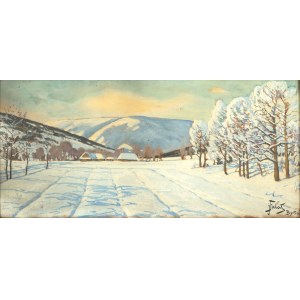
gouache, watercolor, cardboard, 25.5 x 54 cm (inside the frame)
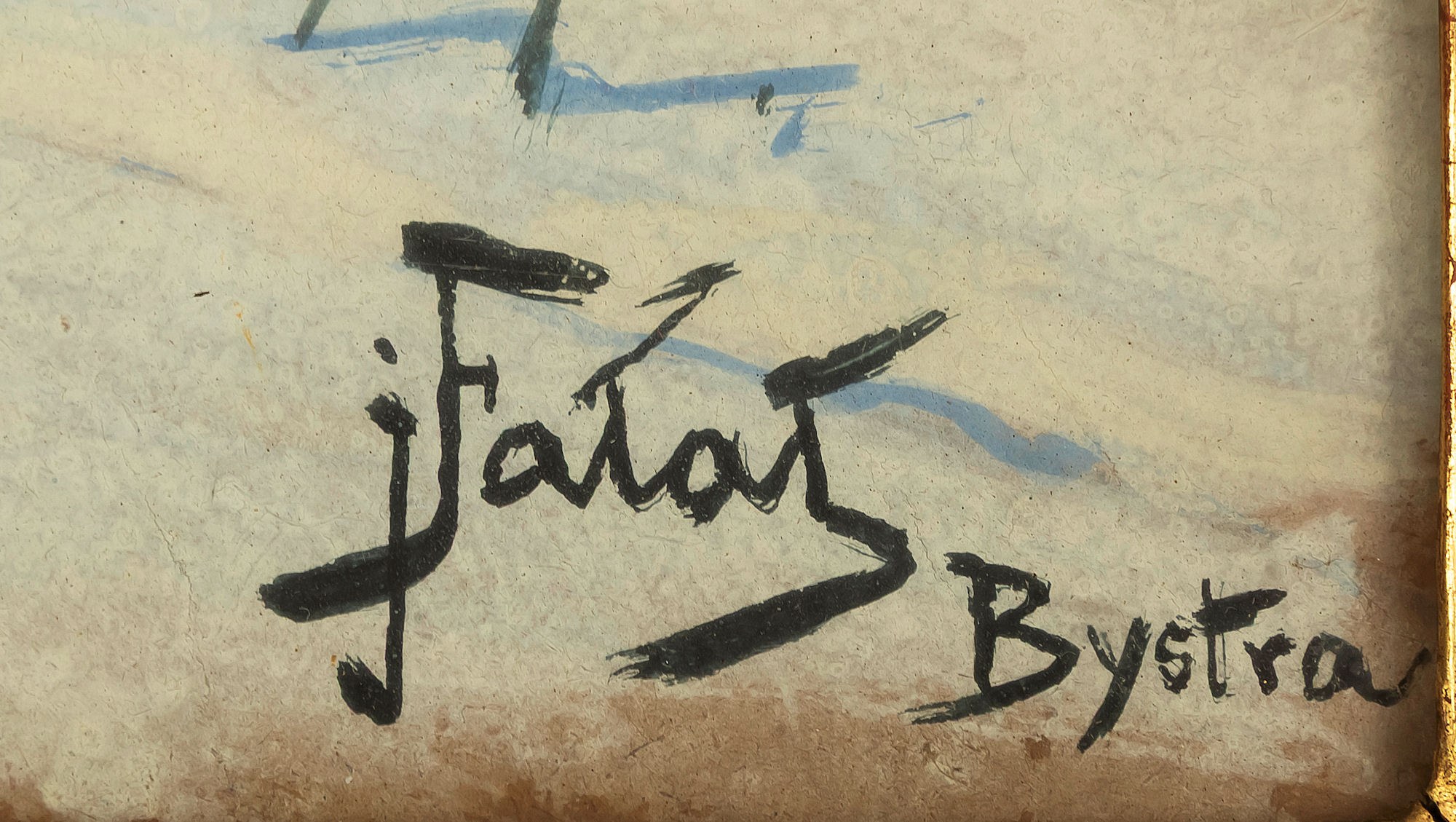
signed and inscribed lower right: “jFałat/Bystra”
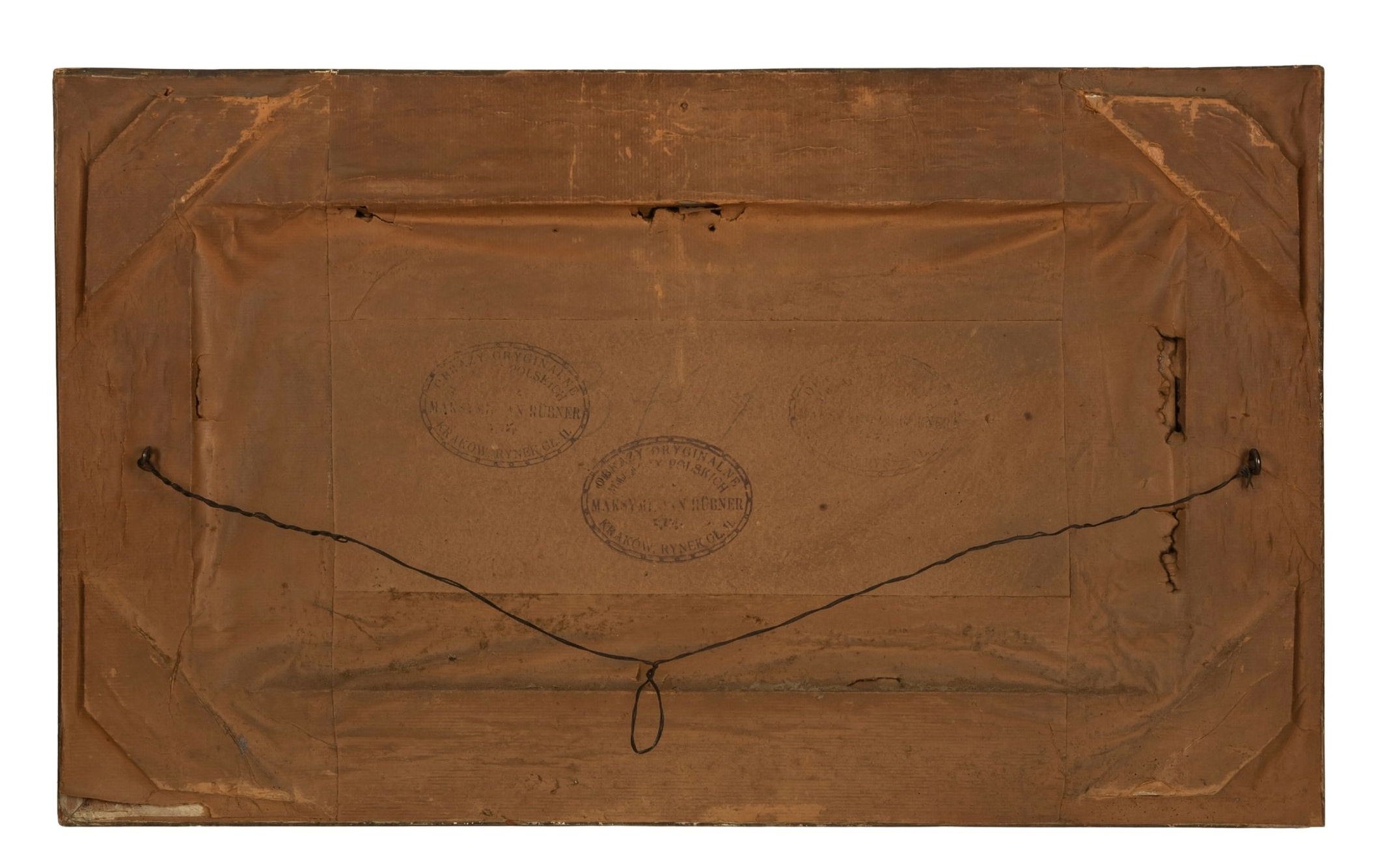
On the reverse, three stamps: "ORIGINAL PAINTINGS | POLISH PAINTERS | MAKSYMILIAN RÜBNER | KRAKOW, MAIN SQUARE 11."
Provenance:
- In a family collection in the Tri-City since the 1970s. Previously acquired from the collection of the director of the Jaworzno Glassworks.
“We’re having a wonderful winter right now. It snowed all night, and the landscape is becoming absolutely beautiful; we just have to wait for the first ray of sunshine to start painting.”
Letter from J. Fałat to his daughter, October 12, 1927, MBB/H-FJ/1350
“Fałat amazes with his technique. Not so much in oil—though even here one can see a remarkable mastery of form and tone in broad, bold, and immense brushstrokes—as in watercolor. No other Polish painter has such a feel for the water in the paint—or rather, on the paper (…) He achieves tones of unprecedented purity, and where necessary, of unprecedented intensity—in no way inferior to those of oil painting. At times, the pure, warm-toned paper—dotted here and there with cobalt in the shadows—becomes snow bathed in sunlight. A single stroke works a miracle. This is a mastery worthy of Besnard or the finest English watercolorists.”
E. Niewiadomski, “Polish Painting of the 19th and 20th Centuries,” Warsaw 1926, pp. 247–248
Bystra—a village Fałat first encountered in 1902 during a recuperative stay at a sanatorium run by Dr. Ludwik Jekeles. Located in the Silesian Beskids, the village and the rich landscape it offered enchanted the artist from the very first moment, influencing his decision to make it his lifelong and artistic haven. It is worth quoting the painter’s recollection from that period: “I happened to come to Dr. Jekeles’s sanatorium here in Bystra for a course of treatment. I really liked the local nature and told myself that I could live here and work in Kraków. Upon returning to Kraków, I confided my plans to my friends, and they said, ‘Fałat has lost his mind!’ Who at that time would have even considered going in that direction? Back then, only the Kraków–Vienna route was known and recognized. Undeterred, I returned again the following year and set my sights on the spot where a wonderful Silesian cottage stood. I was drawn to its traditional appearance and the vibrant colors of the wildflowers surrounding it—hollyhocks, foxgloves, and poppies. (…) the realities of life dictated that the cottage, though beautiful, be demolished and a villa built in its place. I have never regretted it.” (J. Fałat, Memoirs, op. cit., p. 213). In 1910, after resigning from his position as director of the Kraków Academy, Fałat settled permanently in Bystra, bringing fame to this small spa town. For nearly twenty years, the artist engaged in his favorite en plein air studies, enchanted by the nature of the Beskids. Many landscapes date from this period, including numerous winter compositions—the so-called “Fałat snows”—which were highly sought after by clients in the capital. The correspondence of Jadwiga Wołoszynowska, who handled the sale of the artist’s works, has been preserved; in it, she reports: “Almost every buyer wants ‘Snow’ and nothing but snow; I promise it to everyone and make a note of it, but there is no snow here and none in sight, so now I kindly ask you, Dear Sir, to please send me something by mail” (Letter from J. Wołoszynowska to J. Fałat, February 15, 1914, MBB/H-FJ/1498). The artist himself considered the winter landscape a rewarding subject. In a letter to his daughter, he wrote: “We’re having a wonderful winter right now. It snowed all night, and the landscape is becoming absolutely exquisite; one only needs to wait for the first ray of sunshine to begin painting.” (Letter from J. Fałat to his daughter, October 12, 1927, MBB/H-FJ/1350). Among Fałat’s favorite painting motifs, which he repeatedly featured in his compositions, were the valley with the Klimczok hill and the mountain ridges of Skalite and Skrzyczne. The painter remained faithful to Bystra until the end of his life, leaving behind a substantial artistic legacy. “The list of outdoor motifs he drew upon is quite extensive. It is the result not only of his curiosity about the world and his sensitivity to its beauty, but also of Julian Fałat’s passion for traveling in the ‘company’ of his paintbrush, a paintbox, and some kind of painting surface, but also an expression of his persistent striving to capture the power and variability of landscape forms and the moods of nature” (I. Purzycka, Julian Fałat: A Biography Written with a Brush, Bielsko-Biała 2017, p. 153










Paskutiniai peržiūrėti
Prisijunkite, jei norite pamatyti pozicijų sąrašą
Mėgstami
Prisijunkite, jei norite pamatyti pozicijų sąrašą