


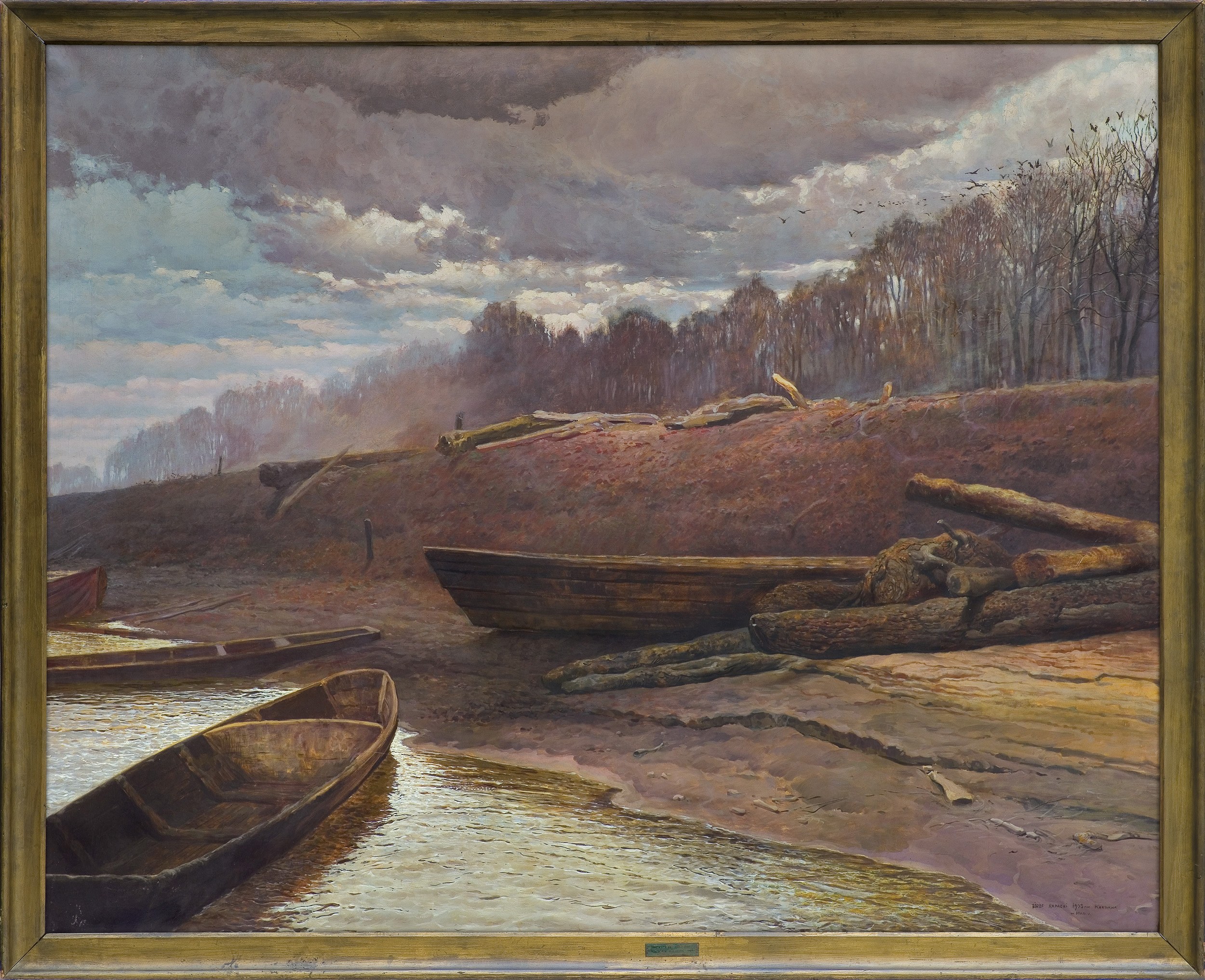
200,5 x 250,5cm - oil, canvas doubled
Sign p.d.: JÓZEF RAPACKI 1903 year WARSAW | in MARCH.
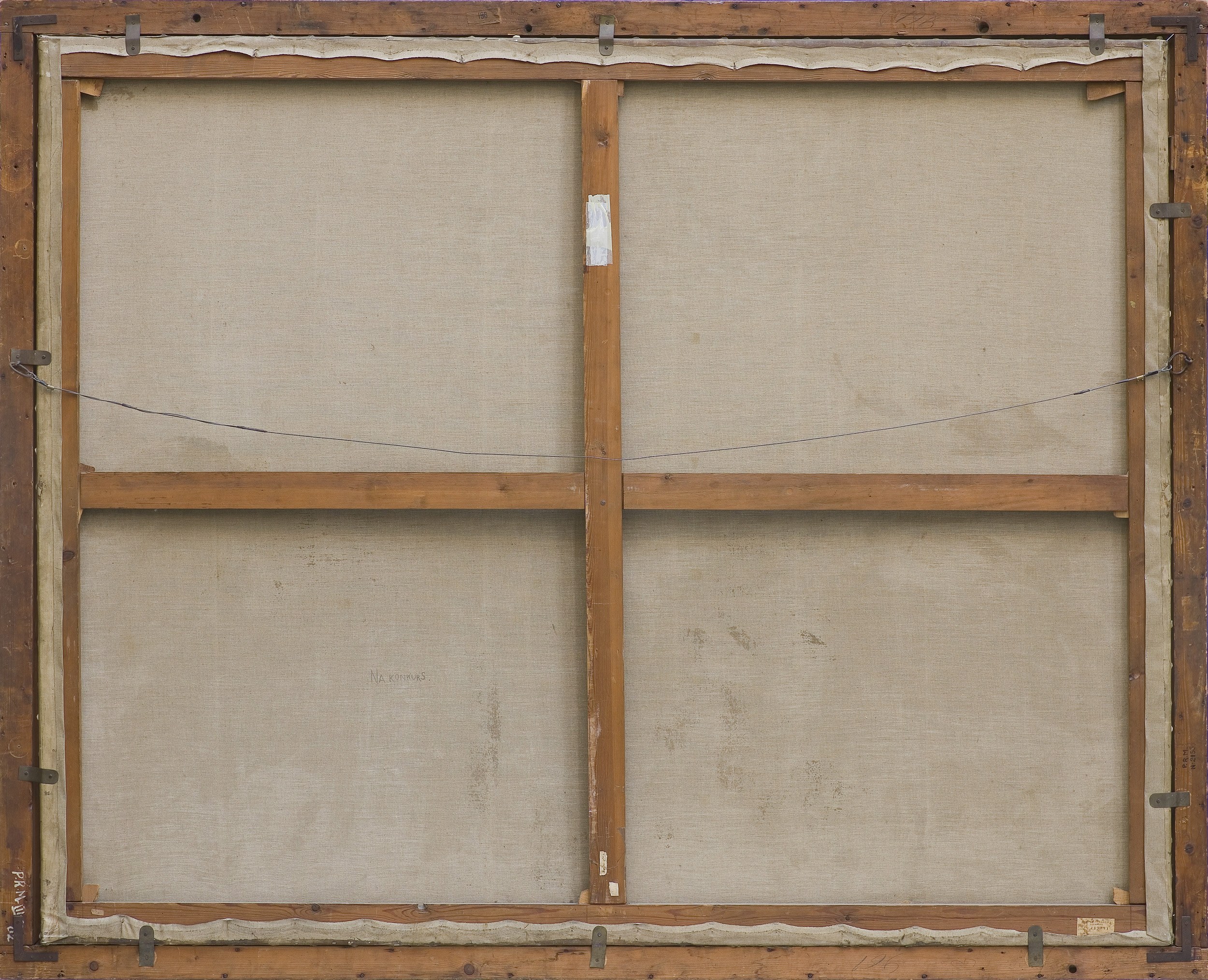
On the reverse on duplicated canvas, inscription (in pencil): FOR COMPETITION; on the upper strip of the loom, stamp: [...] | PRINTINGS OF PAINTING | I. WADOWSKIEGO | MARSZAŁKOWSKA 121 | in Warsaw; on the lower loom strip on the left a slice with no. (in black pen): 903/29/71; on the right, deposit sticker (print, ink): NATIONAL MUSEUM | IN WARSAW | Inv. no. 189198 | Cat. no.; on vertical crossbar of loom at bottom, sticker fragment (in ink): Polish Rapacki; on frame, on upper bar, sticker (print): XII. Esposizione Internazionale d'Arte | della Citta di Venezia - 1920 | 961; on upper and lower slat, number (in blue crayon): 961; also in the corners, repeated twice, the numbers (in black crayon): 1, 2, 3 and 4; on the right strip, inventory number (in black crayon): P. R. M. | N: 2155.; on the left strip the inventory number (in white paint): P.R.M. III - 6 | 82.
Painting mentioned, reproduced and exhibited, among others:
- Malarstwo Polskie od XVI do początku XX wieku, ed. S. Kozakiewicz and K. Sroczyńska, Warsaw 1975, p. 314, cat. no. 828;
- Postage stamp from the series Wisła w malarstwie, designed by J. Wysocki, published in 1984;
- Józef Rapacki, 1871-1929: painting, drawing, graphics, ed. by J. Zielińska. Zyrardow District Museum, IV 1993, pp. 10, 21, cat. I, no. 11;
- A. Pawlowska, Pro Arte. Monograph of a group of Warsaw artists (1922-1932), Warsaw 2006, p. 45;
- Słownik artystów polskich i obcych w Polsce działających: malarze, rzeźbiarze, graficy, T. 8: Pó-Ri, ed. U. Makowska and K. Mikocka-Rachubowa, Warsaw 2007, p. 223;
- Rapacki embodied: an exhibition of works by Józef Rapacki: paintings, lithographs, drawings, photographs, Radziejowice, VII - XII 2010, pp. 7, 13, il. p. 32, cat. no. 12.
Compare with:
- Józef Rapacki, Wiosna na Powiślu, "Tygodnik Ilustrowany" 1903, I półrocze, no. 17, il. s. 330.
The presented Vistula near Bielany, according to the exhibition curator Rapacki embodied - Renata Higersberger - after the exhibition at the Zachęta Gallery, was given to Stefan and Zofia Piłsudski, who loaned it to Marshal Józef Piłsudski at the Belvedere, where it was exhibited until his death in 1935. Then in 1942 it was deposited in the National Museum in Warsaw from where it was looted by the Nazis. The canvas was recovered in 1956 and again deposited in the Warsaw museum for years. In 2008, the painting was acquired at auction by its current owner, who re-lent it to the Belvedere, where it was exhibited from October 2012 to November 2025.
Despite a sticker from the Twelfth International Art Exhibition in Venice in 1920, in its exhibition catalog, in the section devoted to the Polish Pavilion, neither Vistula near Bielany nor any other work by Rapacki is mentioned. Also, press mentions from 1920 do not confirm Rapacki's participation in this exhibition.
Rapacki is perhaps the most popular Warsaw landscape painter of the late 19th century and early 20th century. Landscape was the most essential part of his oevre, and it is with it that the artist is most often associated. (...) From the beginning, he expressed himself through means appropriate to realistic painting," writes Renata Higersberger in the cat. of the Rapacki embodied exhibition, further adding that: influenced by Stanislaw Witkiewicz's turbulent articles, he succumbed to his artistic demands. He demanded respect for realists, and believed that it was not the subject matter but the manner of execution that determined the qualities of a work of art. Fascinated by all that plein-airism carried, he enthusiastically embraced novelties, painting and drawing from nature (...). In 1989-91 he studied at the private school of Friedrich Fehr (1862-1927), where he succumbed to the influence of mood painting, known as stimmung painting. Wanting to achieve the effect of emotional tension, he followed the prevailing tenets of this painting, such as the vast expanse of the landscape with a lowered horizon line, carefully distributed vertical accents of the composition, dramatic play of clouds in the sky, and subtle coloring.
The presented view of the Vistula River near Bielany is the essence of Polish landscape painting at the turn of the 19th and 20th centuries and an excellent example of Józef Rapacki's work. On this monumental canvas, the artist applied a realistic formula noting meticulously hundreds of details, but at times approaching an impressionistic, luministic depiction of light emerging from between the clouds and dancing on the surface of the water. The sky is full of fantastic, jagged clouds. They are alternately gray and radiant. It seems that the air still echoes the last echoes of the struggle between the gloomy March days and the awakening sun of the coming spring. The presented landscape is an intimate study of the Vistula shore and the people associated with the river. Despite the absence of figures, their presence is marked by the boats left in the bay, partly bobbing on the water, partly lying on the bank. The composition combines realistic landscape with moodiness, which is enhanced by a color palette limited to shades of gray and brown, exemplifying the tenets of stimmung painting. An overcast sky with billowing clouds, mists gently hovering over the ground and fowl seeking shelter among the branches of trees all enhance the atmosphere of anticipation.
Jozef Rapacki remained faithful to traditionalist, realistic art, even during the period when avant-garde trends were forming in Poland. On the monumental canvas on display, he captured the magical and nostalgic atmosphere, of his beloved Mazovian land. Vistula near Bielany is one of the most important and outstanding works by Józef Rapacki, and its appearance in our auction is a special treat for lovers of Polish landscape.
Józef Rapacki (Warsaw 1871 - Olszanka near Skierniewice 1929), called "the painter of birches and lilac heather," was one of the most popular Warsaw landscape painters of the late 19th and first quarter of the 20th century. He began his painting education as a student of Wojciech Gerson at the Warsaw Drawing Class. He later went on to study at the School of Fine Arts in Cracow under Florian Cynk (1886-1887) and in Munich at Friedrich Fehr's private school (1888-1889). After his studies, he traveled to Italy several times. He participated in numerous exhibitions at the TZSP in Warsaw and in Lviv (1894 silver medal), Krakow, Vilnius, Kielce. He also exhibited abroad - in Berlin (1893) or Paris, where in 1900 he was awarded a diploma at the Universal World Exhibition. He belonged to the "Pro Arte" group. Since 1907 he lived permanently in Olszanka, a village on the edge of Puszcza Mariańska, near Skierniewice. He painted primarily realistic, atmospheric landscapes and genre scenes set in the landscape, as well as portraits and interiors. He cultivated graphic art (portfolios Z dawnej i niedawnej Warszawy and Pro memoria. Prusak in Poland), engaged in book illustration, and collaborated with Warsaw magazines, including Tygodnik Ilustrowanym, Wędrowiec, Świat and Biesiada Literacka.













Paskutiniai peržiūrėti
Prisijunkite, jei norite pamatyti pozicijų sąrašą
Mėgstami
Prisijunkite, jei norite pamatyti pozicijų sąrašą