


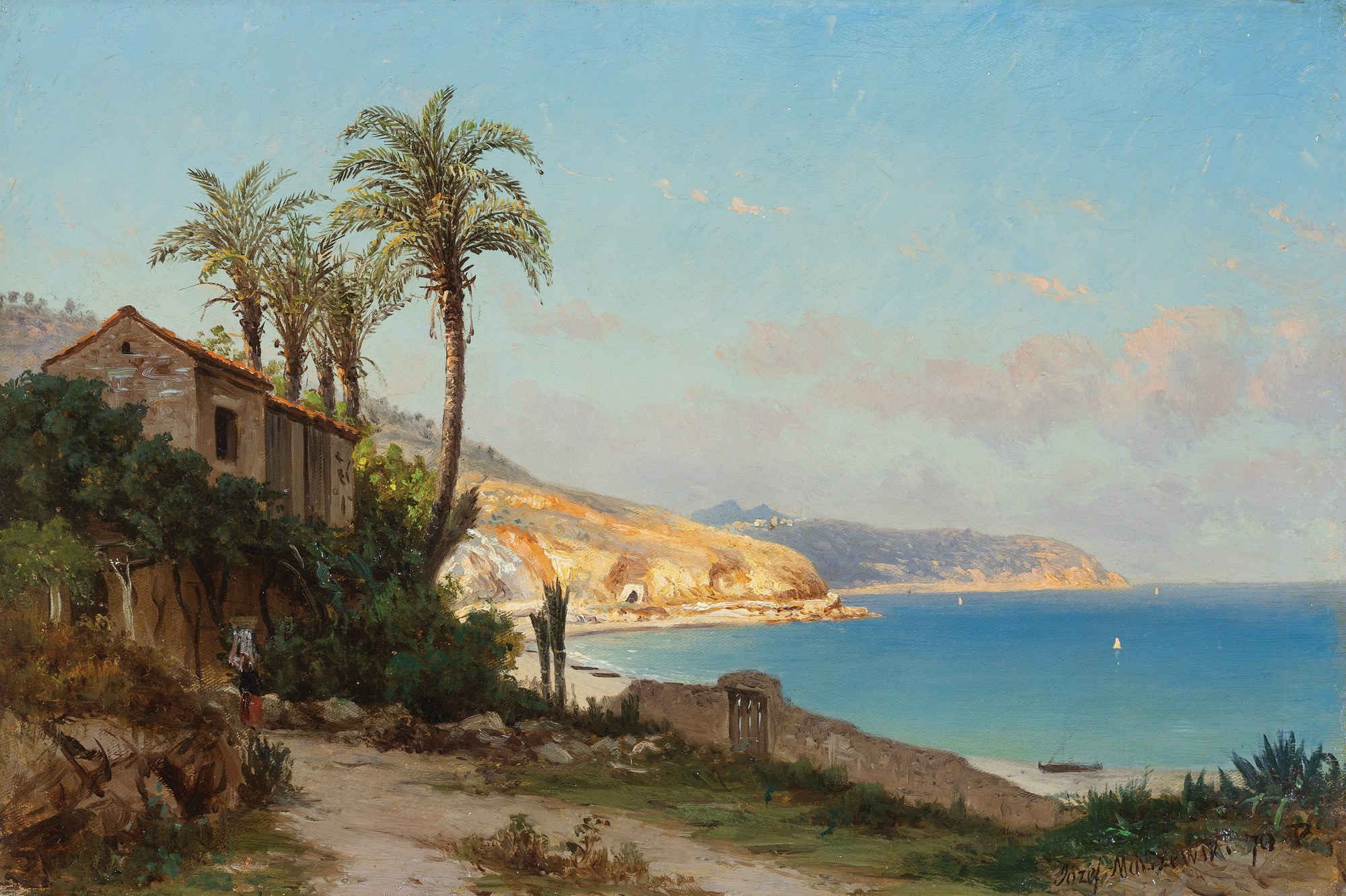
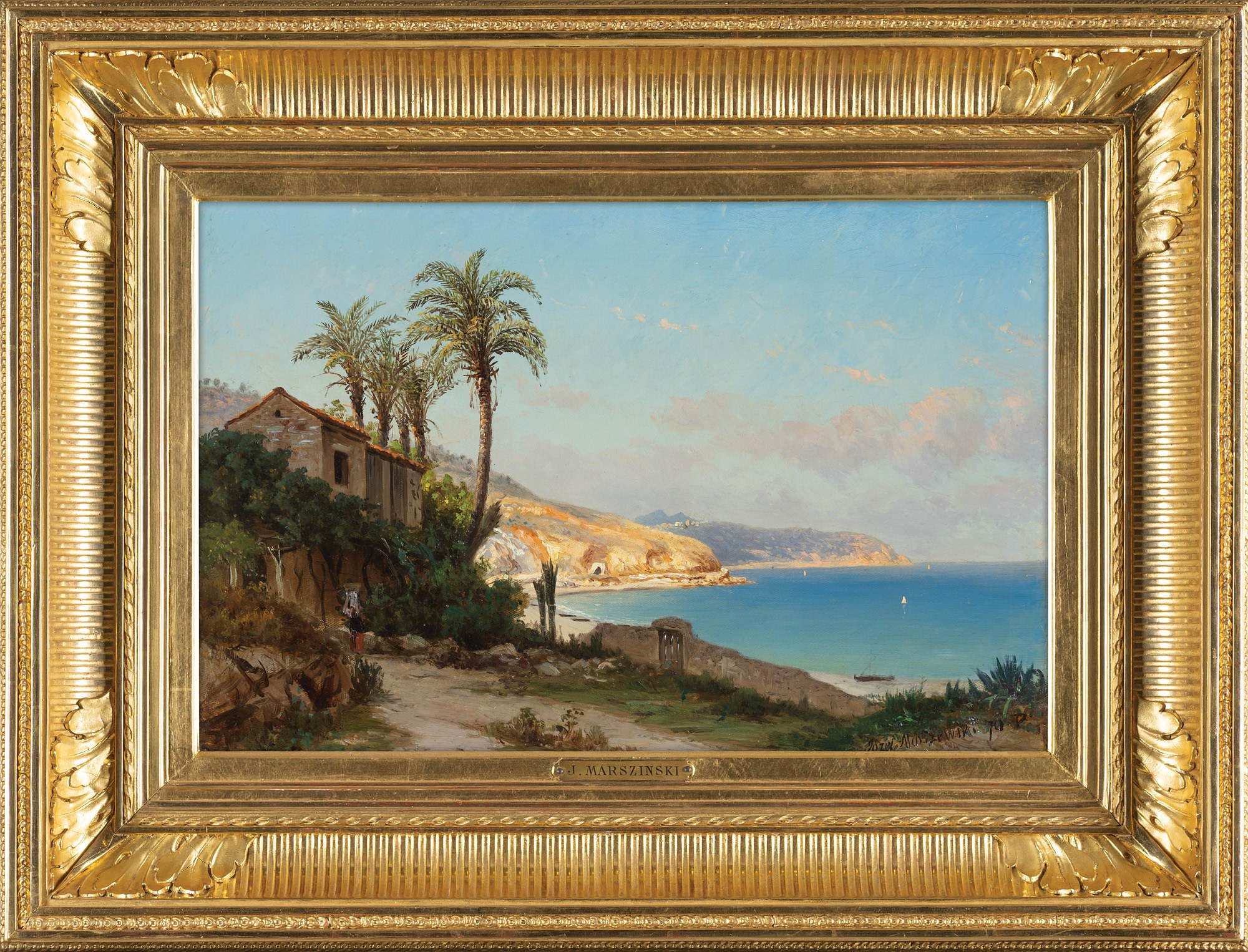
27.0 x 41.0 cm - oil, canvas
sign.p.d.: Jozef Marszewski 70 D/./
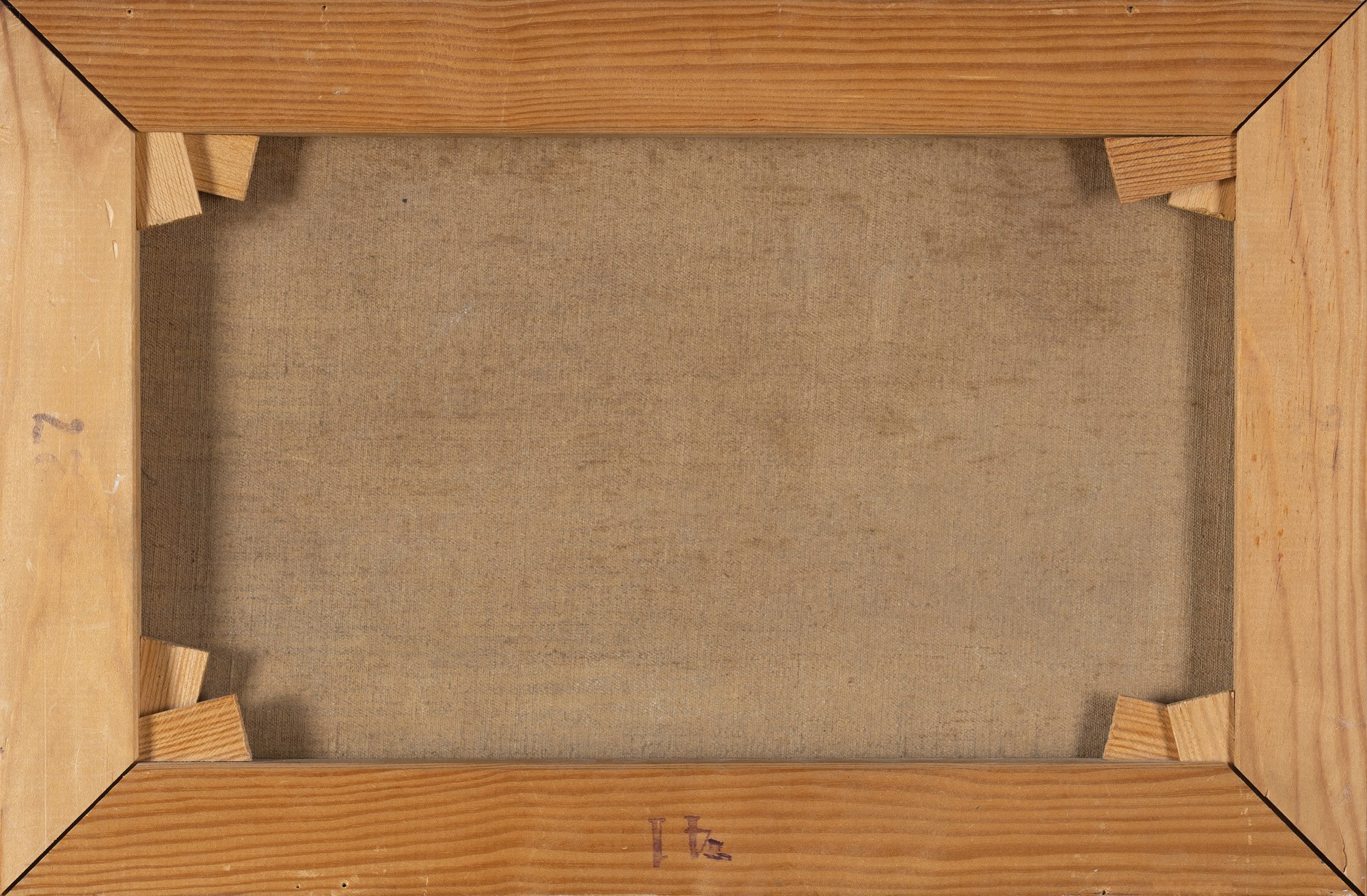
On the upper bar of the painting loom centrally a paper sticker of the framing company: [...]JOUR[...] | [...] OREUR DES MUSÉES IMPÉRIAU[X] | [D]E [LA] [V]ILLE DE PARIS | [FABRIQUE] ET MAGASIN DE CADRES DE TOUS [STYLES] | RENTOILAGE ET RESTAURATION DE TABLEAUX ET GRA[VURES] | [....] | MENTION HONORABLE[...] HORTICOLLE [...] 9 | [MEDA]ILLE [...] 1849 [...] 1re CLASSE;next to a sticker from Agra-Art dated October 2008.
Józef Marszewski (Warsaw or Vilnius 1825 (1826? 1827?) - Warsaw 1883) began his studies in painting and drawing at the private school of Aleksander Kokular in Warsaw or with Wincenty Dmochowski in Vilnius or with both in turn. In 1853-1856, he studied at the Academy of Fine Arts in St. Petersburg under Matvei N. Vorobyov, receiving medals for his schoolwork - in 1853 a large and small silver medal for Sea View and View of the Neva River during the Krys, and again in 1855 a large silver medal for View of the City of Revla. Even after his studies, graduating with the title of artist of the 14th class, he maintained contacts with the St. Petersburg Academy and in 1870 received the honorary title of "kłassnyj chudozhnik" of the first degree for his painting View of Mentona. In 1857 he went abroad and spent the next few years traveling around Europe, sending his paintings to exhibitions in Krakow, Lviv and Warsaw. At that time he visited Paris several times, was in Spain and Switzerland, lived in Rome for several years, and in 1858 and 1864 stayed in Düsseldorf, where he studied with Andreas Achenbach. He also traveled to Ukraine, Lithuania and Courland, and made trips to the Tatra Mountains (1865 and 1866). Around 1872 he settled in Warsaw, where he spent the last years of his life. In 1873, after losing the money he had deposited in the bank, he fell into a deep depression, which in time turned into a mental illness. Marszewski was primarily a landscape painter. During his travels and wanderings, he painted both views from Spain, Italy, Switzerland, Germany, Courland, as well as from Ukraine and Lithuania (especially around Vilnius) and the Tatra Mountains. He treated the landscape in an emotional way, typical of Romantic painters, trying to convey the moods of nature. He painted mysterious nocturnal landscapes with a pale gloomy moon and lit up by the setting sun, views with characteristic picturesque motifs of water, rocks, ruins, churches or windmills. It is known that he also painted portraits and religious scenes. In his early period, he also painted the battle composition Crossing the Berezina River (1847).
He remained in the memory of his contemporaries as "an accomplished and energetic landscape painter [...] an excellent artist and an unlamented colleague [...] full of life, with sparkling black eyes, of small stature, a swarthy brunet with wide eyebrows, he was brimming with enthusiasm for art, and he kept his love of working for it to the last." (W. Gerson, Józef Marszewski (1827-1872), "Echo Muzyczne, Teatralne i Artystyczne" 1891, no. 10 (388), p. 133).













Paskutiniai peržiūrėti
Prisijunkite, jei norite pamatyti pozicijų sąrašą
Mėgstami
Prisijunkite, jei norite pamatyti pozicijų sąrašą