


oil, plywood, 71 × 49 cm
signed l. d.: B. Biegas
on the back two paper stickers: 1) 422/Leda/1919 (handwritten); 2) 1927 APM109/Léda/422 0.70 xo, 48; 3) tag with handwritten number 27
Provenance:
Private collection, Poland
Exhibited:
- "Bolesław Biegas - painting and sculpture," Mazovian Museum in Plock, 15
May 2011 - December 31, 2019.
Reproduced:
- "Bolesław Biegas 1877-1954," Mazovian Museum in Plock 1997, p. 123 (il.).
- Xavier Deryng "Bolesław Biegas," Polish Historical and Literary Society in Paris, Polish Library in Paris, 2011, p. 272
"In the majestic beauty of the night sky, a vast wall of dark blue enamel dotted with muted stars or the evening sky whose blue deepens in waves, devoid of matter in this waning brightness, under a sky colored by the fire of the setting sun and as if ornamented by the extraordinary departure of great birds of purple, emeralds, sapphires - a rock, an island of meditation planted with tall cypresses and castles of dreamy dreams. An enchanted castle, a castle of moonlight, a castle of Atlantis flowering the sea with its sudden bloom, a castle of kings and queens, Biegas' imagination builds them from human shapes, frozen in solemn ecstasy, melancholy kings, hopelessly in love virgins.
Gustave Kahn, "Boleslas Biegas. Les Nuits Mystiques," [in:] Exposition des Ouvres de Charles Hetherington le Célèbre Peintre Américain et de Boleslas Biegas Peintre Polonais, Paris, Galerie André
Seligmann 1925, pp. 12-14
At the beginning of the 1920s, Boleslaw Biegas painted a whole series of paintings with an oneiric and symbolic meaning entitled "Mystique of Infinity." This was a kind of homage to Arnold Böcklin and his famous Island of the Dead, which became a huge inspiration for Biegas. Compositions from this series are scenes maintained in a mystical, almost theatrical atmosphere of nocturnes, shrouded in dark black and dark blue, with a peculiar depiction of figures in a bright glow contrasting to the background.
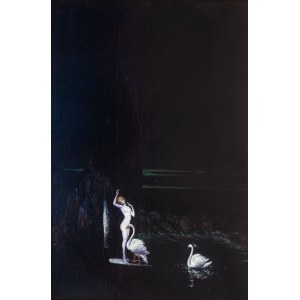
The painting "Leda" presented in the catalog is an excellent example of a scene from this series. Here Biegas used the motif of the mythological figure of Leda, queen of Sprata, mistress of Zeus, who seduced her in the form of a swan. He depicted the composition in a gloomy setting characteristic of the series.
Beneath a towering soaring cypress tree in the shadows, one can see the figure of a young blonde woman glowing silvery. Her slender, almost columnar figure is shown slightly bent in a sensually erotic pose with her arms stretched upward as if in ecstasy. By her side stands a white swan, with its head resting on her bosom. A second swan swims up to the couple, its silhouette reflected in the slightly murmured water.










Paskutiniai peržiūrėti
Prisijunkite, jei norite pamatyti pozicijų sąrašą
Mėgstami
Prisijunkite, jei norite pamatyti pozicijų sąrašą