


Pencil and crayon on paper
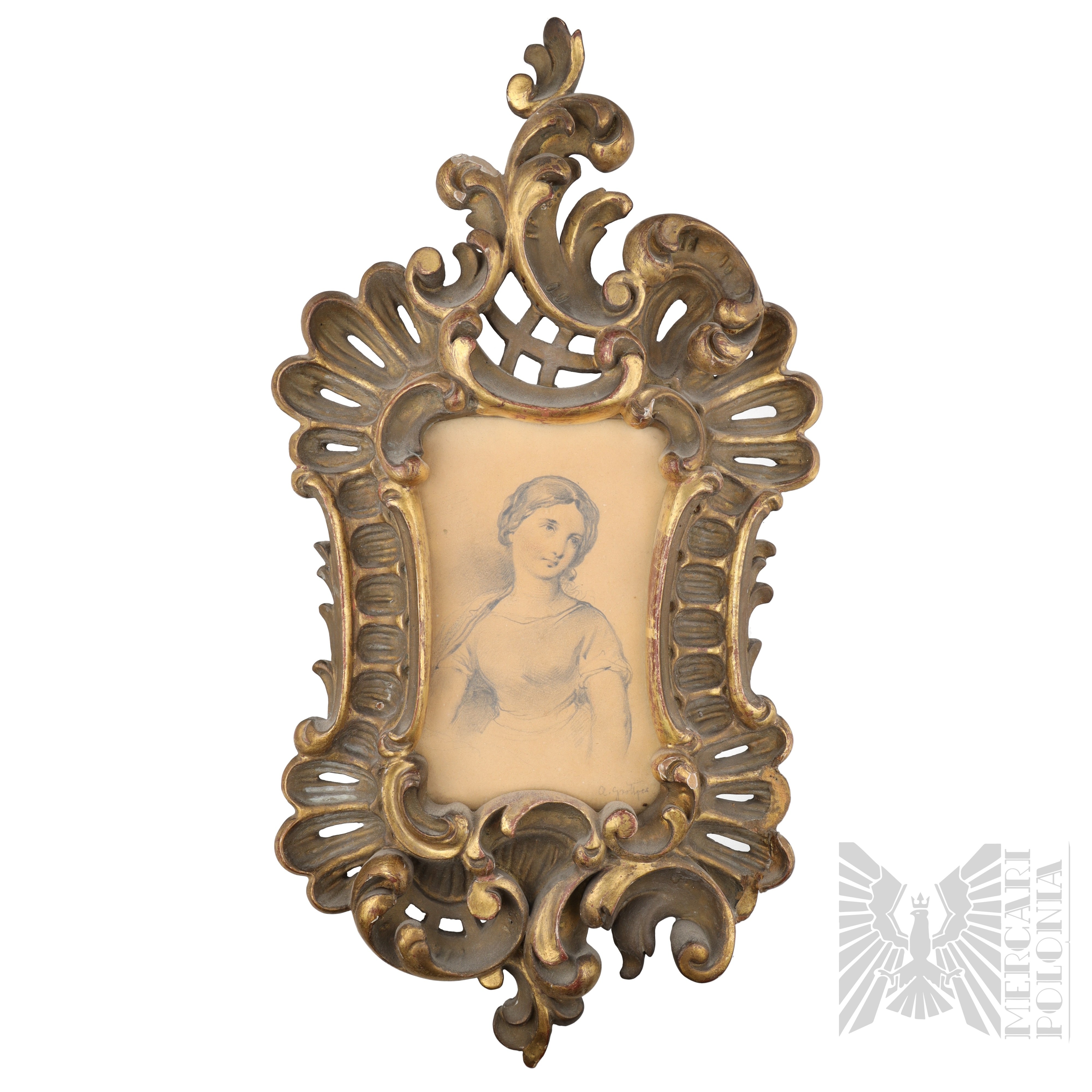
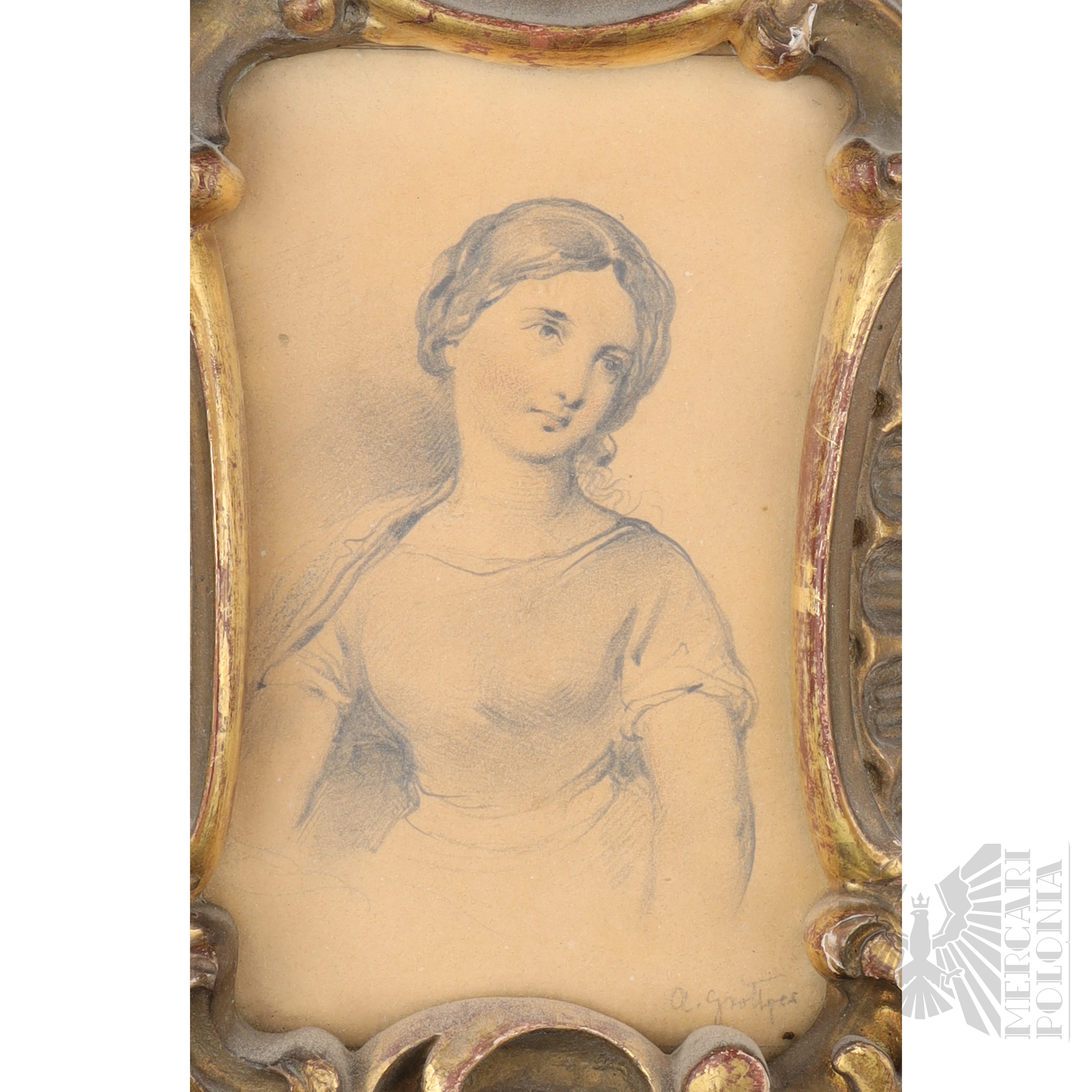
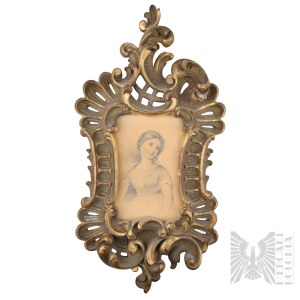
A drawing depicting a young woman shown from the waist up, almost head-on, with her head slightly tilted and turned three-quarters of the way. The model has regular, subtly idealized facial features and hair parted in the middle and arranged in a wide braid encircling her head. She is wearing a simple short-sleeved dress, accentuated by a belt at the waist. The facial features and hair are rendered in greater detail, while the dress and the lower part of the composition are left as a loose sketch. On the left side of the figure, delicate hatching creates shadow and sets the figure apart from the undefined background.
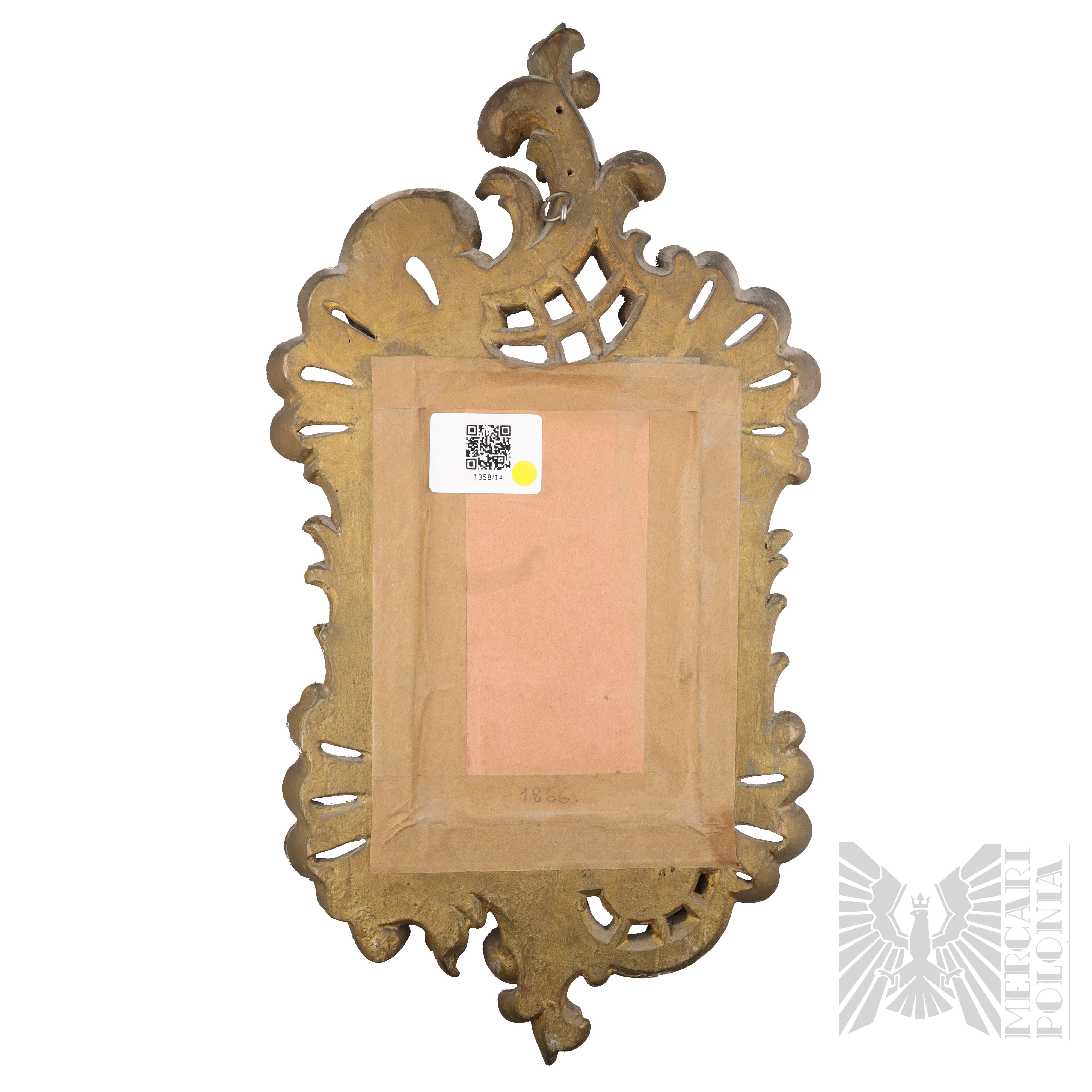
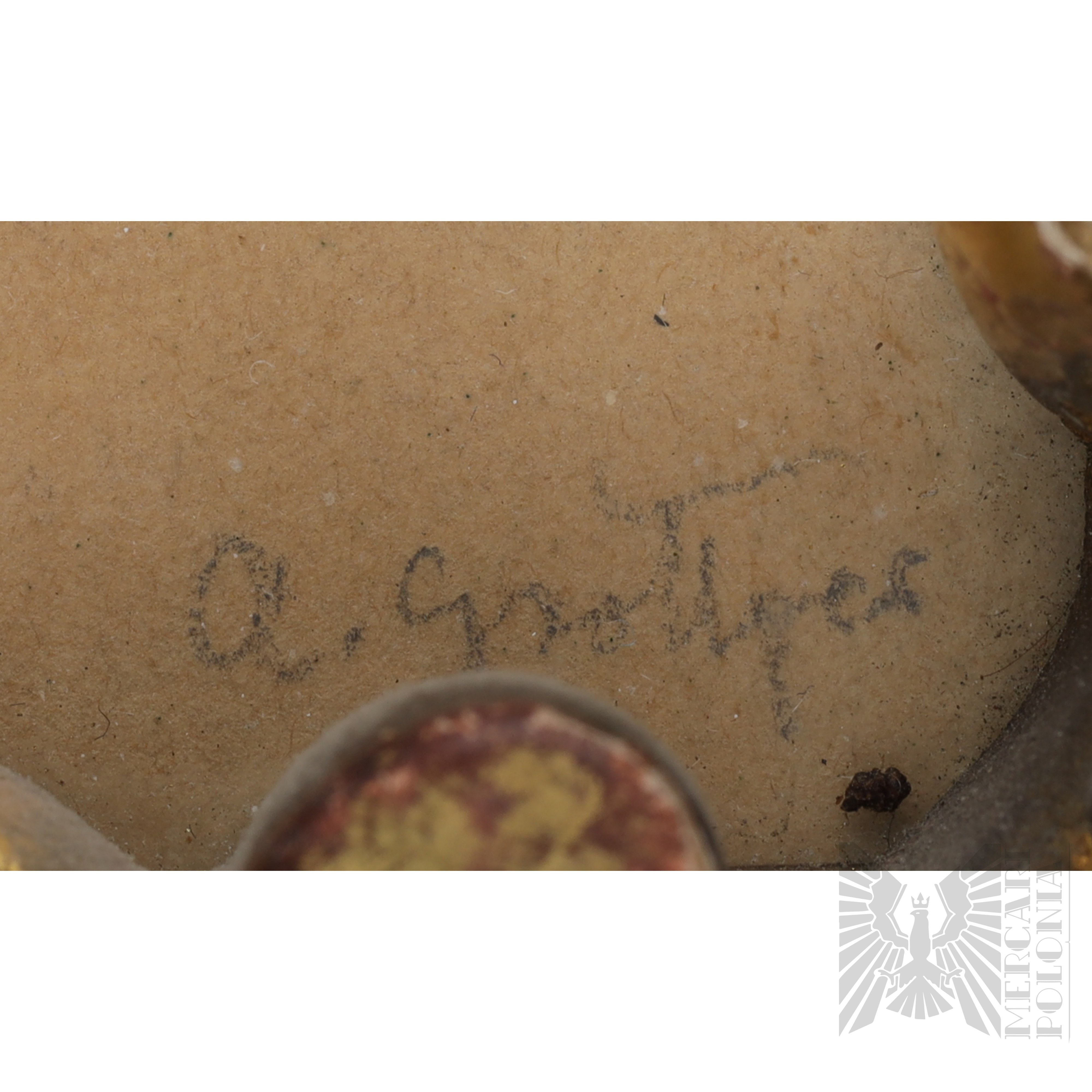
Pencil and colored pencil on paper. A handwritten signature is visible in the lower right corner: “A. Grottger.” The inscription “1866” appears on the back of the frame. The date “1866” on the reverse of the frame may be the date the work was created; the date itself may indicate that the person depicted is Wanda Monne herself, Artur Grottger’s fiancée. However, this has not been confirmed.
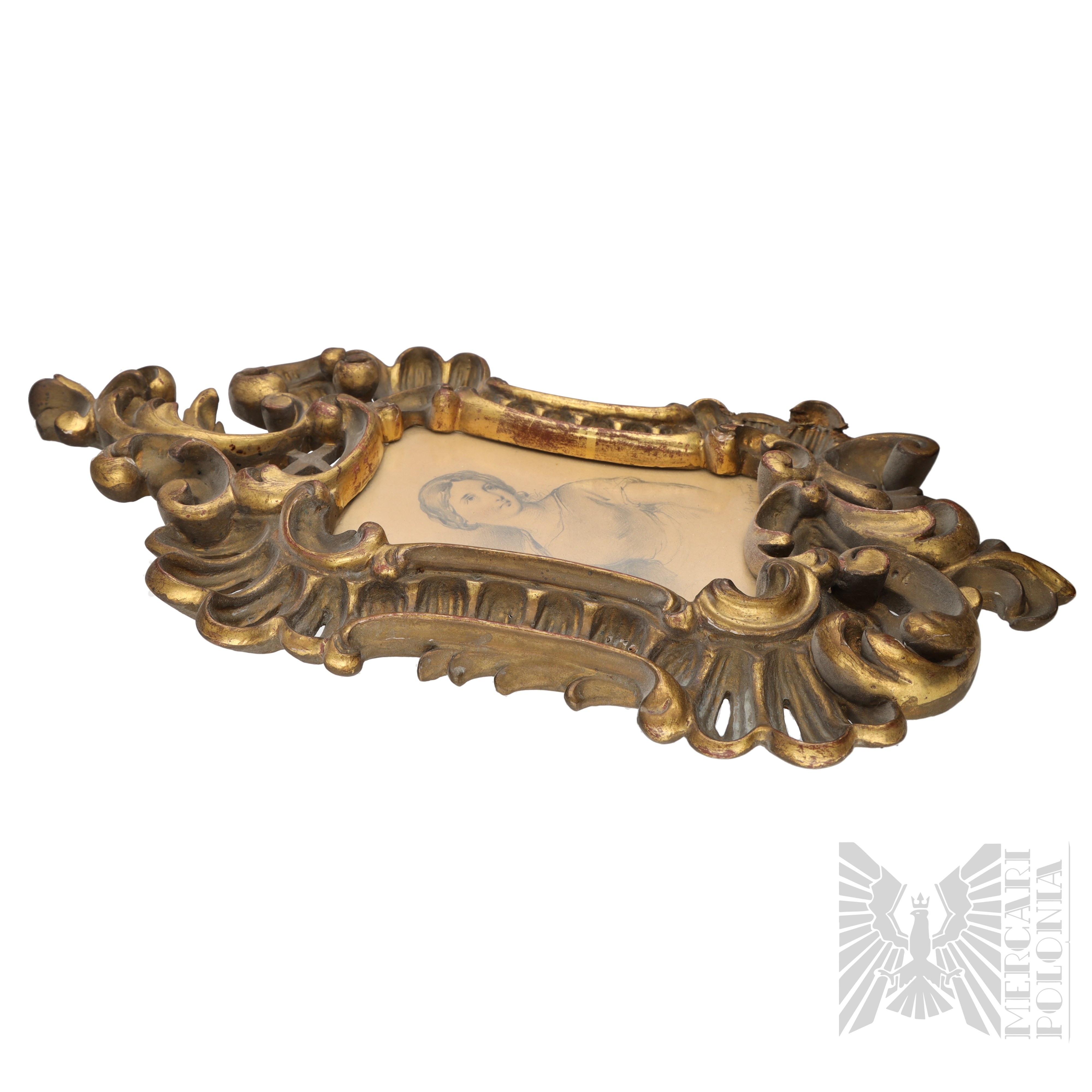
The work is mounted in an elaborate, openwork wooden frame, carved by a woodcarver, covered with gilding and, in places, darker and reddish polychrome. The frame is designed in the Neo-Rococo style: with an asymmetrical finial and motifs of rocaille, volutes, shells, and curling leaves. The irregular, undulating cutout of the frame has been adapted to the small, vertical format of the artwork. The frame may date from around 1886, according to the inscription preserved on the reverse.
Artur Grottger was one of the most outstanding representatives of Polish Romanticism—a painter, illustrator, and, above all, a master of drawing. He received his early artistic training in Lviv under Jan Maszkowski, and later studied at the Kraków School of Fine Arts under Wojciech Korneli Stattler and Władysław Łuszczkiewicz. From 1854 to 1859, he studied at the Academy of Fine Arts in Vienna, where he was exposed to academic drawing techniques and European historical painting.
A special place in his body of work is occupied by series of cartoons devoted to Polish historical and national experiences: “Warsaw I,” “Warsaw II,” “Polonia,” “Lithuania,” and “War.” Grottger employed an expressive, chiaroscuro-modeled line, combining academic precision with a Romantic mood and psychological characterization of his figures. In addition to patriotic compositions, he also created portraits, genre scenes, figure studies, and depictions of women, often rendered in an intimate drawing style.
In 1866, the artist met Wanda Monné, who became his fiancée and one of the most important people in the final period of his life. Progressive tuberculosis forced him to travel to France for treatment. He died on December 13, 1867, at the Amélie-les-Bains spa in the Pyrenees. His remains were brought back to Lviv and buried at the Lychakiv Cemetery.
Dimensions of the drawing: 8 × 13.5 cm.
Frame dimensions: 18 × 34 cm.
Condition: as shown in the photos.








Paskutiniai peržiūrėti
Prisijunkite, jei norite pamatyti pozicijų sąrašą
Mėgstami
Prisijunkite, jei norite pamatyti pozicijų sąrašą