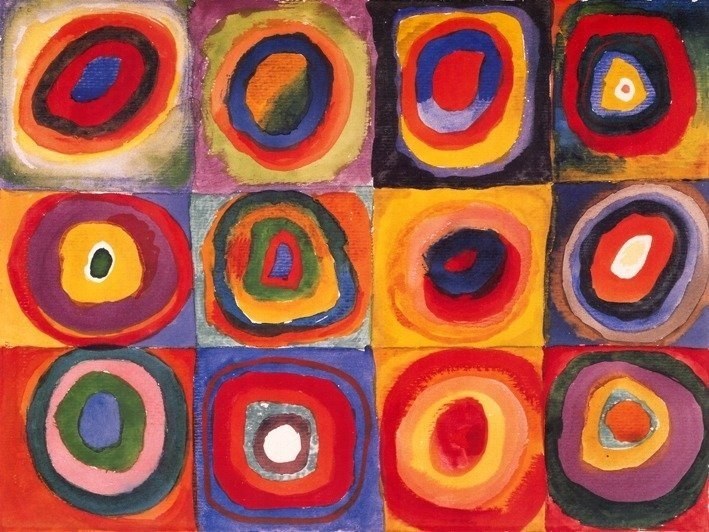
Offset lithograph, 250 weight satin paper, 80 x 60 cm, on the backroundstamp"OXIMORON Talleres Graficos Ibero - A,ericanos" and typographically "CERTIFIES THE INTERNATIONAL ART.COLLECTIVE".
Vassily Kandinsky's painting titled "Study of Color" (German: Farbige Studien), which shows multicolored circles, is one of his most recognizable works. It isalsooften referred to as "Circlesin a Circle" or "ColorStudy: squares with concentriccircles" ( Farbstudie - Quadrate mit konzentrischen Ringen).
For Wassily Kandinsky, music and color were inextricably linked. This relationship was soclearthat Kandinskyassociatedeachnote with a particular hue.Heoncesaid:"the sound of colors is sodistinctthatit would bedifficult tofindsomeone who wouldexpressbrightyellowwith bass tones or a dark lake with treble tones."
Infact, after an unusually visual reaction to a performance of Wagner's compositionLohengrin at the Bolshoi Theater, he left his legal career tostudy painting atthe prestigiousAcademy ofFineArtsin Munich.Helaterdescribed thislife-changingexperience: "I saw all my colors in the spirit before my eyes. Wild, almost crazy lineswere sketched in front ofme."
Music playedan importantrole in the development ofKandinsky' s abstractpaintings. ThefamousViennesecomposer ArnoldSchönbergwas one of hisinfluences.Schönbergabandoned tonal and harmonic conventions in his compositions in the sameway that Kandinskyrejectedthe figure or recognizable objectin favor ofshapes, lines and disharmoniouscolors in his work. Heused color,line,shape andtexture tocreate a rhythmicvisual experiencethatevoked anemotionalresponse,
This painting is in the collection of the Lenbachhaus Museum in Munich (Städtische Galerie im Lenbachhaus), which has one of the largest collections of works by Kandinsky and other artists associated with the Der Blaue Reiter group.
Lenbachhaus in Munich is a very significant institution for modernist art, especially Expressionism andthework ofKandinsky,whowasassociated with the cityfor many years.
The neurological phenomenon Kandinskyexperiencedis calledsynesthesia (or "combined perception," from the Greekwordsyn meaning "tocombine" andaisthesis meaning "perception"). It is a very rare but real condition in which one sense, such as hearing,simultaneously activates anothersense, such as sight. Kandinskyliterallysaw colors whenheheardmusic andheardmusic when hepainted. To honor Kandinsky, the Centre Pompidou incollaboration with Google Arts & Culturedecidedto"read"thesoundshidden onthe canvas. Musicians Antoine Bertin and NSDOS, with the help of artificial intelligence, used Kandinsky's theoretical texts totranslatethe composition's components intomelody. On the project's website, we candiscoverwhat the different parts of the paintingwould sound likeand what emotions theycarriedforusaccording to Kandinsky.