


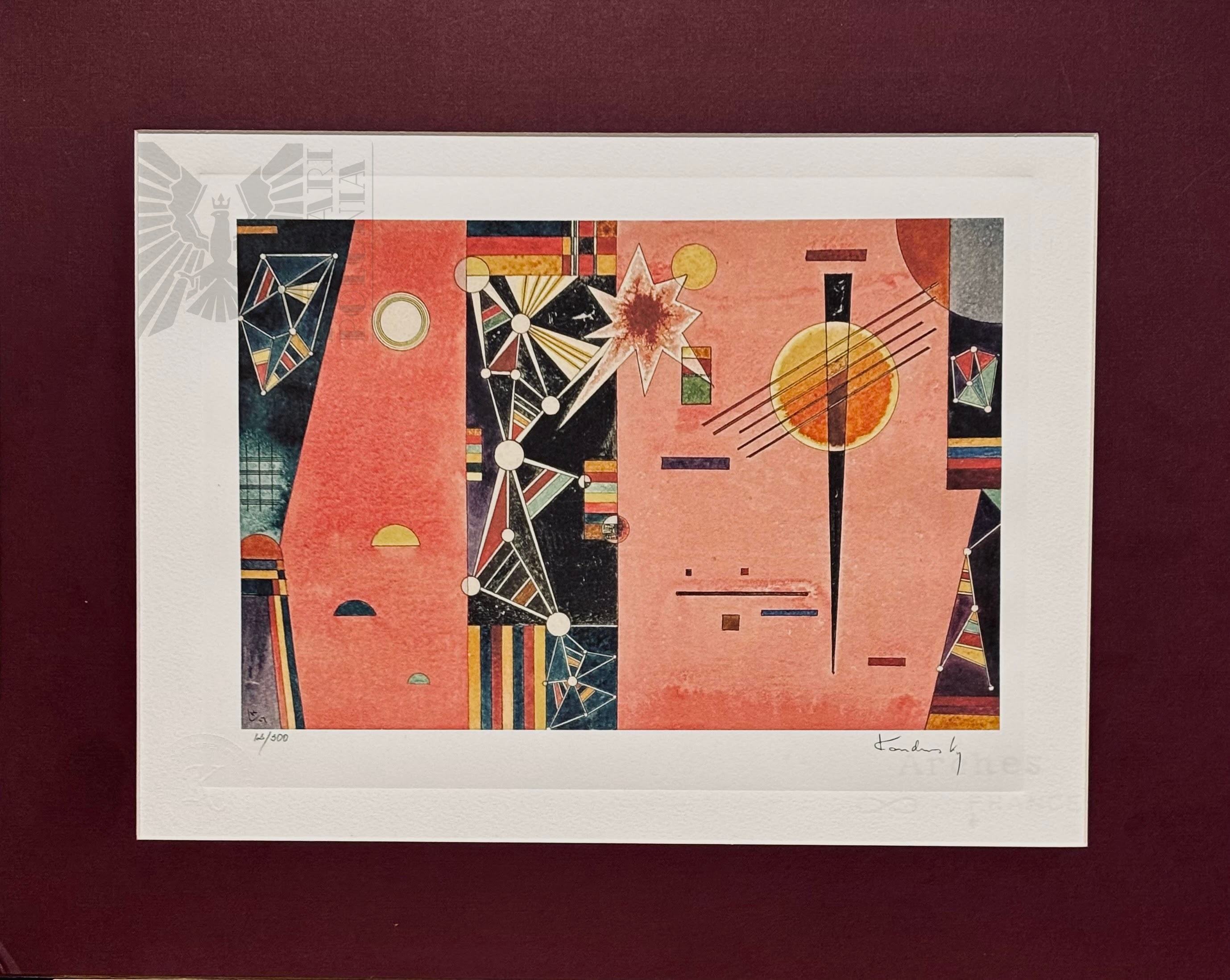
color heliogravure, heavyweight velin paper, 31 x 23 cm (plate imprint), framed in passe - partout 47 x 37 cm, numbered in pencil 12/300 signed from plate under composition "Manet", dry publisher's stamp l. d.: letter K surrounded by the words "EDITION LIMITED CERTIFIED ARTS USA EUROPE SINCE 1998". Original publisher's certificate attached.
After the extraordinarily visual reaction he experienced during a performance of Wagner's composition Lohengrin at the Bolshoi Theater, Wassily Kandinsky abandoned his legal career to study painting at the prestigious Academy of Fine Arts in Munich. He later described this life-changing experience: "I saw all my colors in the spirit before my eyes. Wild, almost crazy lines were sketched in front of me." Kandinsky believed that colors have a direct effect on the human soul, and that their combinations can evoke certain emotions. For Wassily Kandinsky, music and color were inextricably linked. This relationship was so clear that Kandinsky associated each note with a particular hue. He once said: "the sound of colors is so distinct that it would be difficult to find someone who would express bright yellow with bass tones or a dark lake with treble tones."
The painting " Rose" (" Rose") from 1927, fully reflects Wassily Kandinsky's mature, abstract style. This work, in pink and red tones, exemplifies his experiments with color and form, typical of the period associated with the Bauhaus, where Kandinsky worked on color theory and the psychological effects of abstraction on the viewer.
The painting is full of delicate, almost geometric shapes, such as lines, circles and curves, which seem to be arranged in a rhythmic, almost musical composition. In Kandinsky's work, colors and forms were meant to function like sounds in music - instead of representing a concrete reality, they were meant to evoke emotions and resonate with the viewer's inner experiences. The rose, although not depicted in a realistic way, is present as a symbol - in the very colors and shapes that seem to "bloom" on the canvas.
Kandinsky believed that colors have a direct effect on the human soul, and their combinations can evoke certain emotions. In "Rose" we see how the artist strives to create harmony between different shades of pink which gives the painting elegance and intensity at the same time.











Paskutiniai peržiūrėti
Prisijunkite, jei norite pamatyti pozicijų sąrašą
Mėgstami
Prisijunkite, jei norite pamatyti pozicijų sąrašą