


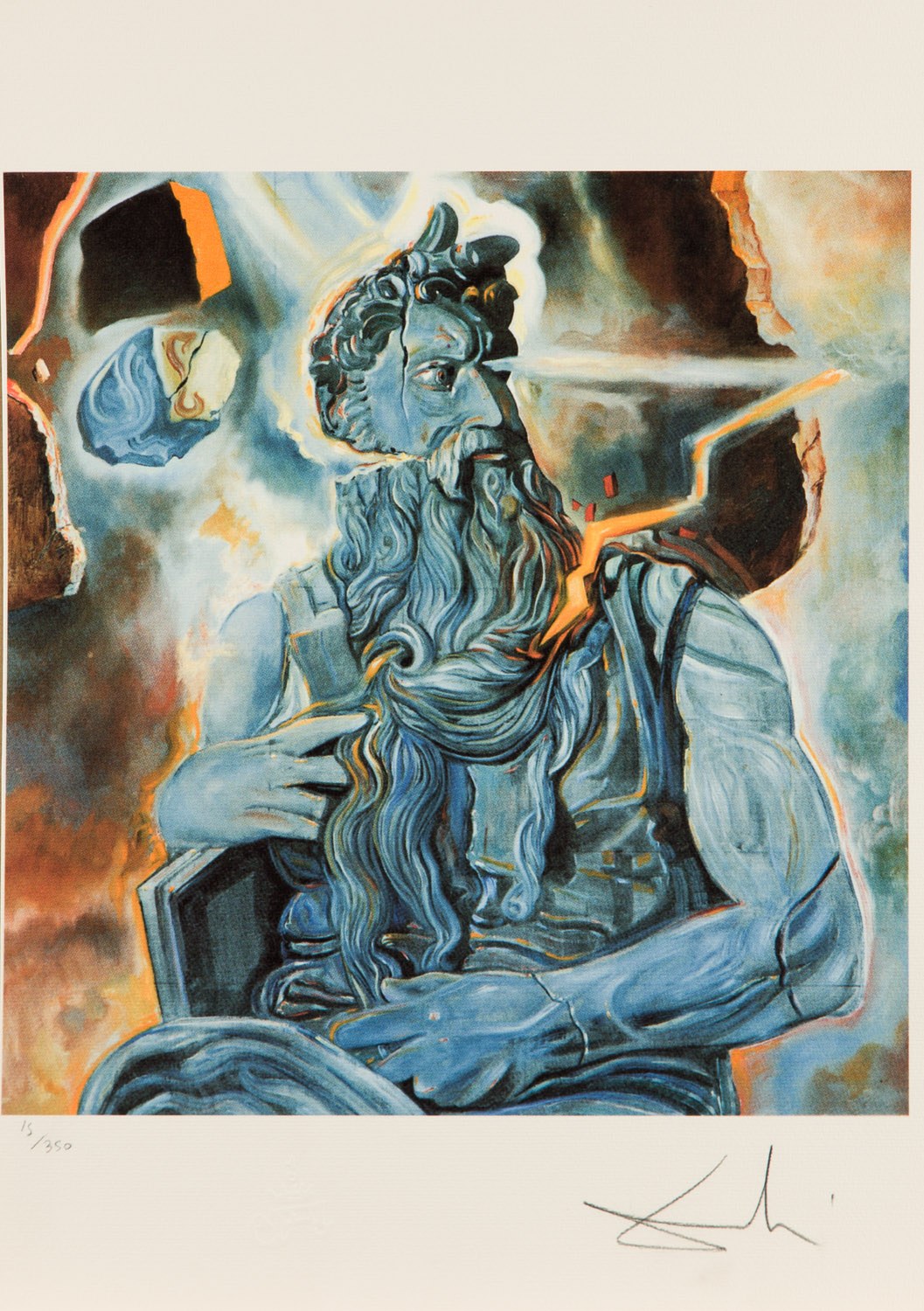
lithographed, limited edition of 350 pieces, Arches velin paper, dimensions: 36 x 34 cm (composition), 51 x 35 cm (sheet), individually numbered in pencil l.d.: 15/350 and signed under the composition, facsimile of DALI's signature p.d., publisher's dry stamp Certified DALI, with crown l.d.
Salvador Domingo Felipe Jacinto Dalí -Spanish painter, one of the most famous surrealists. He is one of the more recognizable artists of the 20th century. Perceived sometimes as an extreme eccentric, he invented his own surrealist method called "paranoid-critical".
Salvador Dalí, known for his surrealist works full of symbolism and ambiguity, created a painting entitled "Michelangelo's Moses on the Tomb of Julius II in Rome," also known as "Moses." This painting is a tribute to one of the greatest artists of the Renaissance, Michelangelo, and his sculpture of Moses, which adorns the tomb of Pope Julius II in Rome.
This painting was inspired by Michelangelo's sculpture of Moses, of which Dalí was a great admirer. Michelangelo created this sculpture as part of a larger tomb project for Pope Julius II. Moses is depicted with horns on his head, the result of a mistranslation of the Bible where "rays of light" was translated as "horns." For Dalí, the sculpture symbolized not only great art, but also deep spiritual and religious symbolism.Dalí focuses on several symbolic elements in his painting: Moses' horns- horns are a symbol of divine enlightenment and power, Dalí often explored religious and mythological motifs, which can be seen in his many works; composition and deformation- Dalí was a master at distorting reality to emphasize the psychological and emotional depth of the figures. In the case of Moses, he could manipulate the form of the sculpture to give it an additional symbolic dimension
Salvador Dalí was one of the most eccentric and recognizable artists of the 20th century. As a leading exponent of Surrealism, Dalí sought to explore the subconscious and depict dreams and hallucinations in his paintings. Dalí was also an accomplished technician who could accurately reproduce the smallest details, often using the techniques of the Renaissance masters, making his surreal visions even more realistic and convincing. Dalí was famous for his eccentric lifestyle, which he transferred to his works. His paintings often combined realistic elements with fantastic and absurd motifs, creating a unique and inimitable effect. Dalí also had a remarkable ability to combine traditional painting techniques with innovative ideas, which allowed him to experiment with form and content.
Salvador Dalí's painting "Michelangelo's Moses on the Tomb of Julius II in Rome" is a testament to his deep fascination with the Renaissance masters and his unique ability to transform classical motifs into surreal masterpieces. His work, full of symbolism, complex techniques and eccentric charm, continues to inspire and intrigue viewers around the world.










Paskutiniai peržiūrėti
Prisijunkite, jei norite pamatyti pozicijų sąrašą
Mėgstami
Prisijunkite, jei norite pamatyti pozicijų sąrašą