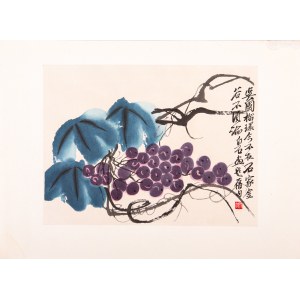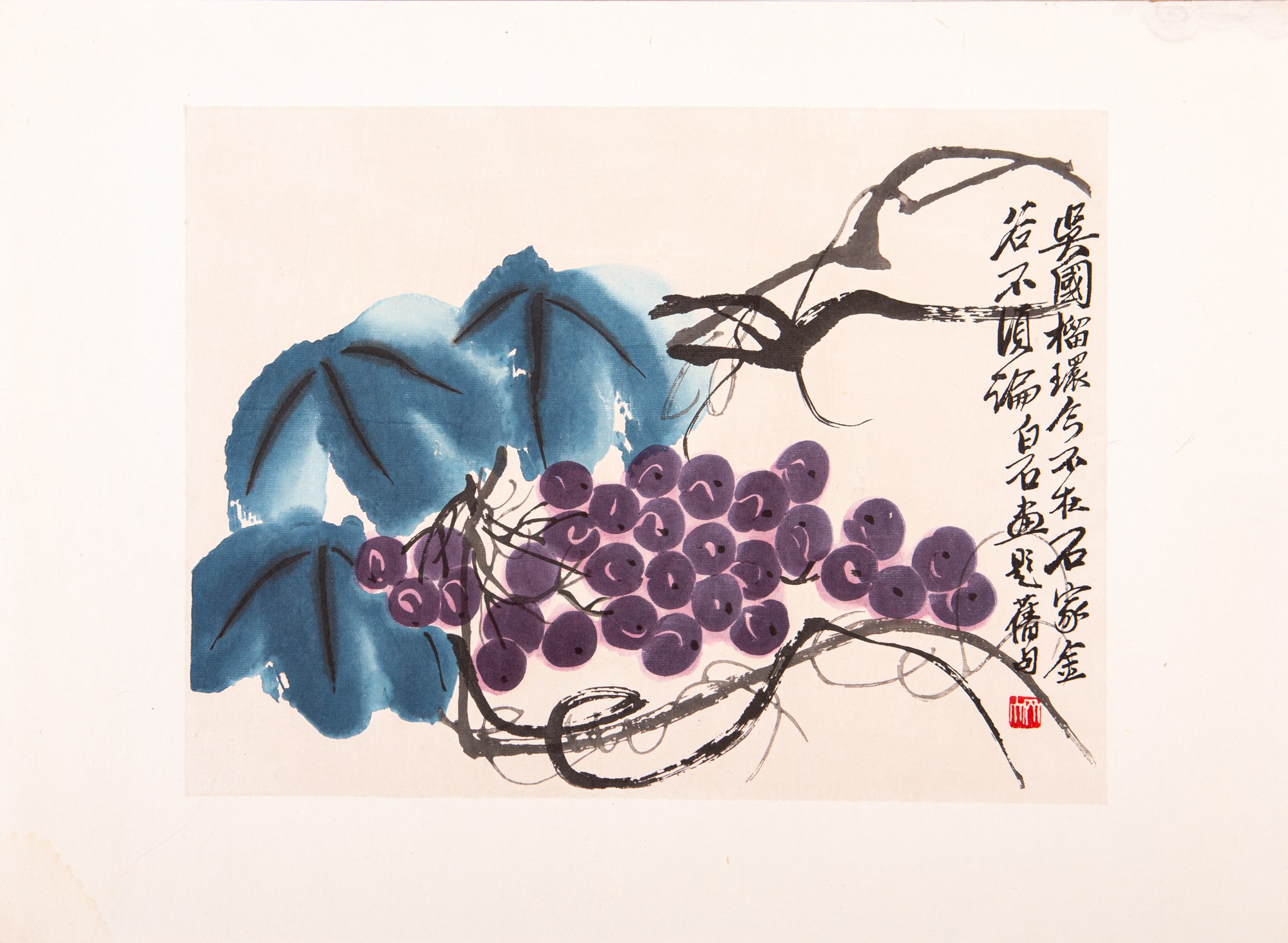
Color woodcut on Chinese xuan paper; 31.5 x 43 cm
Signed, described, p. d. :「吳國楊璋今不在,石齋金谷不園編。白石自名並題。」
(Yang Zhang of Mr. and Mrs. Wu today is no longer alive, the stone pavilion and golden garden do not
exist. Baishi, Ziming, added.) and a red Baishi seal (白石 - White
Stone).
From the portfolio Album of Paintings of the Old Baishi Man, published by Rong Bao Zhai, Beijing 1953.
Provenance: private collection, Poland.
Grapes are among the most characteristic motifs in Qi
Baishi. They symbolize fertility, prosperity and abundance of life. In the inscription, the artist refers
to old masters and lost places, while emphasizing the transience of
human creations. This composition, one of the most highly regarded in his oeuvre, combines the
the richness of nature with a reflection on transience.
Chinese painter, calligrapher and seal engraver, considered one of the most outstanding
20th century artists in China. Born in Xiangtan (Hunan province) to a poor
family, initially worked as a carpenter and wood carver. Self-taught, he was inspired
classical painting textbooks, the tradition of poetry and nature. Around 1917
he settled in Beijing, where his work quickly gained wide recognition.
Qi Baishi is best known for his depictions of insects, fish, birds, flowers
and fruits, which he painted with remarkable simplicity and energy, giving everyday
motifs the status of art. He combined the free gesture of calligraphy with expressive color, often
annotating his paintings with his own poems. He used numerous nicknames, including Baishi
("White Stone"), Ziming ("the one who gave himself a name"), and Laoren ("Old
Man").
His oeuvre, awarded the International Peace Prize in 1955, is considered
today as a symbol of 20th century Chinese art. Qi Baishi's works are in the
collections of the world's most important museums, including the National Art Museum of China in
Beijing, the Beijing Fine Art Academy, the British Museum in London, the Metropolitan
Museum of Art in New York, and the Tokyo National Museum.
Chinese painter, calligrapher, and seal carver, regarded as one of the most important
artists of the 20th century in China. Born in Xiangtan (Hunan province) to a poor
family, he began his career as a carpenter and woodcarver. Largely self-taught, he
was inspired by classical painting manuals, poetry, and direct observation of nature.
Around 1917 he settled in Beijing, where his art soon gained wide recognition.
Qi Baishi became especially renowned for his depictions of insects, fish, birds,
flowers, and fruits, painted with striking simplicity and vitality. He combined the
expressive energy of calligraphy with bold color, often accompanying his works with
his own poems. He used numerous sobriquets, including Baishi ("White Stone"),
Ziming ("the one who named himself"), and Laoren ("the Old Man").
In 1955 he was awarded the International Peace Prize, and today his oeuvre is
considered a symbol of 20th-century Chinese art.Works by Qi Baishi are held in
major museum collections worldwide, including the National Art Museum of China in
Beijing, the Beijing Fine Art Academy, the British Museum in London, the
Metropolitan Museum of Art in New York, and the Tokyo National Museum.