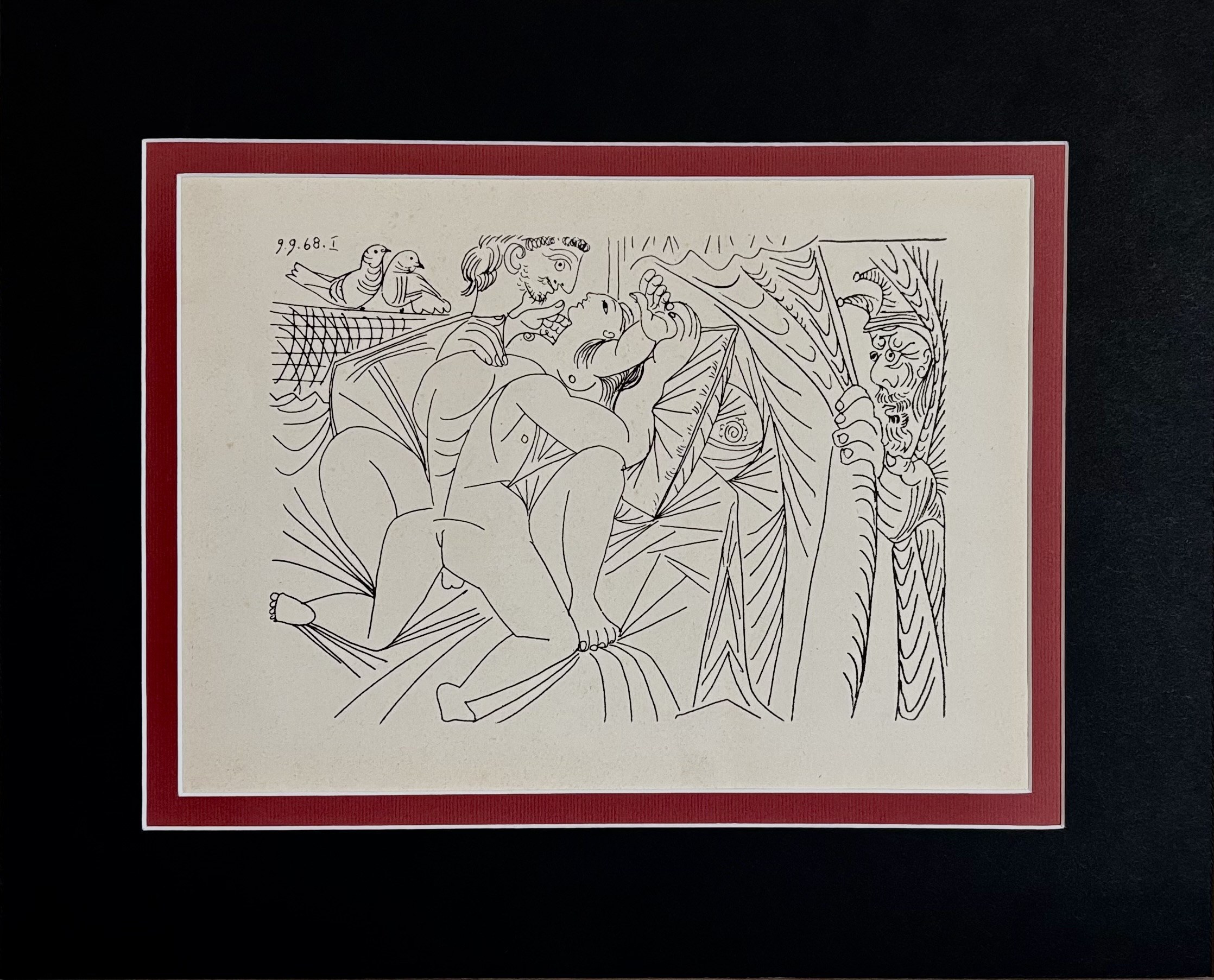
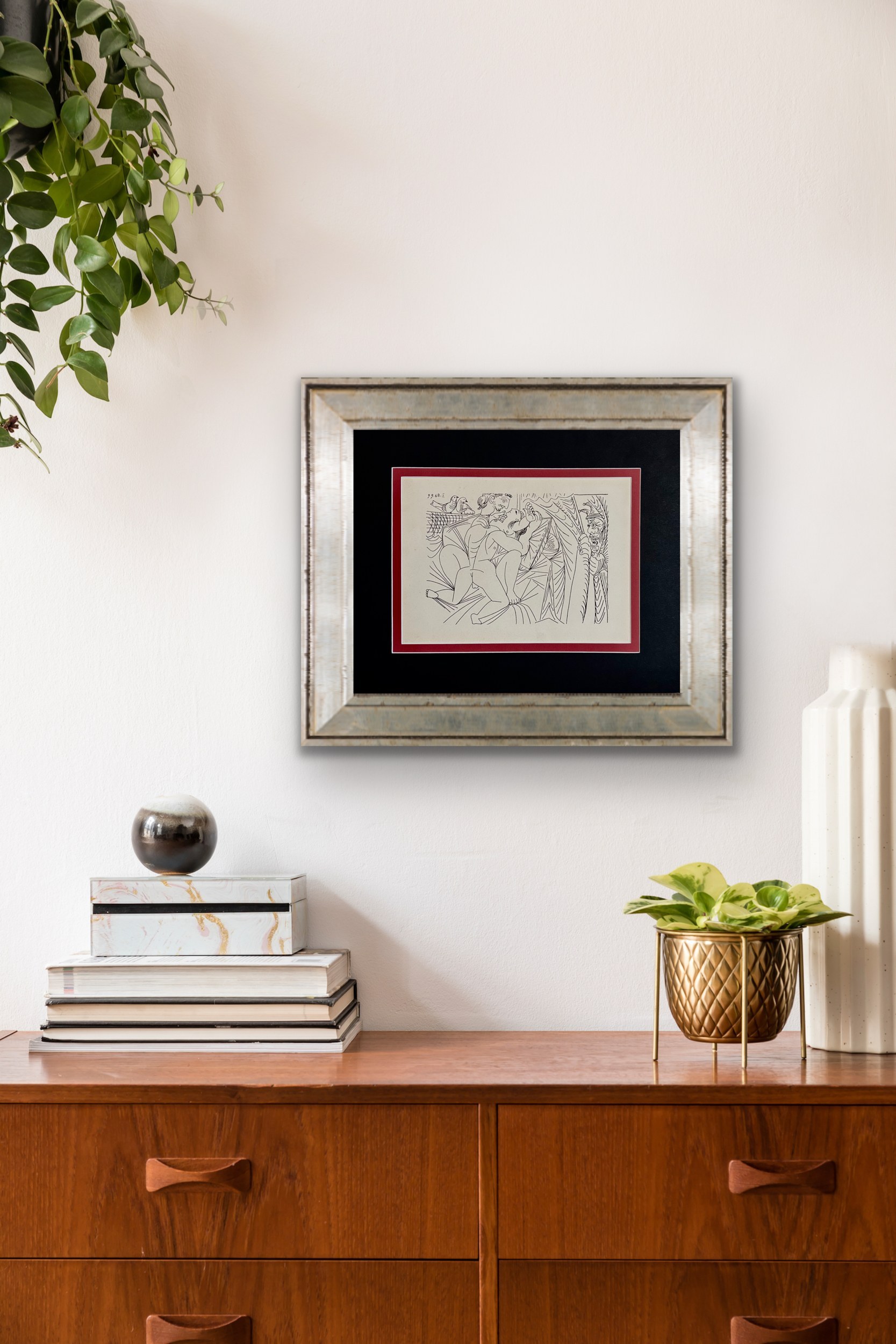
Lithograph from the series "347 engravings", Arches veline paper, dimensions : 19 x 26 cm in light double passe-partout, 30 x 38 cm framed passe-partout, limited edition, unnumbered, date of creation of the engraving "26.7.68. I, l.g.
Publisher Playmen-Tattilo 1973 with portfolio "Con gli auguri di Playmen" ( With best wishes from Playmen).
Adelina Tattilo , owner of Playmen Publishing House, was a very well-known and influential figure, especially in Italy, where her magazine "Playmen" played a key role in the moral revolution of the 1960s and 1970s. She was referred to as "Italy's Hugh Hefner." Tattilo was well-known in publishing and media circles, mainly in Europe. Her magazine was often compared to the American "Playboy," and she even waged court battles with it over distribution rights in some markets. "Playmen" was distributed in some European countries, but did not achieve the same global scale and recognition as "Playboy."
Pablo Picasso's series of works titled "347 Engravings," a collection of engravings created by the artist in a very short period of time, between March 16 and October 5, 1968, when the artist was 87 years old, is one of the most remarkable and prolific undertakings in his late career. The series consists of 347 engravings and etchings that Picasso created in just seven months, an astonishing achievement considering his age.
The series is full of bold, often provocative erotic scenes that explore human sexuality and the act of voyeurism. Picasso often depicted himself as an observer, sometimes a clown or an old man who admires young, beautiful models. This is a reflection of his own relationships with younger women despite his age.
Picasso's series 347, because of its subject matter and form, received a mixed and often controversial reception, both among critics and the public. At the time, even though Picasso was already an established artist, this openness and directness, especially for someone of his age, shocked and outraged many viewers. Some critics interpreted the works as a sign of an old man's obsession with sex and youth, and even accused Picasso of misogyny.
In some circles, the series was seen as an example of degenerate art, unresponsive to "serious" social or artistic themes.
The 347 series is considered one of the key works of Picasso's late period, demonstrating his enduring vitality, creativity and mastery of printmaking.
Lithograph from the series "347 engravings", Arches velin paper, dimensions : 19 x 26 cm in light double passe-partout, 30 x 38 cm in framed passe-partout, limited edition, unnumbered, date of creation of the engraving "26.4.68. III l.g.
Publisher Playmen-Tattilo 1973 with portfolio "Con gli auguri di Playmen" ( With best wishes from Playmen).
Adelina Tattilo , owner of Playmen publishing house, was a very well-known and influential figure, especially in Italy, where her magazine "Playmen" played a key role in the moral revolution of the 1960s and 1970s. She was referred to as "Italy's Hugh Hefner." Tattilo was well-known in publishing and media circles, mainly in Europe. Her magazine was often compared to the American "Playboy," and she even waged court battles with it over distribution rights in some markets. "Playmen" was distributed in some European countries, but did not achieve the same global scale and recognition as "Playboy."
Pablo Picasso's series of works titled "347 Engravings," a collection of engravings created by the artist in a very short period of time, between March 16 and October 5, 1968, when the artist was 87 years old, is one of the most remarkable and prolific undertakings in his late career. The series consists of 347 engravings and etchings that Picasso created in just seven months, an astonishing achievement considering his age.
The series is full of bold, often provocative erotic scenes that explore human sexuality and the act of voyeurism. Picasso often depicted himself as an observer, sometimes a clown or an old man who admires young, beautiful models. This is a reflection of his own relationships with younger women despite his age.
Picasso's series 347, because of its subject matter and form, received a mixed and often controversial reception, both among critics and the public. At the time, even though Picasso was already an established artist, this openness and directness, especially for someone of his age, shocked and outraged many viewers. Some critics interpreted the works as a sign of an old man's obsession with sex and youth, and even accused Picasso of misogyny.
In some circles, the series was seen as an example of degenerate art, unresponsive to "serious" social or artistic themes.
The 347 series is considered one of the key works of Picasso's late period, demonstrating his enduring vitality, creativity and mastery of printmaking.