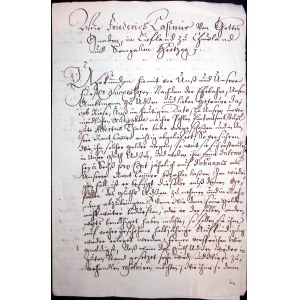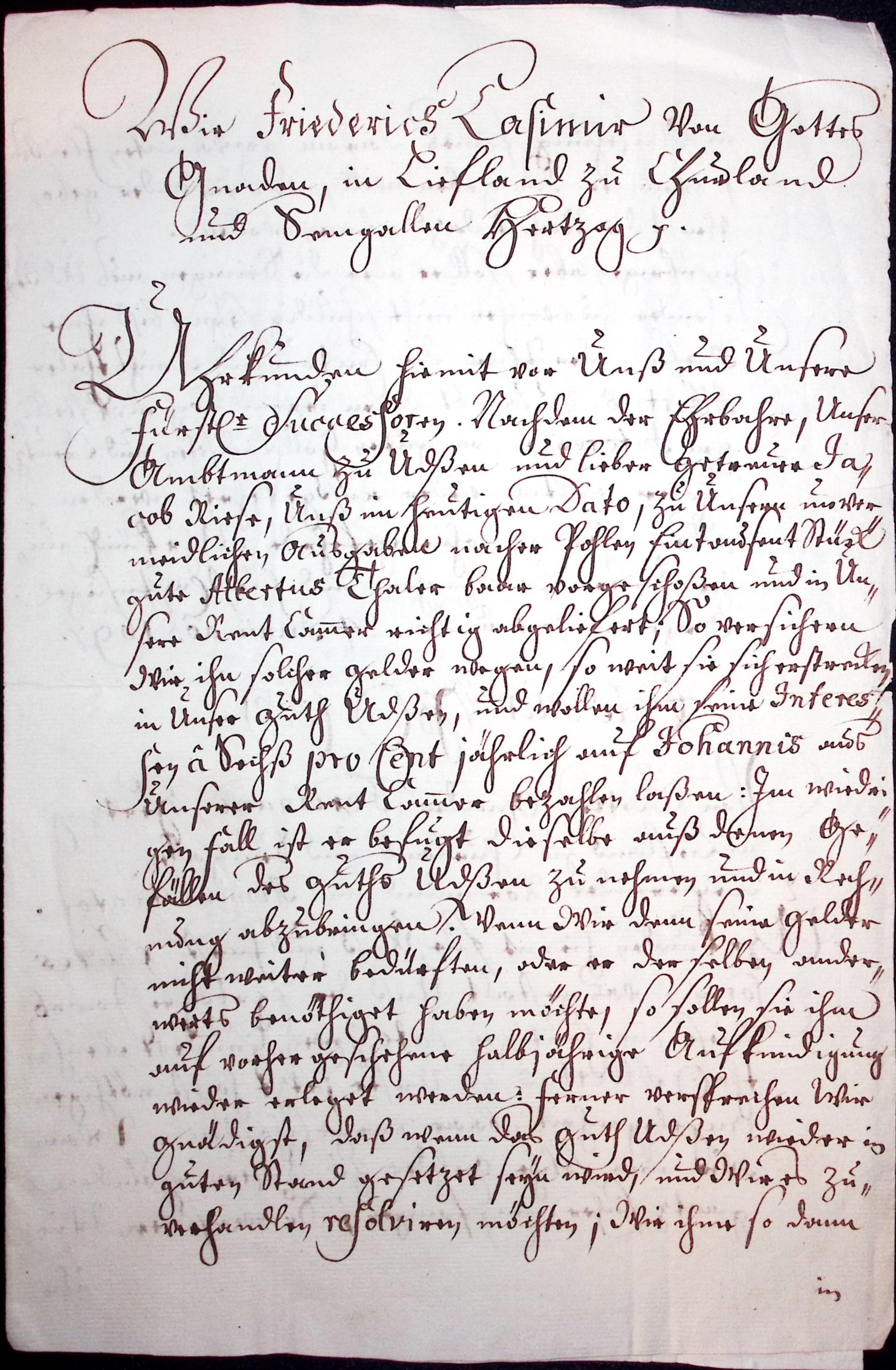
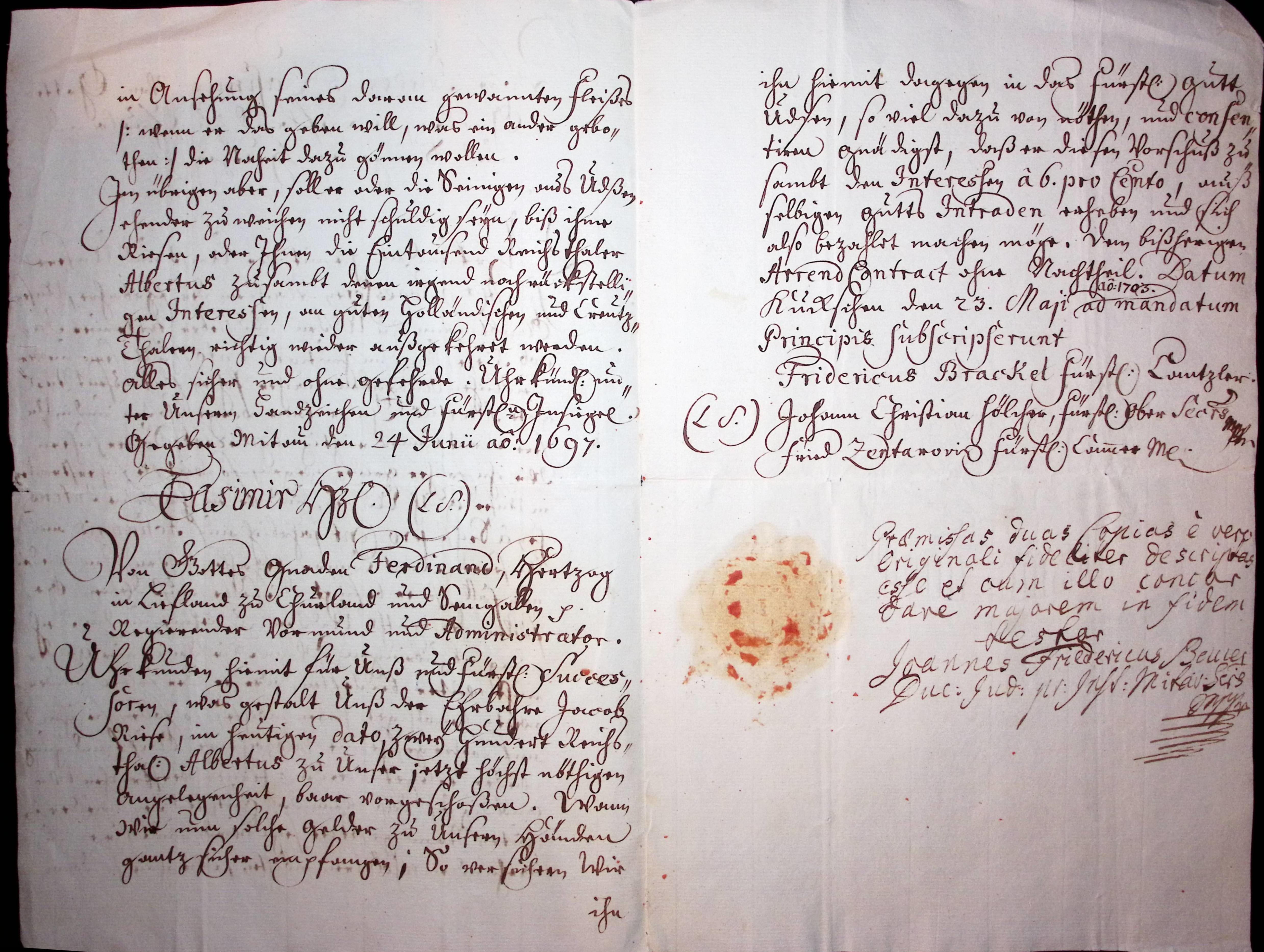
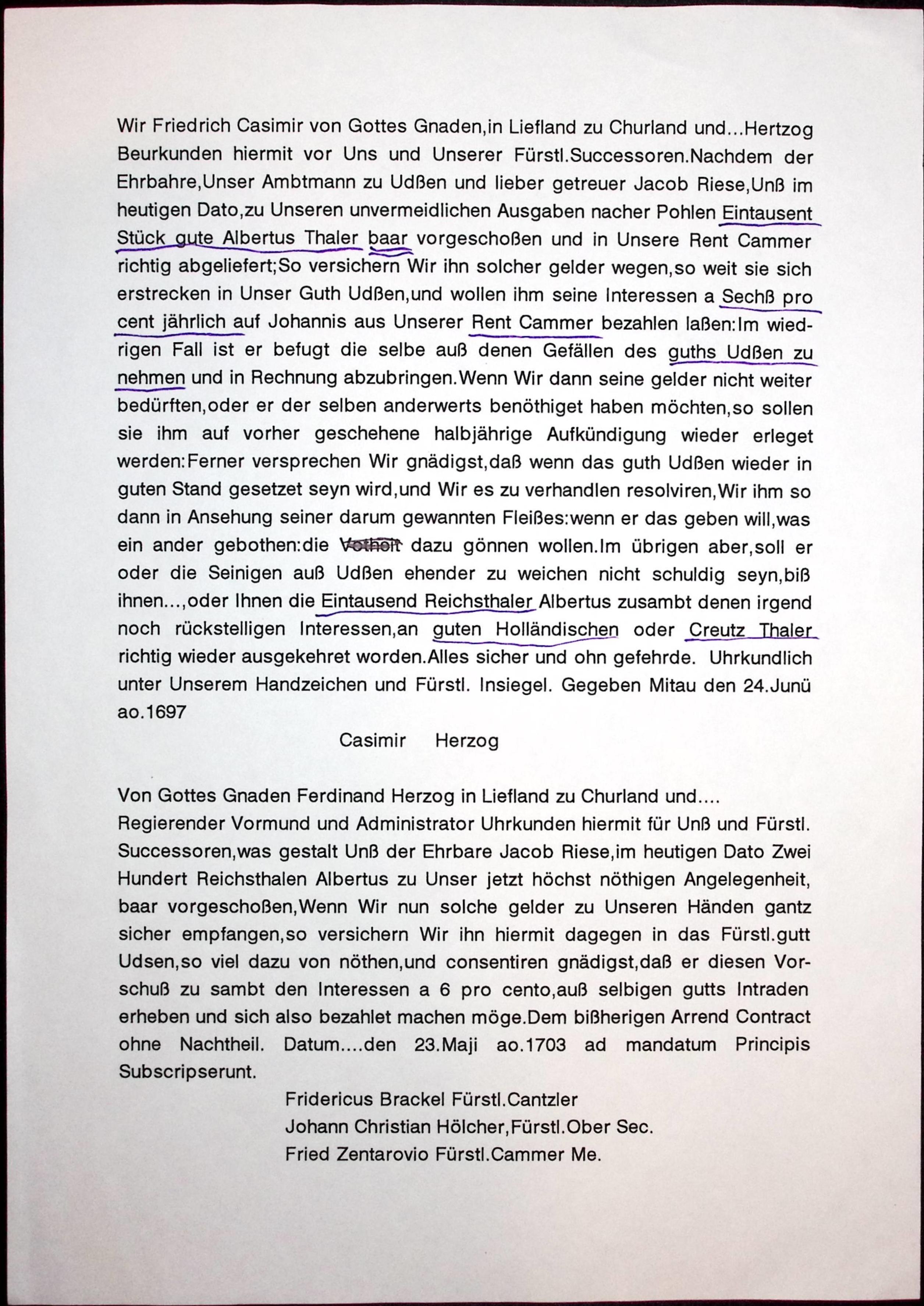
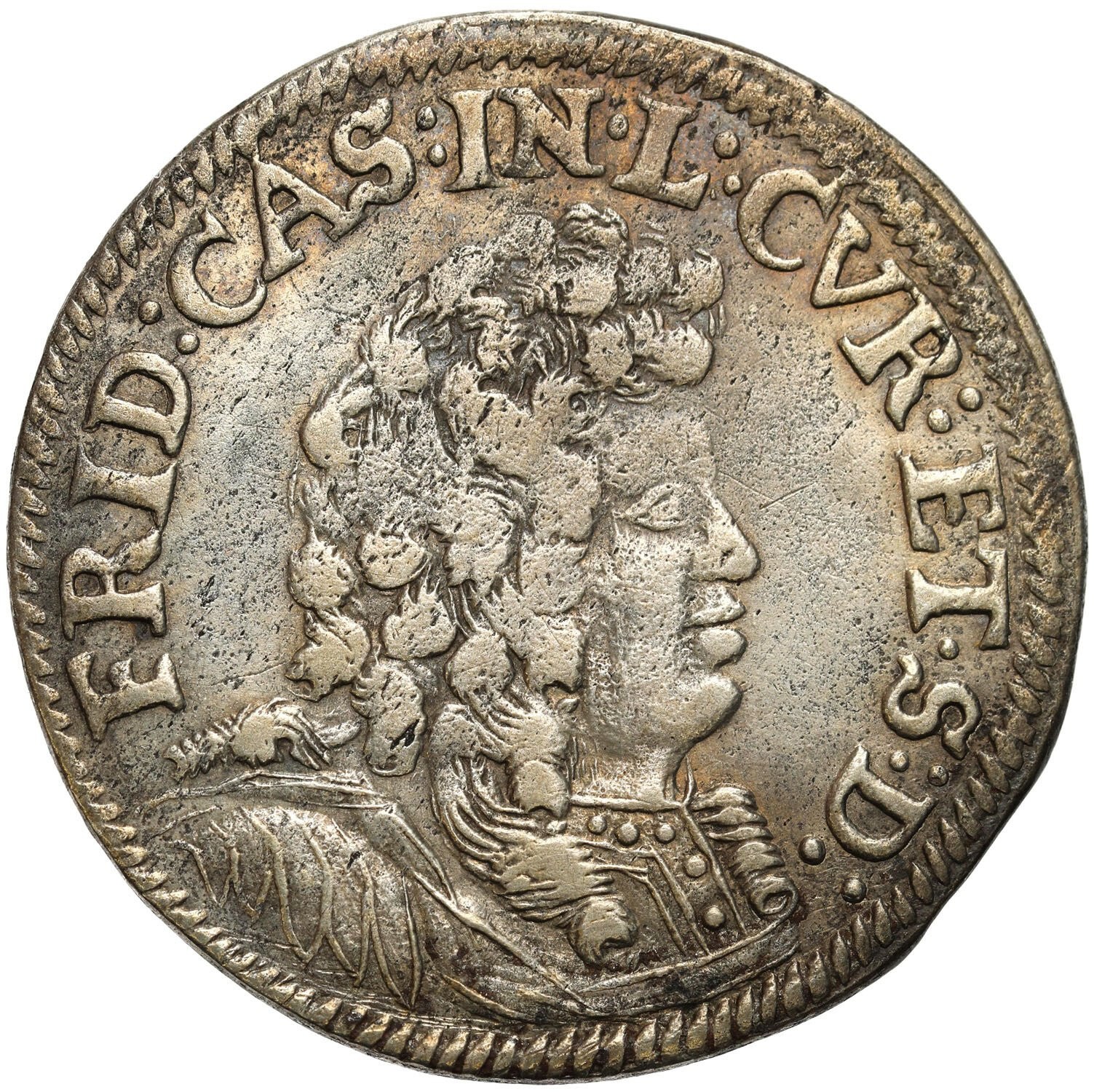
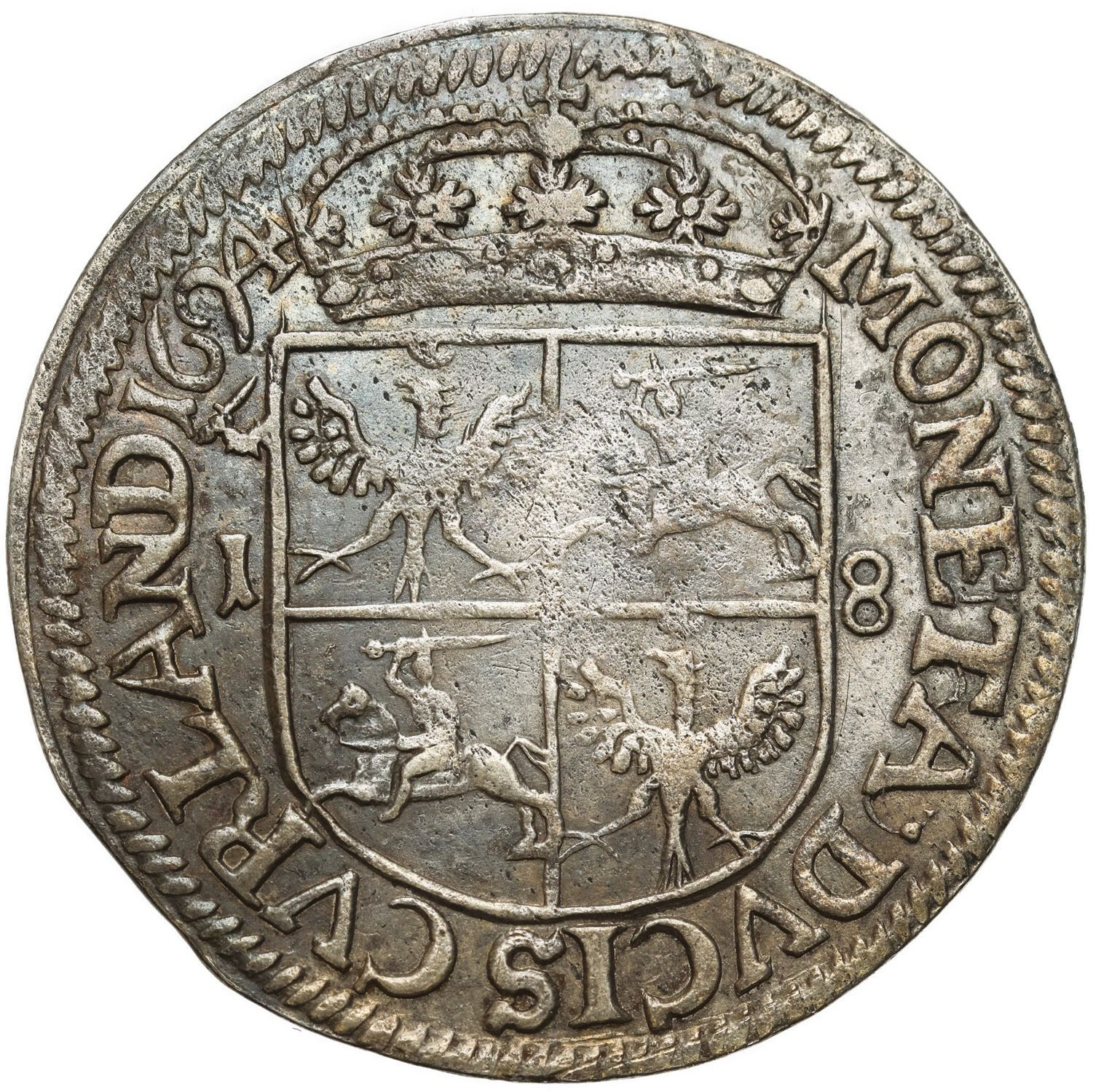
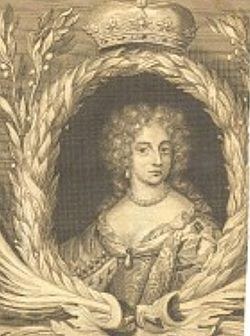
Frederick Casimir Kettler, Loan at 6% for 1000 thalers, Mitawa 1697
Loan from the ruler of Inflants.
Good state of preservation, German text, lacquer seal missing.
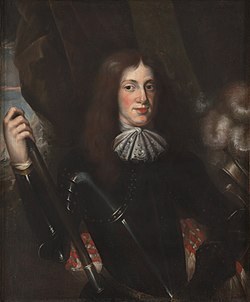
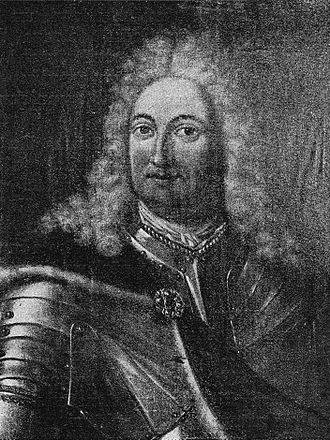
Friedrich Casimir Kettler German. Friedrich Kasimir Kettler (born July 6 1650, died January 22 1698 in Mitava) - Prince of Courland and Semigallia in 1682-1698, fief of the Polish-Lithuanian Commonwealth.
Road to the throne
He was born as the eldest son of Jacob Kettler and Ludwika Karolina, daughter of George William, Elector of Brandenburg. From 1658 to 1660, he and his family were in Swedish captivity. From 1666 he stayed at the Berlin court of his uncle Frederick William, where he received a careful education. At the University of Erlagen, he studied law and the sciences of state. In his youth, he and his brothers visited many European cities, including Paris. He mastered several languages perfectly (including French and Latin). In 1670, in Dutch service, he commanded his own regiment of cavalry in the war with France. With Dutch money, he formed two more regiments in Courland, which he brought with the ship "Jacobus" from Lipawa. The young Kettler's activities in a foreign army, in addition, during the period of rapprochement between France and the Republic, caused a storm at the Diet. As a result, Frederick Casimir was recalled to the country in 1676. Despite his thorough education, he was not allowed by his father in state affairs. By his father's will in 1677, he received estates in Brandenburg and mines and income mainly from trade in Norway and Iceland. He also received rights to the Kurland colonies[1].
Reign
Domestic policy
After his father's death (1682), he became Duke of Courland and Semigallia. His ascension to the throne necessitated concessions to the nobility, whose influence was being curtailed by Jacob. The pretext for the speech was the prince's appointment of a Calvinist , Christopher Henry von Puttkamer, as the new chancellor , which, in view of the powers the chancellor had in the Kurland consistory, was perceived as an attempt to strengthen the ruler's position in the duchy. As a result of the agreement reached during the Kurland Landtag, the chancellor was dismissed, and the nobility received further privileges. The next step was to settle the issue of the Plitinsk district, whose administrator since the Swedish Deluge had been Prince Jacob Kettler. Frederick succeeded in 1684 in concluding an agreement with the county's nobility, under which the county became an autonomous part of the duchy, united with it by a personal union. Instead, plans to modernize the Duchy of Courland through the establishment of industrial manufactories, new depots, and the commercial expansion of the Kurland fleet in the Baltic, fought by the Swedes, failed. The duchy's economy remained based on the export of agricultural products to England and the Netherlands. Prince Frederick did not get involved in economic affairs like his mercantilist-fascinated father, trying to gain a higher position inside the state as well as internationally by increasing the duchy's income. Enthralled by the splendor of Versailles Louis XIV, as well as the court of his uncle the Great Elector, Frederick Casimir spread patronage of art and culture[2]. In 1684, the first ever printing of a book in the Latvian language was done . From the country's capital, Mitava , he sought to make a significant cultural center by organizing costly celebrations. In 1697 he entertained Peter I the Great, whowas traveling to Western Europe . The prince also began building a new palace in Mitava for this purpose, bringing in artists and craftsmen from Western Europe. However, the cost of maintaining the lavish court, as well as the prince's numerous investments, entailed a huge burden on the budget of the small principality. The policy of saving the budget by borrowing from the nobility, spoiling the coinage, and, following the example of the German princes, hiring mercenaries abroad, did not make him popular among the local nobility. On the other hand, the prince continued the tradition of the Kettlers by providing care for the Kurland peasants. Between 1689 and 1690, he traveled throughout northern and western Reich, as well as to Holland and Vienna[3].
Foreign policy
The prince, unlike his predecessor, who pursued a rather independent policy from the Republic, loyally discharged his fief duties. The fief homage was paid to the Polish king (through an envoy) on March 18, 1683 in Warsaw. King John III also approved a treaty between Frederick and his brother Ferdinand, under which the prince took over his father's entire inheritance, including rights to the Courland colonies. In 1685 Frederick Casimir was part of the campaign against the Turks. The duchy supported the Republic, as well as the troops of the Holy League, throughout the war. The Kurland regiment was commanded by the duke's brothers Ferdinand and Alexander, who was killed at Buda during hostilities in 1686. The prince maintained close relations with the scoligized Brandenburg court. After the death of his first wife, he remarried his cousin, daughter of Frederick William-Elisabeth Sophie. In Polish-Swedish relations, he continued the policy of neutrality pursued by his father. However, unlike him, he established friendly relations with Russia. Czar Peter I guaranteed Courland neutrality in the event of a Russo-Swedish conflict, as well as promising the hand of one of his nieces to his son Frederick Casimir-Friedrich Wilhelm.
The prince attempted to reclaim the former Kurland colonies in The Gambia and on the island of Tobago, lost to the Swedish invasion of 1658. An attempt to re-explore Tobago was made in June 1686 by Captain Schmoll, who was ordered to rebuild the former fortifications. Several hundred Kurland colonists arrived on Tobago. The venture was hampered by tropical storms and disease, which killed a third of the newcomers by the spring of 1687. Eventually, after a supply ship sank in October 1687, the prince abandoned his attempts to colonize the island. In 1691, Courland concluded a treaty with Brandenburg providing for cooperation in the colonization of Tobago, but this failed and the island was soon occupied by the English. It was also during Frederick's reign in 1692 that a Kurland ship was sent for the last time to trade towards the Gambiancoast .
Distraught after the death of his younger son Leopold Charles, he died on February 22, 1698, and was buried in Mitava. The prince's grave was robbed by the Swedes in 1705[6]. He was succeeded by six-year-old Prince Frederick William, in whose name the regency would be held jointly by Prince Ferdinand and Princess Elisabeth Sophie.
Assessment of the reign
The assessment of Prince Frederick's reign is not clear-cut. The prince was certainly a generous patron who, through his investments in the field of culture, significantly raised the prestige of the dynasty in the eyes of neighboring countries, as evidenced by the reaction, staying in Mitava, of Peter I the Great, on whom the Kurland court made quite an impression. At the same time, the court's expenses burdened the duchy's budget, which, combined with the lack of continuation of the active economic policy pursued during the reign of Jacob Kettler and as a result of Frederick Casimir's short-sighted financial policy, led to economic stagnation in the duchy. The prince's reign is also associated with the end of the dream of Kurland colonies in the New World. On the other hand, the prince had undoubted successes in the field of foreign policy, where he managed to pursue a fairly independent policy towards neighboring powers and maintain relations with many European courts. A considerable diplomatic flair can be evidenced by his rapprochement with the growing power of Czar Peter I's Russia. Despite the numerous mistakes made in terms of economic policy, the death of the prince will be a considerable blow to the state, which will be plunged into disputes over regency between his widow and ducal brother. The final collapse of the Kettler duchy will come as a result of the events of the Great Northern War.
Private life
He was married twice. His first wife was (from October 5, 1675) with Sophia Amalia von Nassau-Siegen (d. April 29, 1691). He had three daughters with her:
- Maria Dorota (1684-1743), who 1703 married Albrecht Friedrich Hohenzollern (1672-1731), son of Friedrich Wilhelm I.
- Eleonora Carolina (1686-1748), who in 1714 married Ernest Ferdinand of Brunswick-Bevern, son of Ferdinand Albrecht I of Brunswick-Lüneburg.
- Amalia Ludwika (1687-1750), who in 1708 married Frederick William of Nassau-Siegen
On April 29, 1691, Frederick Casimir married Elisabeth Sophie Hohenzollern. The couple lived to see two sons:
- Friedrich Wilhelm Kettler (1692-1711)
- Leopold Karl (1693-1697)