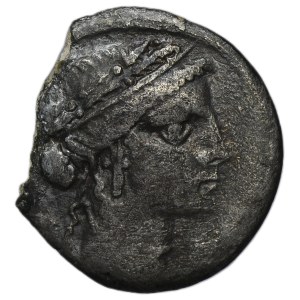


A highly interesting denarius of Julius Caesar, combining propaganda recalling his victories in the Gallic Wars with the political messaging of the civil war against Pompey. The issue was struck in 48–47 BC, when Caesar was conducting military operations outside Italy and his mobile mint accompanied the army. This type belongs to Caesar’s second major coinage issue of the Civil War period.
In 48 BC, the conflict between Caesar and Gnaeus Pompeius Magnus entered its decisive phase. Following Pompey’s departure from Italy, military operations shifted to the eastern coast of the Adriatic. The campaign culminated in the Battle of Pharsalus on 9 August 48 BC, which ended in a decisive victory for Caesar. Pompey subsequently fled to Egypt, where he was murdered. Caesar followed him to Alexandria, becoming involved in the dynastic struggle between Cleopatra VII and Ptolemy XIII.
The present denarius was struck during this turbulent period, although its iconography does not refer directly to the war against Pompey. The reverse deliberately evokes Caesar’s earlier victories in Gaul, which had laid the foundations of his military power and political position.
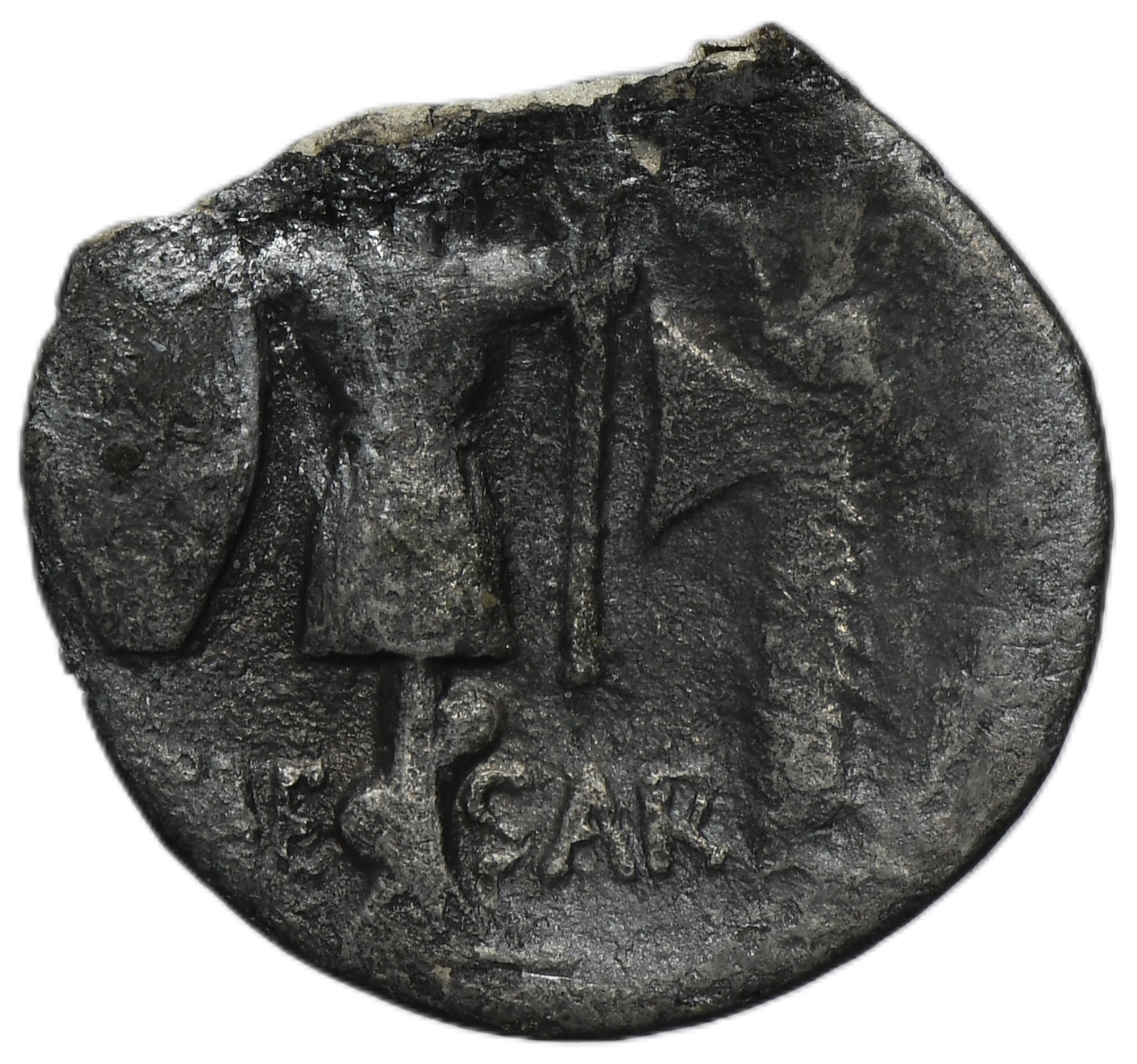
The trophy depicted on the reverse consists of characteristic elements of Gallic military equipment. Particularly distinctive is the carnyx, a long, curved war trumpet used by the Celts. It is accompanied by a Gallic shield and an axe. Crawford places this coin within a broader group of Caesar’s denominations employing the motif of a Gallic trophy; studies of this issue indicate that the presence of the shield and carnyx clearly identifies the trophy as a reference to the conquest of Gaul.
This imagery recalled Caesar’s greatest military achievement up to that point. The Gallic Wars of 58–50 BC brought him immense prestige and wealth and, above all, a loyal and highly experienced army. At the outbreak of the Civil War, recalling his victories in Gaul therefore carried an unmistakable propagandistic message: the issuer of the coin was a victorious commander whose position rested upon years of military success.
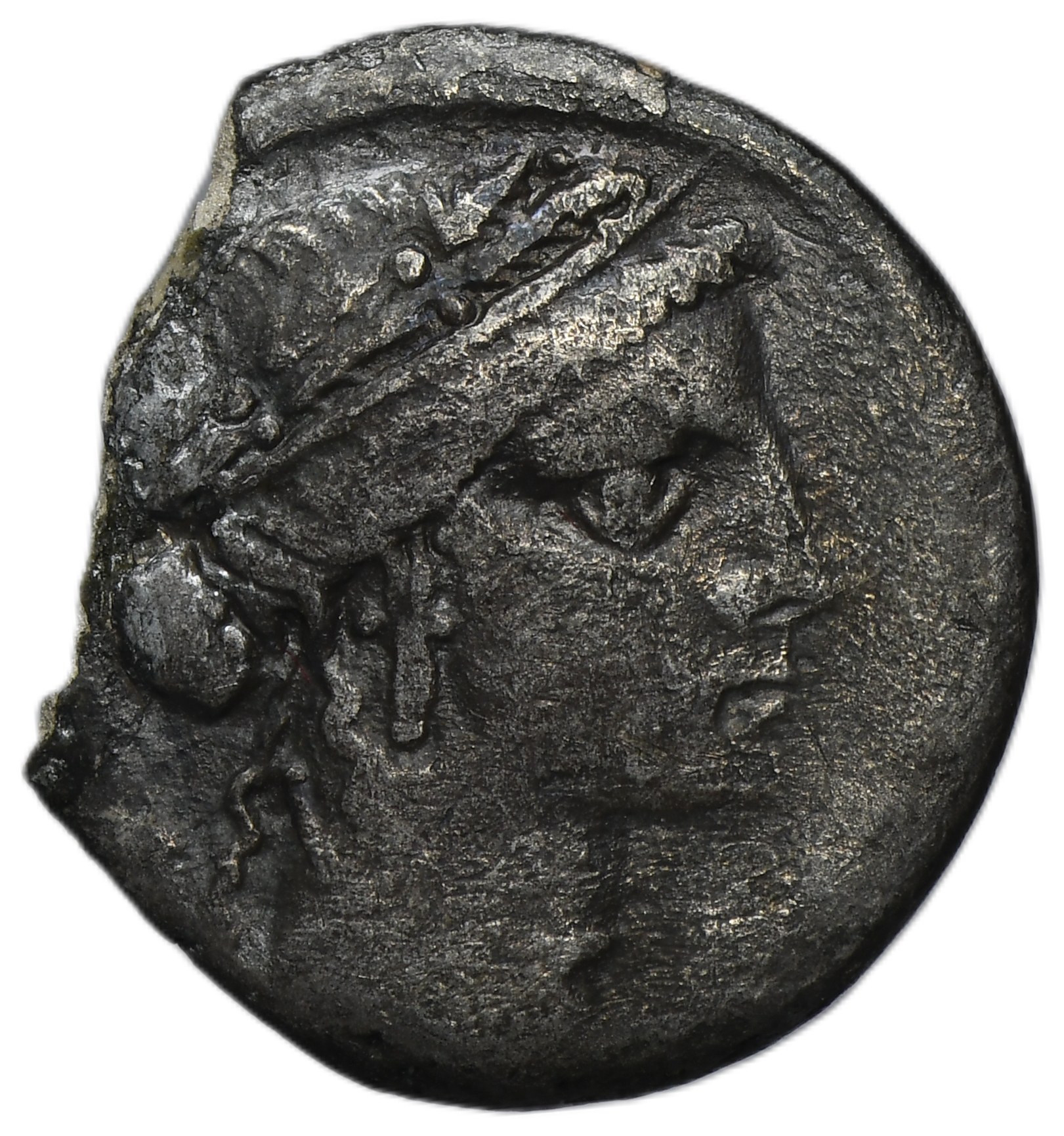
The obverse is particularly intriguing. In earlier scholarship, the female figure was frequently identified unequivocally as Pietas, although a modern description should be more cautious. The female head wears a diadem and an oak wreath. Both Pietas and Clementia have been proposed as possible identifications in the literature. The latter interpretation is particularly interesting in the context of Caesar’s propaganda, as during the Civil War he deliberately emphasised his clementia – his clemency towards defeated opponents. There is, however, insufficient evidence to regard this identification as certain.
The combination of the obverse and reverse creates a remarkably deliberate message. On one side is a trophy recalling the conquest of Gaul and Caesar’s military achievements; on the other, a female personification probably associated with the virtues Caesar wished to attribute to his own rule. The coin was therefore not merely a means of payment intended for the army, but also a vehicle for a carefully constructed political message.
The present denarius is thus a characteristic example of the way in which Caesar employed coinage to shape his public image during the Civil War. The Gallic trophy reminded soldiers and political opponents alike of the identity of its issuer: a commander who had brought vast territories of Gaul under Roman control and who, at the head of an army hardened by years of campaigning, subsequently entered the struggle for control of the Republic.
Coin with a broken fragment.
Roman Republic
Julius Caesar (47-46 BC), Denarius 48-47 BC, uncertain mint
Obverse: head of Pietas right
Reverse: trophy with Gallic shield and carnyx, axe to right
CAESAR
Diameter 19 mm, weight 2.92 g