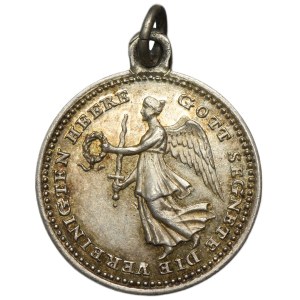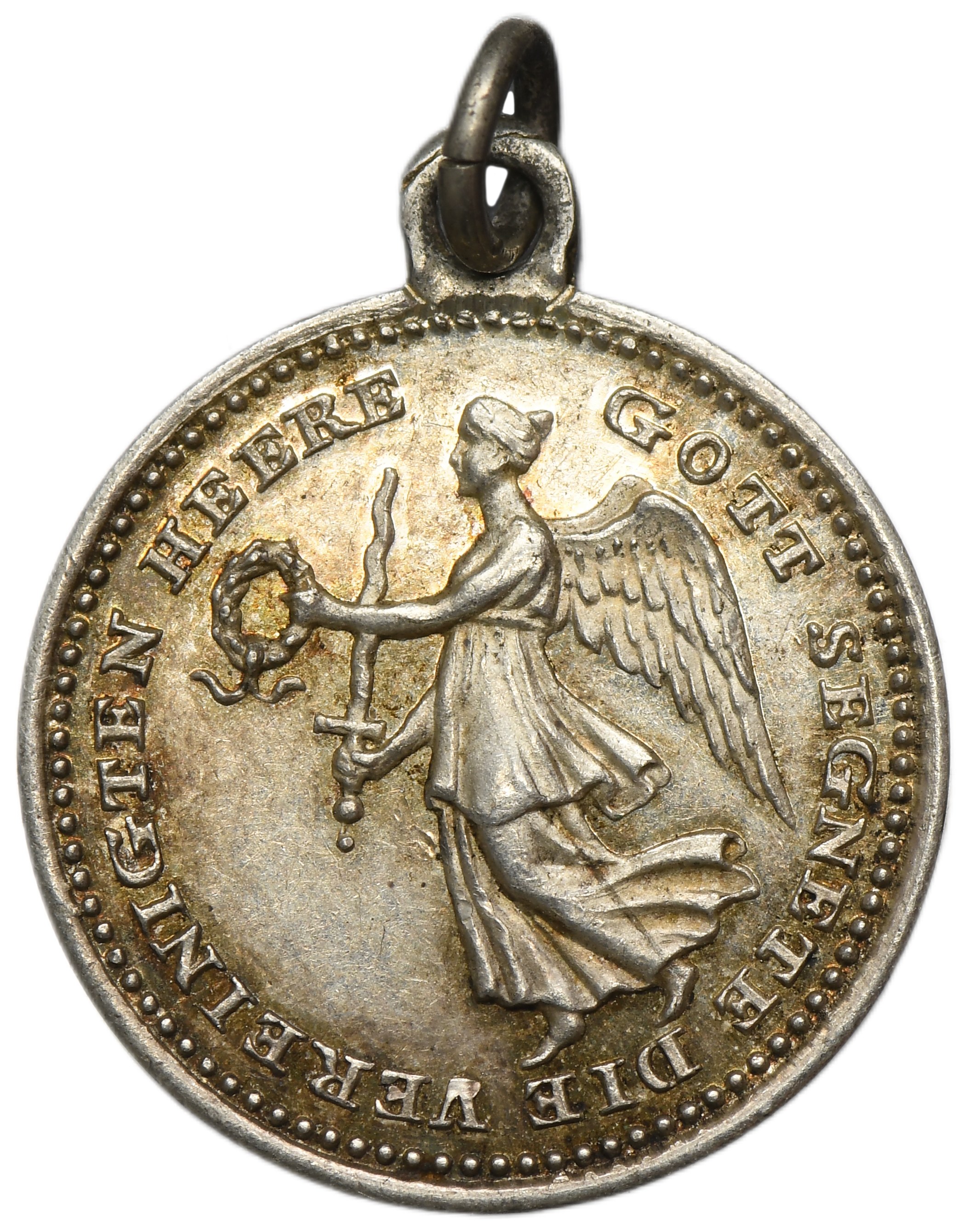
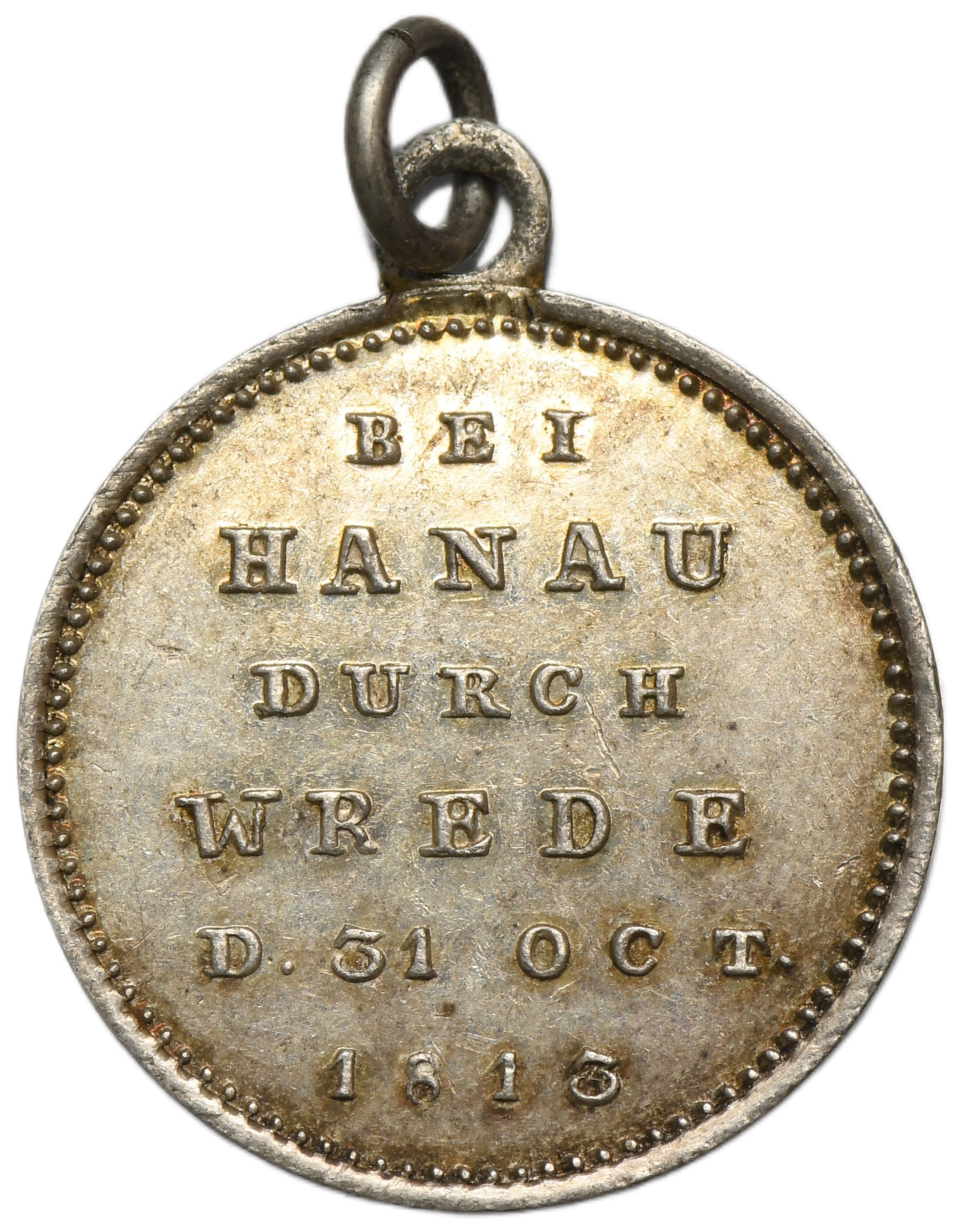
A small silver commemorative medal, known as a Siegespfennig, struck to commemorate the operations of General Karl Philipp von Wrede’s Austro-Bavarian forces at Hanau on 31 October 1813. Designed by Daniel Friedrich Loos, it belongs to a series of miniature medals associated with the German Wars of Liberation.
Following the defeat at Leipzig, Napoleon’s army retreated towards the Rhine. Near Hanau, its route was blocked by an Austro-Bavarian corps of more than 40,000 soldiers commanded by Karl Philipp von Wrede. Bavaria had only recently abandoned its alliance with France and joined the Sixth Coalition.
On 30 October, Napoleon attacked Wrede’s positions and, after heavy fighting, forced his troops to withdraw, reopening the road towards Frankfurt. The engagement ended in a tactical French victory and proved to be Napoleon’s final victory on German soil.
The medal, however, bears the date 31 October, when Wrede attacked Hanau again and expelled the French rearguard left in the town. The general was seriously wounded during the assault. The medal therefore commemorates this local success rather than the outcome of the battle as a whole.
The obverse depicts the winged goddess Victory holding a flaming sword and a laurel wreath. The legend GOTT SEGNETE DIE VEREINIGTEN HEERE translates as “God blessed the united armies.”
Fitted with a suspension loop and ring.
An interesting memento of Wrede’s recapture of Hanau, issued despite Napoleon’s tactical victory in the battle as a whole.
Obverse: winged Victory holding a flaming sword and a laurel wreath
GOTT SEGNETE DIE VEREINIGTEN HEERE
Reverse: six-line inscription
BEI / HANAU / DURCH / WREDE / D. 31 OCT. / 1813
Silver, diameter 15 mm, weight 1.30 g