


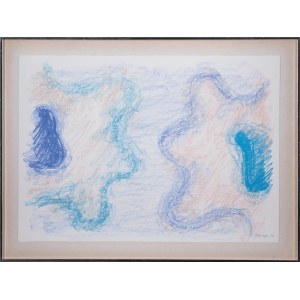
oil crayon/paper, 50.5 x 71 cm
signed p.d.: Fangor 70
on the reverse of the author's binding, inscription: FANGOR 2570
Wojciech Fangor is one of the most prominent representatives of abstract art of the op-art trend. In 1965 he participated in the exhibition of optical art "The Responsive Eye" at the Museum of Modern Art in New York. Since 1958, when together with Stanislaw Zamecznik he realized the environment "Study of Space," his thinking about painting has been dominated by the problem of space. The statement that "the modern painting is no longer a hole in the frame to look into" was accompanied by experiments to, as the artist wanted, "incorporate space-time into painting." These experiments did not go beyond purely painterly means. Until the mid-1970s, Fangor created his famous pulsating paintings, depicting colorful circles or waves. He achieved the optical effect of movement on the surface of the painting through soft shading, imitating Leonardo's sfumato. In turn, the artist was inspired by his fascination with astronomy and observation of the stars through a telescope, producing sharp and blurred images. Stefan Szydlowski characterized the peculiarities of works from this period: "The same material object becomes a different image each time, because it is impossible to approach it twice by the same path and at the same pace. This property of Fangor's paintings, paintings conventionally called circles, waves, amoeboid and amorphous paintings, where scattered transitions of color into color perplex us, openness and indeterminacy, vagueness and uncertainty, allows us to obtain real contact with life. Wojciech Fangor brought the painting to life, in contact with the viewer, the painting lives a life of its own, which has been called immanent vibration and kinetics by critics. [...]. "Fangor is the great romantic of op-art," wrote John Canaday, "working not according to theoretical rules, but through a combination of intuition and experiment. Appealing not to reason, but to our longing for mystery" (S. Szydłowski, Wojciech Fangor. Space as a Game, Krakow 2012, pp. 124, 126 [Album accompanying the exhibition at the National Museum in Krakow]).
Parallel to the paintings, there were works on paper, repeating the compositions and arrangements of the paintings. Among them is the presented drawing with two amoeboid forms, approaching and moving away from each other. One can clearly see here an attempt to blur the edges of shapes this time by drawing means.


![Wojciech Fangor (1922-2015), Kopia obrazu Pabla Picassa Acrobate à la Boule [Akrobatka na kuli], 1954](https://img1.one.bid/img/10573/3329745_1w.webp?1791984376)










Paskutiniai peržiūrėti
Prisijunkite, jei norite pamatyti pozicijų sąrašą
Mėgstami
Prisijunkite, jei norite pamatyti pozicijų sąrašą