


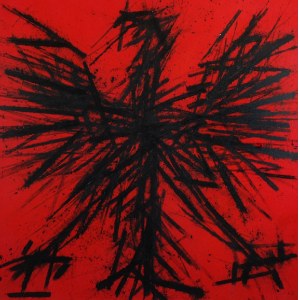
acrylic, canvas; 150 x 150 cm;
signed, dated and described on the reverse: TOMASZ MUSIAŁ / BLACK ORZEŁ 2014 / ACRYL 150 x 150 cm;
on the painter's loom a sticker from the exhibition:
TOMASZ MUSIAŁ ORZEŁ BIAŁY / ORZEŁ CZERWONY, Olimpus Gallery, Lodz 2014/2015;
Attached to the painting is a DVD with a record of the creation of the work.
Image exhibited in the exhibition:
White Eagle/Red Eagle, Olimpus Gallery, Lodz, 2015.
Studied 1995-2000 at the Academy of Fine Arts in Lodz. In 2010 he defended his doctoral degree. He currently runs the Drawing Studio at the Faculty of Painting and Drawing at the Academy of Fine Arts in Lodz.
He has exhibited his works in exhibitions such as: "White Eagle/Red Eagle", Olimpus Gallery, Lodz (2015); "Polnische kunst heute", Glasbau (2014); "Positive Disintegration", Art Propaganda Center, Lodz (2013); "Thymós. Art of Anger 1900-2011," Center for Contemporary Art Signs of the Times, Torun (2011); "Nord Art.", Budelsdorf (2010); Moscow Biennale for Young Art, Qui vive? Moscow (2010); "Strong man&Strange man," City Art Gallery 13 Muses, Szczecin (2010); "Memoirs of the Tamagochi Generation," Klima Bocheńska Gallery, Warsaw (2008); "The Damned in Haus Schwarzenberg," Galerie Neurotitan, Berlin (2005); "Bielska Jesień," Bielska Galeria BWA (2003); "International Young Art.", Sotheby's, Tel-Aviv, The Elizabeth Foundation for the Arts, New York (2001).
In 2006. Alexander S.Onassis Foundation in Athens awarded the painting "Whipping," which was one of the four equal best works at the International Competition for the Composition of Original Painting. In addition, he received awards at the 12th National Art Salon "EGERIA 2004" (2004), the Biennale of Young Art "Fish Eye" (2008) and the Festival of Young Art "Przeciąg" in Szczecin (2009).
(Source: asp.lodz.pl, tomaszmusial.com)
"(...) It can be said that the author's technique of whipping, has found its full expression and conceptual complement in the eagles. Earlier "whippings" did not create a specific image, but were enforced on silhouettes painted with full freedom of expression (man at the pillory), or landscapes. Already at that time they attracted attention with their power of influence, but in retrospect it can be said that the natural consequence of the applied creative method was to arrive at an appropriate theme, and only "Eagles" became a theme fully constituted by the measured times of the painting substrate.
Tomasz Musial's approach to the creative process itself shows clear affinities with action painting in the broadest sense - high expressive power, a certain degree of controlled chance, the horizontal position of the canvas while working, or the performativity of the creative act, highlighted by film documentation. Probably that's why such an important aspect of the series, as mentioned by the author himself, is to convey to the viewers a certain dose of energy, accompanying the creation of these works. For this is not a finesse action (in the manual sense), but a forceful one - reminding us that art filters through all sorts of emotions, not only positive ones, and that it also uses violence. For this reason, an integral component of the series, evidently boosting the power of the message, are the films, revealing the process of creating the works. (...)
Tomasz Musiał, whipping the eagles, undoubtedly directs our thoughts to the history of the Polish nation, marked by voluntary sacrifice, and the painful page this country has in its relations with its various neighbors. On the other hand, by creating such a simple and catchy symbol, he does not allow himself to be locked into an unambiguous interpretation. It is hard to resist the impression that the artist approaches with a certain dose of irony the model of Polishness, which is realized in the masochistic scratching of wounds, or even the "victim syndrome", within which the sense of patriotism is founded on the cultivation of the memory of lofty events, but which are, however, disasters. This dual reading of the "Eagles" series gains even more relevance now that we have entered the so-called "Smolensk period" after 2010.
(Text published in the art magazine Format, no. 70)





Paskutiniai peržiūrėti
Prisijunkite, jei norite pamatyti pozicijų sąrašą
Mėgstami
Prisijunkite, jei norite pamatyti pozicijų sąrašą