


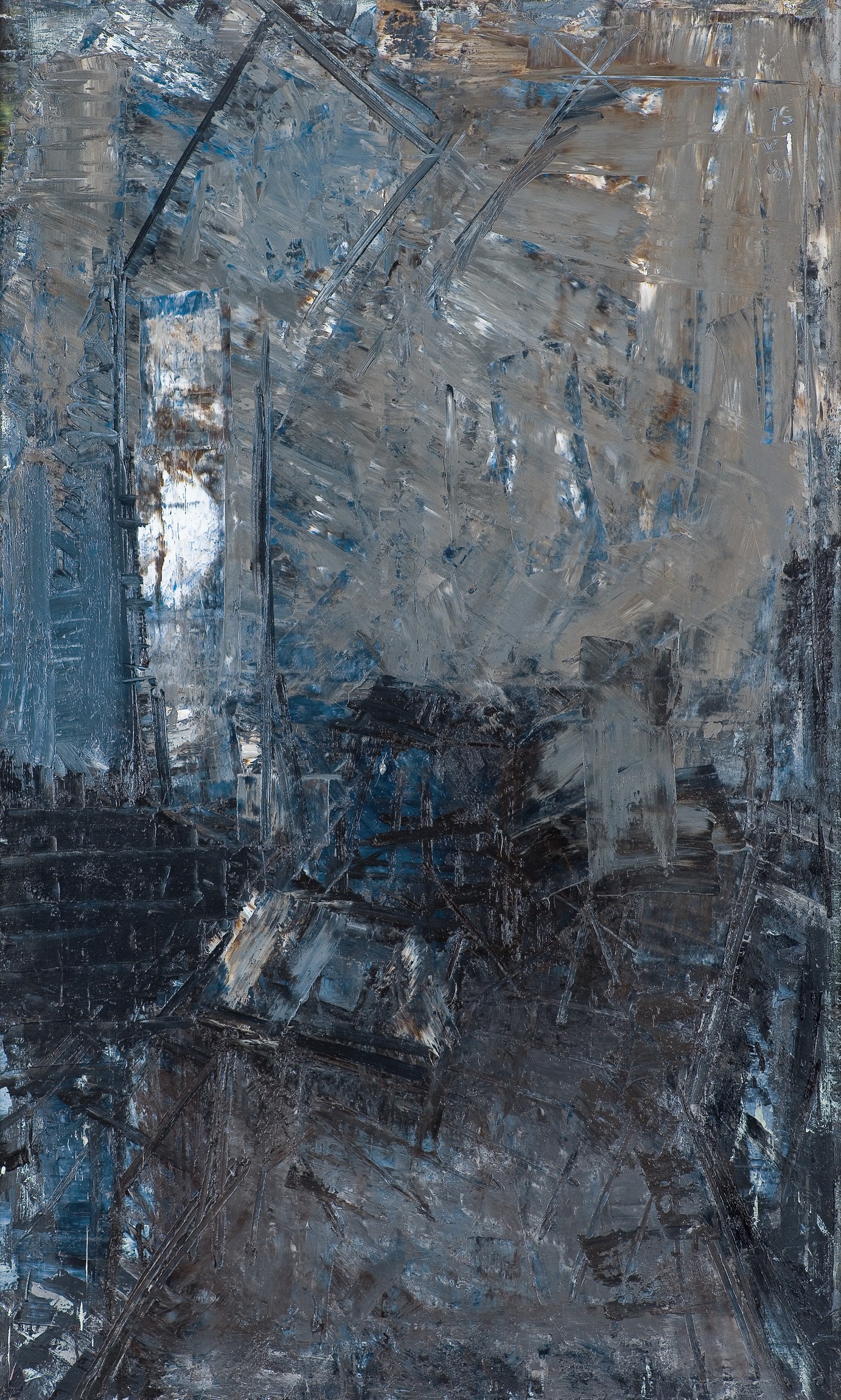
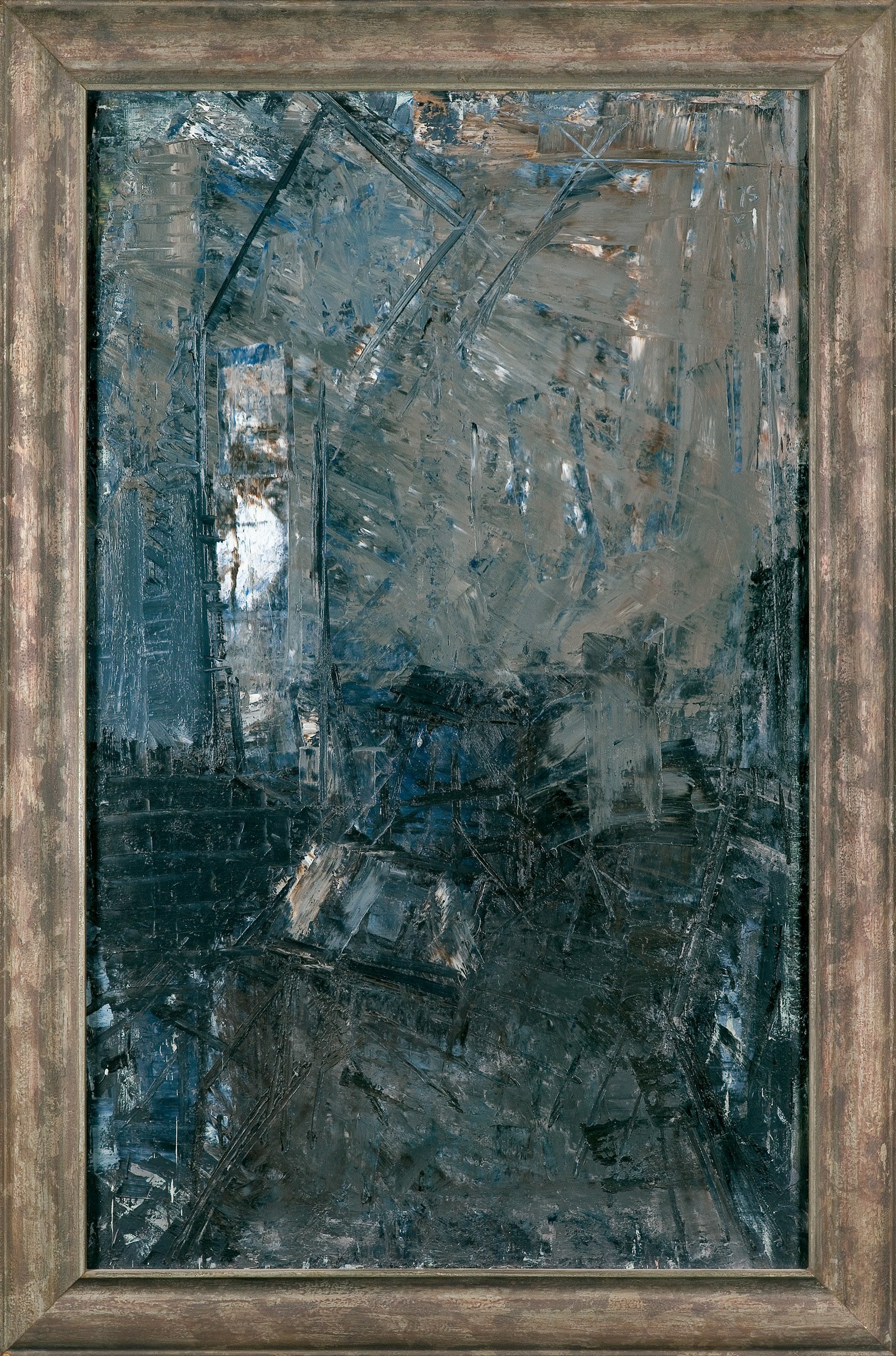
145.00 x 91.00 cm - oil, canvas
sign. l.g.: JS | V | 91
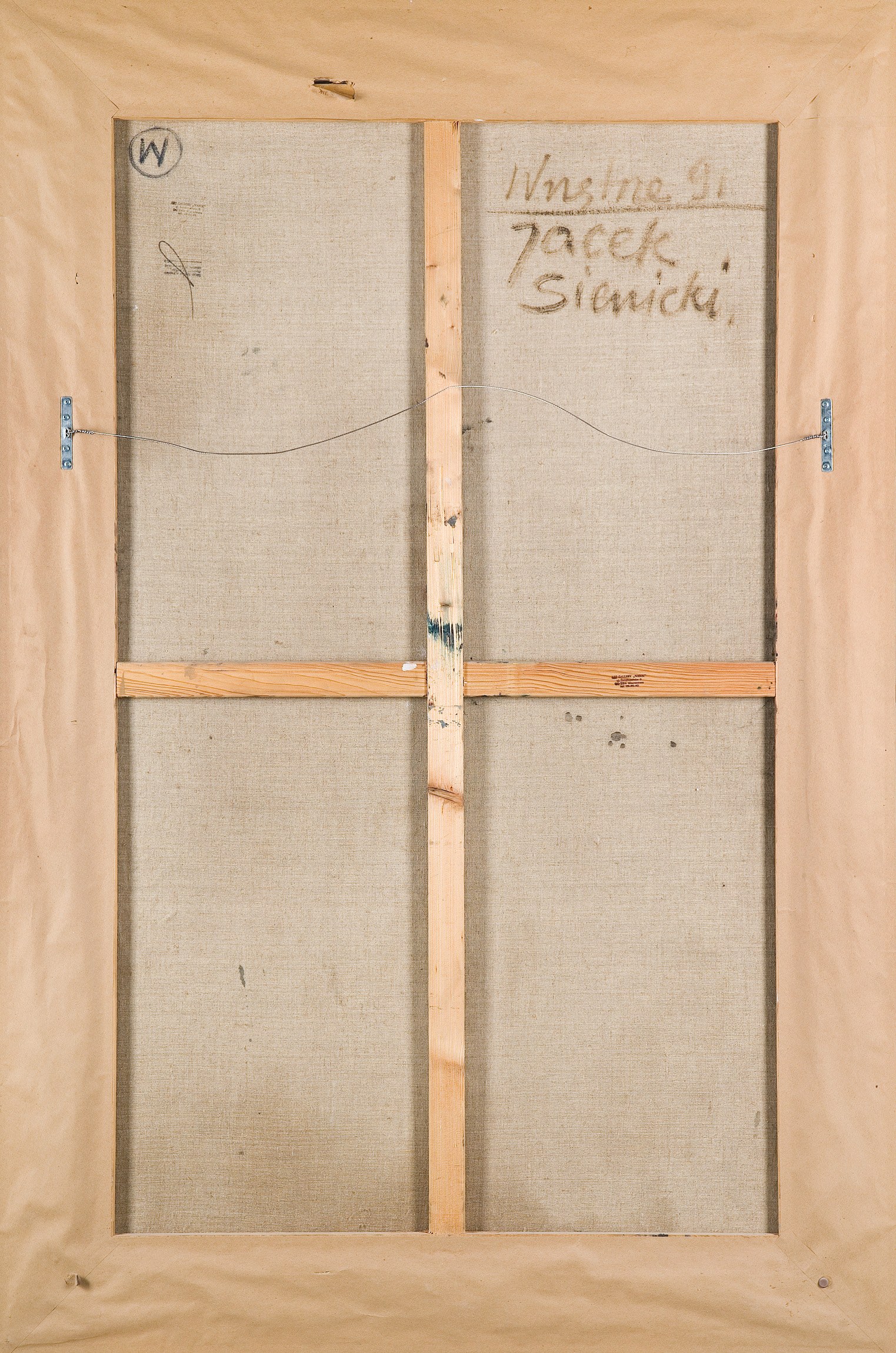
signed on the reverse p.g.: Interior 91 | Jacek | Sienicki; l.g.: W [in circle], below two stamps: of the Art Gallery "Vava" repeated on the middle strip of the stretcher, the other - export stamp
Reproduced painting:
-Jacek Sienicki, Browarna Gallery, 1994, graphic design. A. Biernacki, color illustration p. 10, in reproduction list p. 138.
There are several recurring thematic motifs in Jacek Sienicki's work, which the artist treated as an inexhaustible source of inspiration, while these motifs always served primarily to express his own emotions, his own perception of the world. One such thread, was the motif of the interior of the studio. Sienicki said: I portray the interiors of the studio and I portray myself, I portray flowers, all those things that I paint, in a very close relationship with nature, which means that I have to have them next to me. Of course, I also hope that I am primarily portraying myself (You can't live without art. With Jacek Sienicki in conversation with Waldemar Odorowski, "New Books," 1995 No. 4, p. 7). As early as 1971, in a conversation with Stanislaw Rodziński, the painter stated: I repeat the same theme many times in the hope that I will find the right key, touch the right nerve and tell the truth (Stanislaw Rodziński, Jacek Sienicki, in cat. of exhibition at BWA, Krakow, 1971, p. 10), and he remained faithful to this attitude until the end of his career. Despite the large number of canvases depicting the motif of the interior of the studio, one does not see in these paintings any routine or weariness with the subject, but present here is a constant, fervent dabbling in the matter of painting, which is supposed to lead to capturing those most convincing shots. As Małgorzata Kitowska-Łysiak wrote: Sienicki analyzed the seen (...) and then applied the paint, often thickly, in many layers, with thick impastos, and then scraped it off, wiped it off, in order to extract from it - impenetrable (of which he was aware) - the mystery, to reach the truth of color. He trusted it only when it was consistent - it reflected the truth of seeing and the truth of experiencing. (M. Kitowska-Łysiak, Poeticity of Prose [in:] Jacek Sienicki, aTAK Gallery, exhibition cat. 12 December 2008 - 24 I 2009, p. 25)
The painting, presented in our auction, was painted in the artist's studio at 10 Rycerska Street, in the Old Town. About the interior of this studio, Stanislaw Rodzinski wrote: Jacek Sienicki's studio in the Old Town in Warsaw is small, even cramped. It has a strongly defined sloping ceiling, with two windows heavily carved into it. On one side are piles of canvases, drawings in rolls, on the other - tables with utensils, the painter's workshop. (...) We read the furniture, the painter's workshop, the table and the easel. The plane of the canvas is kept in balance, but the intrigue of the ceiling cut by the window is already beginning to emerge. Perhaps it was this extremely intriguing fragment of the interior that determined the painter and caused the idea of the next canvas. (...) Sienicki will henceforth paint the interior of his studio almost exclusively to paint space and light. He moved on to large, very large even formats. After a number of intense color-arranged variations, he limits his palette to almost monochromatic grays and blues (...) It is this limitation of means that leads the painter to take up one of the oldest and most difficult problems in painting: the problem of light. (Stanislaw Rodzinski, Jacek Sienicki, [in:] cat. exhibition at BWA, Krakow, 1971, pp. 12-13)
Jacek Sienicki (Warsaw, February 29, 1928 - Warsaw, December 14, 2000) studied at the Faculty of Painting of the Academy of Fine Arts in Warsaw, where he received his diploma in the studio of Prof. Artur Nacht-Samborski in 1954. In 1955 he was a participant in the Exhibition of Young Visual Arts at the Warsaw Arsenal. Participation in this manifestation was not only a proper debut for the artist, but also defined for years his attitude, shared with the other "Arsenalists", the principles of which are: the primacy of ethics, skepticism towards passing artistic fashions, loyalty to oneself. In 1955 Sienicki began teaching at his alma mater. He passed through all academic levels, receiving the title of professor in 1981. He was the recipient of significant awards, including the Cyprian Kamil Norwid Critic's Award in 1974, the Jan Cybis Award (independent) in 1984, and the Alfred Jurzykowski Foundation Award in 1993. From his early years, his painting oscillated between figurativism with an often dramatic existential message and an inclination toward abstraction. At the same time, the painter did not abandon a rather limited set of favorite motifs, which included horse skulls, elongated figures, dark interiors, which he played out in a similar dark-cold color range. In parallel to painting, he drew a lot, usually in charcoal, treating works in this technique as autonomous works.












