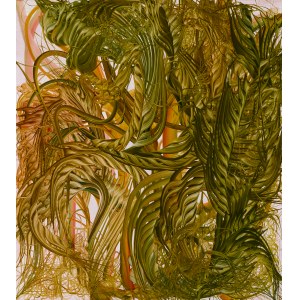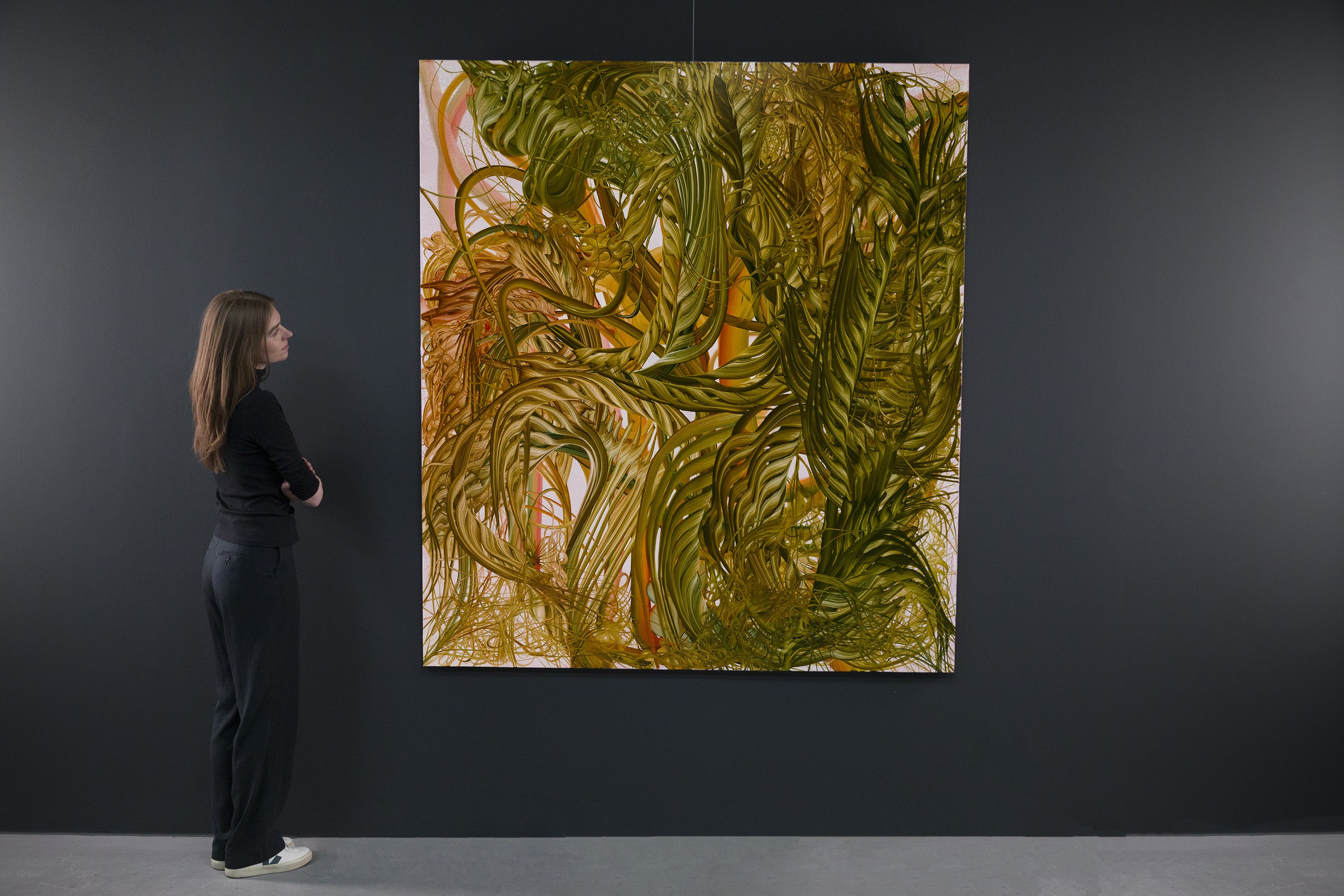
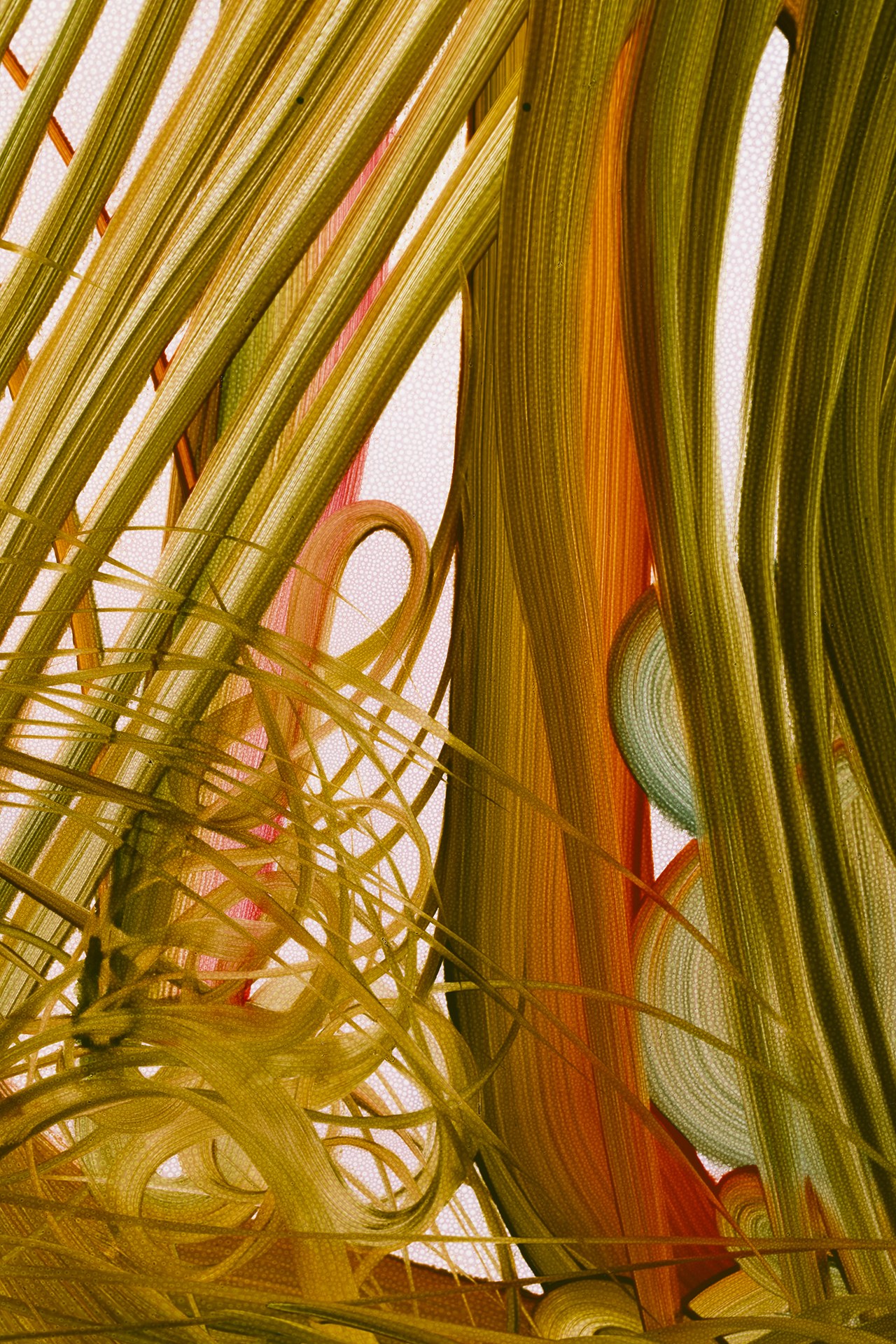
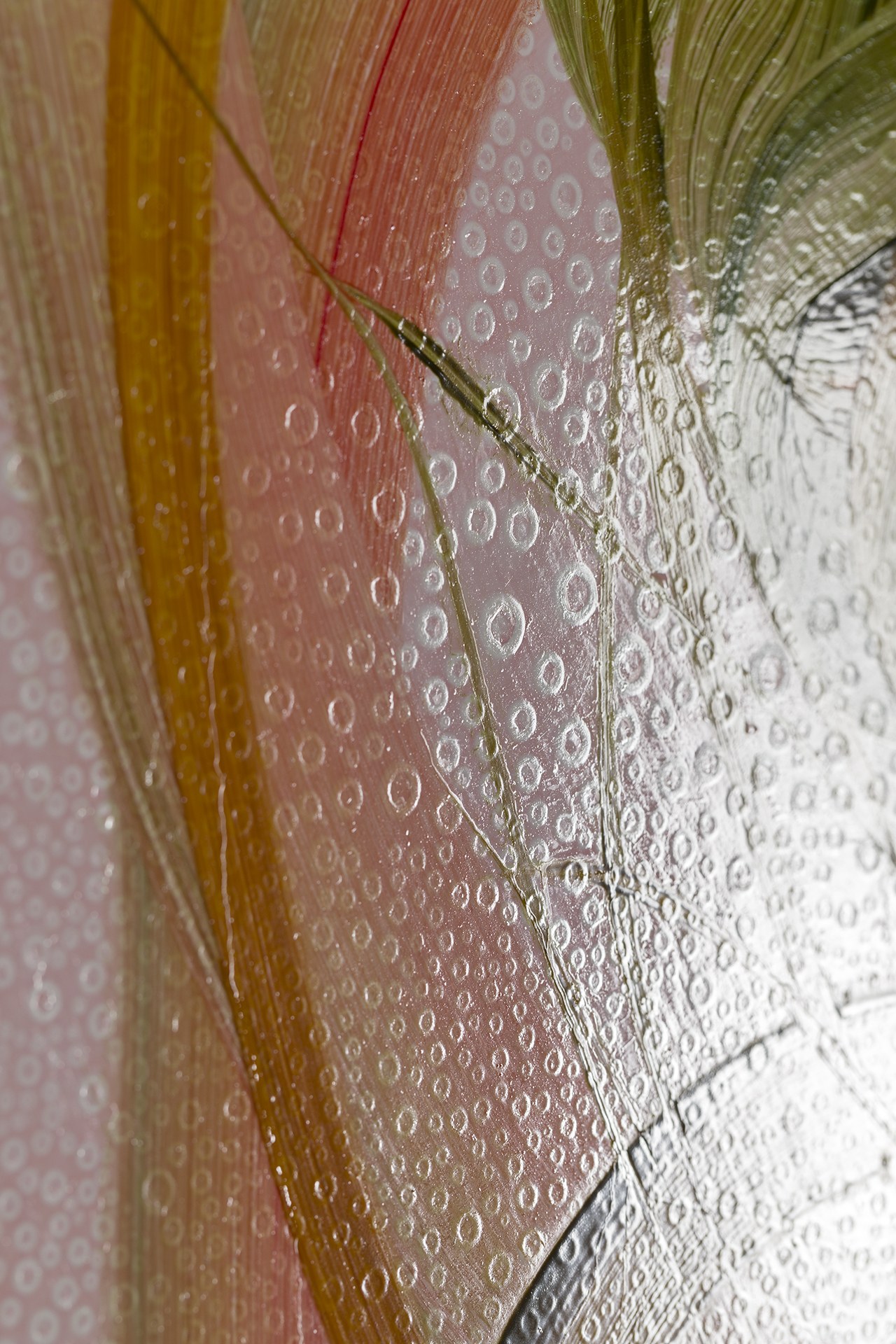
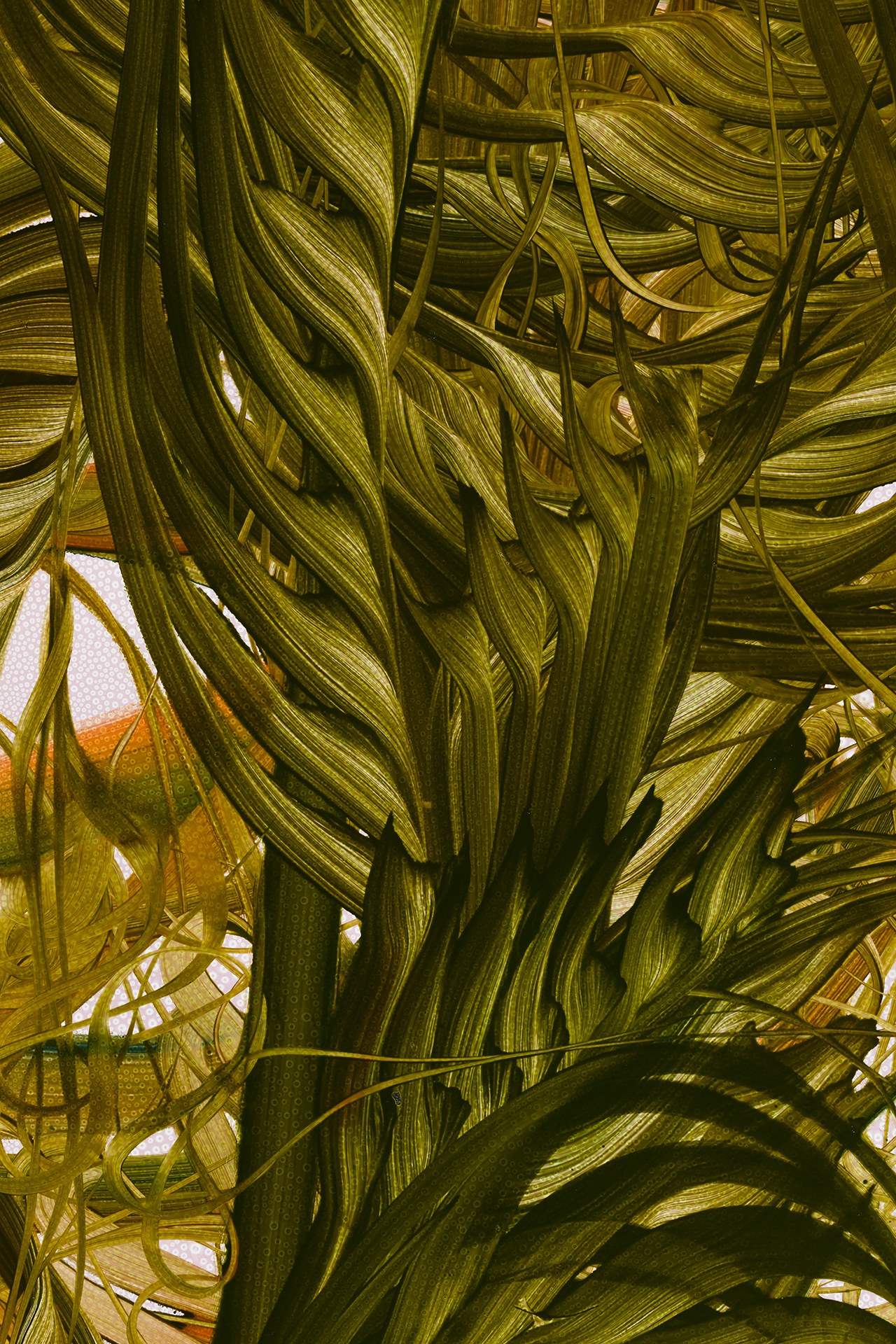
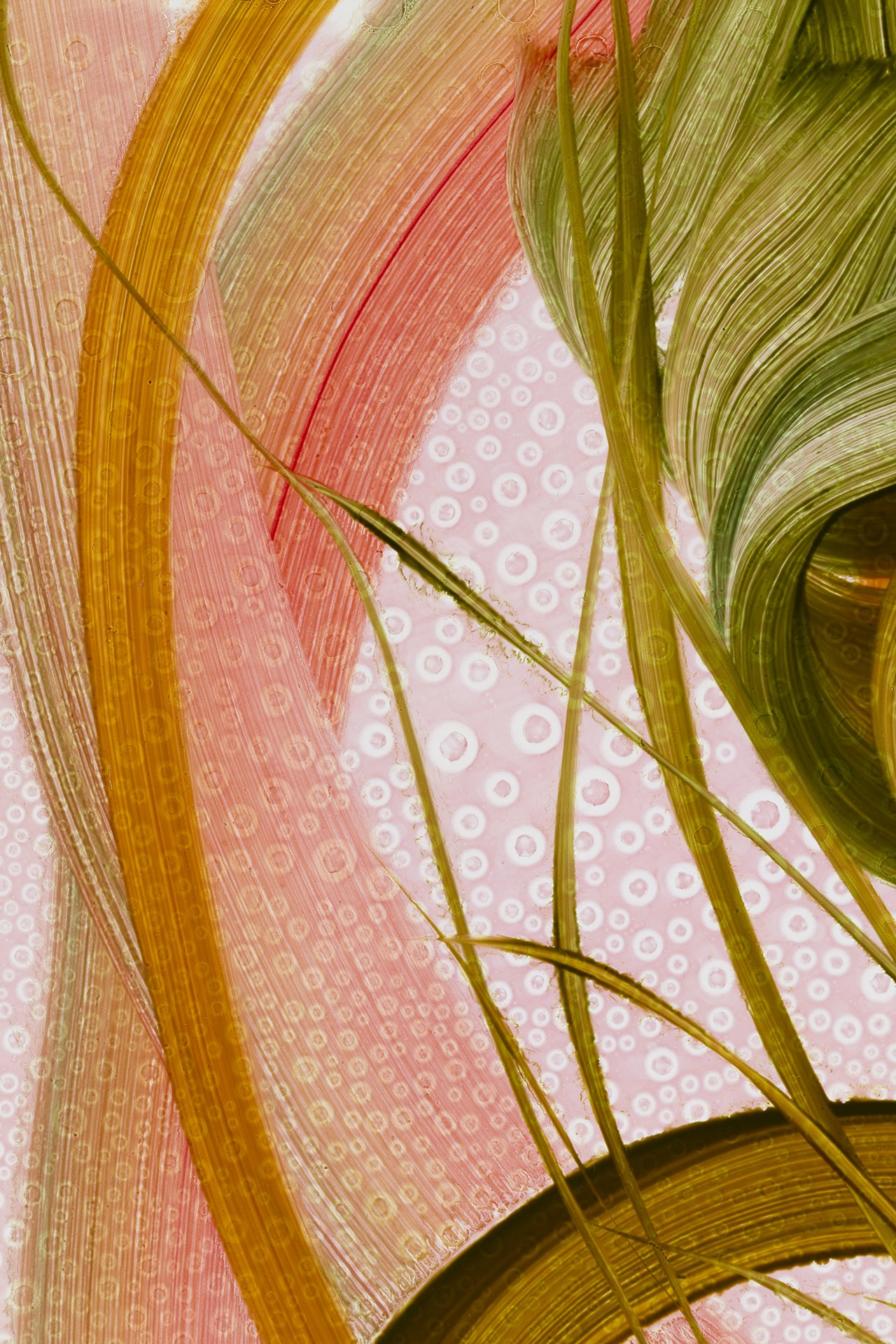
oil, enamel, canvas, 180 x 160 cm signed, dated and described on the reverse: Edyta Hul/2025/WARSAW
Edyta Hul (1986, Dobre Miasto) Visual artist, graduate of the Faculty of Painting at the Academy of Fine Arts in Gdansk (2012). Winner of the Grand Prix (ex aequo) of the 46th Biennale of Painting Bielska Jesień 2023. She lives and works in Warsaw.
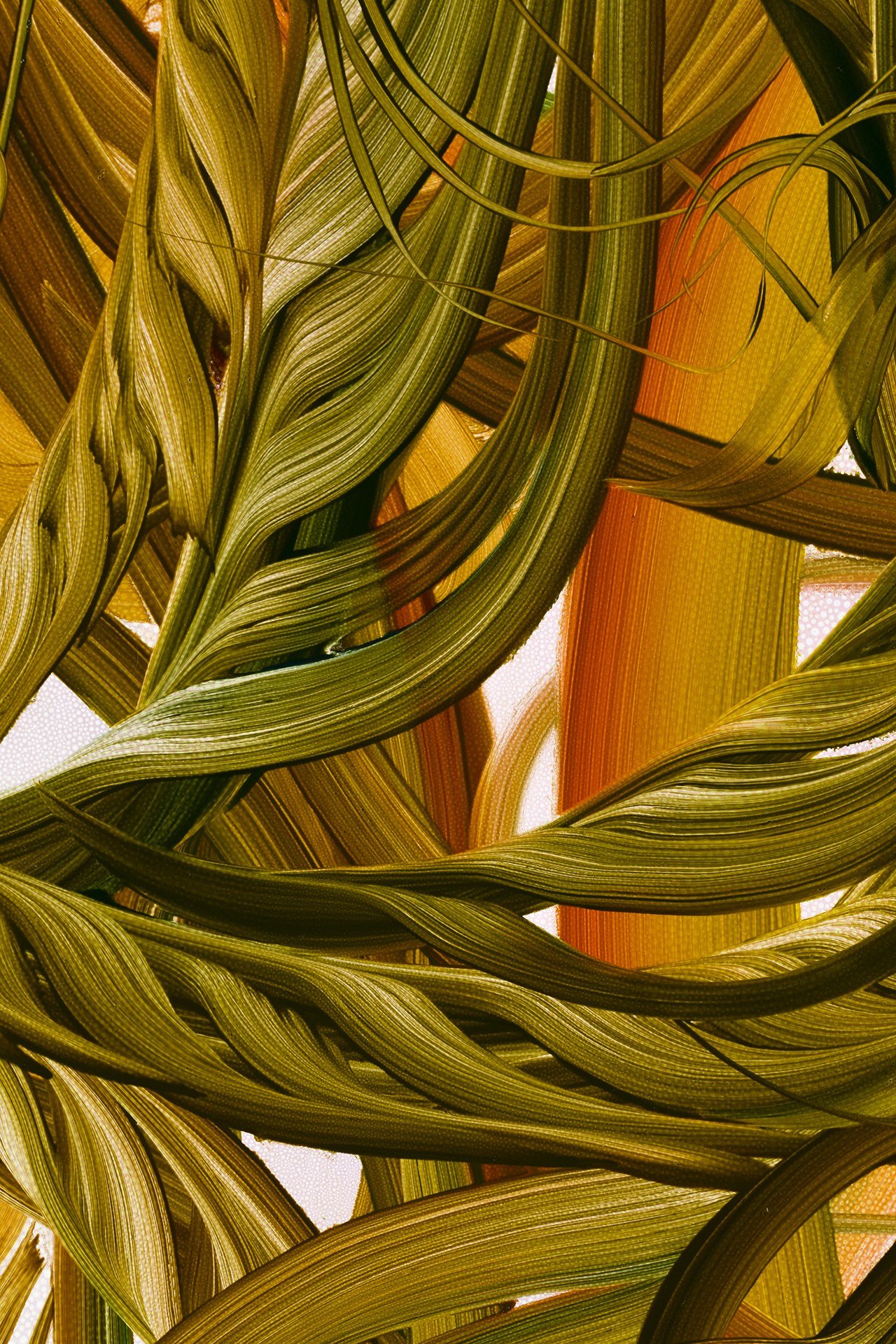
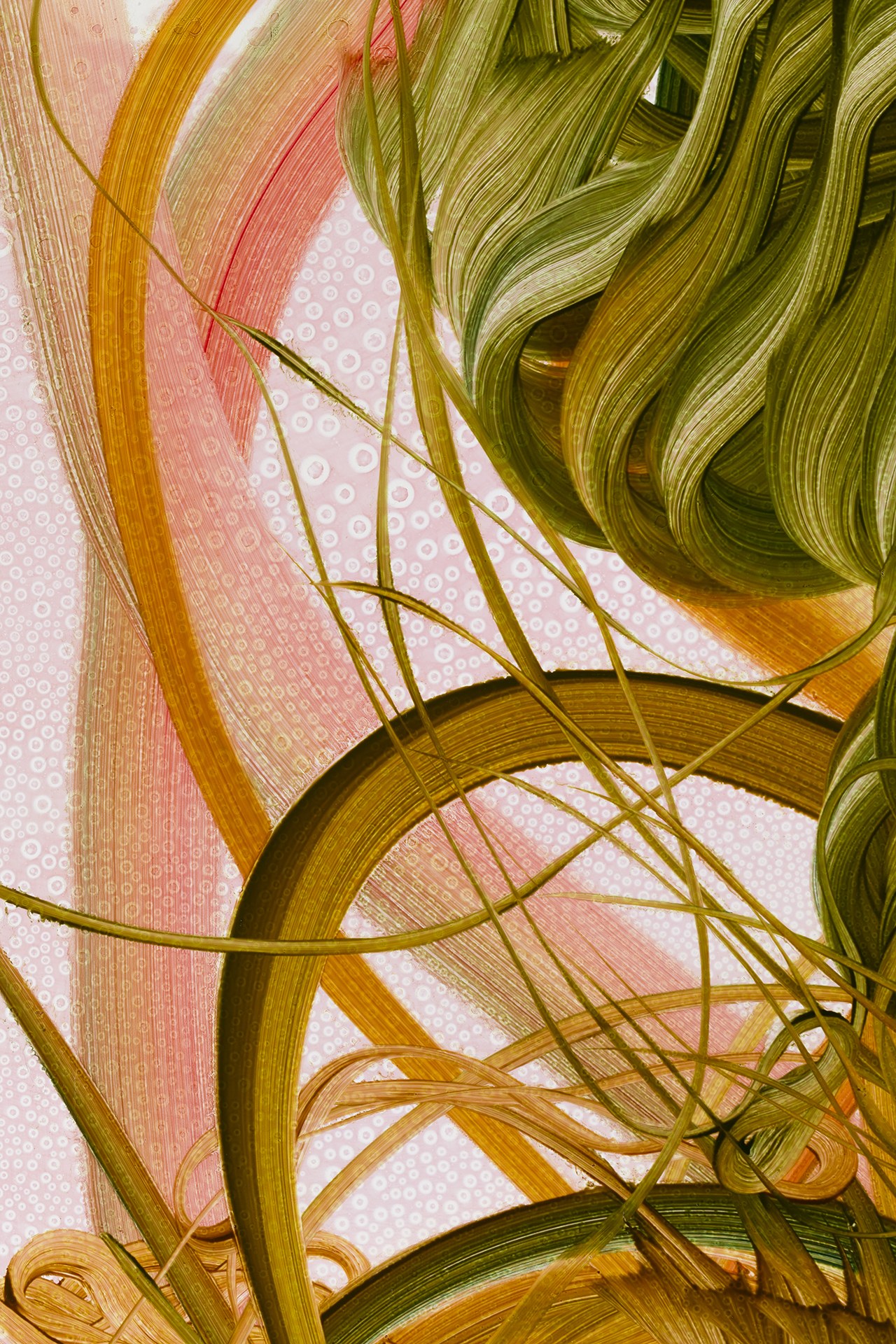
Edyta Hul's paintings are stretched between organic abstraction and the world of natural forms evoking underwater and terrestrial flora and fauna. In her proprietary technique, the artist combines oil paints with industrial enamel, which allows her to achieve unprecedented depth and a smooth finish on the canvas. An important aspect of the creative process for the artist is gesture, the metre of which is determined by her own body and state of mind. The final composition captured in the foreground is always created on a single day to capture a rhythm unique to a particular moment in time.
Edyta Hul is the author of numerous solo and group exhibitions in Poland, as well as in the United States, Italy, Hungary, Germany and Denmark. The artist's works are in the collections of the Bielska Galeria BWA and the Stefan Gierowski Foundation in Warsaw, among others. Edyta Hul is represented by Piękna Gallery.
Selected solo exhibitions:
Savage System - Volery Gallery, Dubai, 2025.
Density of the Spell - Slag&RX Gallery, New York, 2025Something is in the Water - Bielska Galeria BWA, Bielsko-Biala, 2024
If you can, send rain - Zachęta Projects Place, Warsaw, 2023
Barren Land - MS44 Gallery of Contemporary Art, Swinoujscie, 2021
Nectar - Pilipczuk Gallery, Copenhagen, 2021
Currara - ABC Gallery , Poznan, 2021
Rose Water - Żak Gallery, Gdańsk, 2021
Medium - Art Hub Gallery, Lodz, 2021
Behold the Mirror, What Everything Guessed - open studio, Warsaw, 2020
Acid Earth - Secret Gallery, Gdansk, 2020
Elixir - Pilipczuk Gallery, Copenhagen, 2020
Solitude of the Forest - New Era Art Gallery, Cracow, 2017
Zoomorphic Images - Pionova Gallery, Gdansk, 2012.
Selected group exhibitions:
Post-competition exhibition "Bielska Jesień Biennale", Bielska BWA Gallery, Bielsko-Biała, 2023
Kunstnernes Efterarsudstilling 2022 - Den Frie Centre of Contemporary Art, Copenhagen, 2022
Living Through The End Of Nature - duo exhibition with Italian artist, UMA Gallery/Novara/Italy, 2022
From "Abstraction" To Abstraction - international group exhibition, Stefan Gierowski Foundation, Warsaw, 2022
Power of Plants - Polish-Hungarian group exhibition, Mank Non Profit / Mank Gallery, Szentendre/Budapest, 2021
Herbarium novum. Efflorescentiae - BWA City Gallery, Bydgoszcz, 2020
Nowy Obraz Nowe Spojrzenie - Galeria BWA Miejski Ośrodek Sztuki in Gorzow Wlkp, UAP in Poznan, 2014.
Awards/Achievements:
Grand Prix of the Bielska Jesień 2023 Painting Biennale.
#18 position in the ranking Compass of Young Art 2021
Honorable mention in the Eugeniusz Eibisch Foundation competition, Warsaw (2018)
Honorable mention in the competition Disruptions / Umwelt - Solvay Center for Contemporary Art, Krakow (2018)
Artist Residencies:
Artificialmente Naturale - UMA Gallery Milan, Italy (2021)
Q21 - MuseumsQuartier Artists-in-Residence, Vienna, Austria (2019)
Pieńków International Artist Residency, Marek Maria Pieńkowski Foundation, Pieńków (2018)
Works in Public Art Institutions:
Stefan Gierowski Foundation, Warsaw
Bielska Galeria BWA, Bielsko-Biala
Q&A
Garden of Curiosities - 5 questions for Edyta Hul
Q: How was this painting painted?
Edyta Hul: That's what almost everyone asks when standing in front of huge canvases with amazingly smooth textures. The technique in which Edyta Hul paints is not known to anyone, and the artist herself, finishing her work, is never sure what she will find in the studio in the morning. The huge-format works are painted flat using the author's mixture of paints and liquid materials, which enter into chemical reactions with each other, eventually solidifying into paintings.
Q: It takes days, weeks, or perhaps hours for a canvas of this scale to become overgrown with tangled organic forms, varied to the finest tonal transitions? How do you get to the point where a whole thicket of plans is created on the painting, but the structure of the work remains luminous as if it were polished?
E.H.: It takes me the most time to prepare the sub-images. I hate bought canvases, ready-made ones. I have to be in the process from the very beginning - the linen is stretched by hand, and there must be ten more thin layers of paint under the painting, so that there is not even a trace of weave on the surface. When each of these stages is perfected, I have the confidence that this final coating, which is the painting, will look perfect. I think that the very treatment of this matter says a lot about a person, how much he is able to sacrifice for this work and how long he is able to search, to delve into it until it is perfect.
Q: And this final shell - is it created in many days, as in the case of deeper layers, or is it the result of a moment of expression?
E.H.: It has to be ready one day. I adhere to the principle that a painting should be finished as soon as possible, especially when you transfer your gestures, the energy of your own body, the movements of your wrists, your spine. Later, perhaps the very next day, one is in a sense a different person, and some gestures can no longer be returned to naturally. Another gesture marks the border like a foreign layer.
Q: There are times when you are not satisfied with some technological result?
E.H.: There is a lot of waste in such a mode of experimentation, but that's what exploration is all about, trying to control a reactive, wet matter in which anything can happen. I've always had a knack for tinkering, a need to work on the singularity of some material. I often wonder what to call it, and think only of the reward. It's like I find a prize in the studio in the morning.
Q: You create simultaneously in three painting series, the most mysterious of which seem to be abstract clusters in olive-brown colors. Some see in them plant shoots, others multiplied fins, bodies or animal tails....
E.H.: I've always thought of it as abstraction, although it's more a kind of individual gesture, like handwriting or a personal language. When I work on a painting, I work with my whole body - there must be harmony and fluidity in it like in a dance. I like movement, so this painting is created from my energy. I grew up with my grandparents in Warmia, in a natural environment, but I also collected plants for a long time, so they were always with me. In the world of plants a lot interests me aesthetically, but nature also replicates itself perfectly and continuously. These are certain rhythms that repeat in my painting as well. There is an entanglement, and at the same time a balance.
Q: Your paintings can be disturbing... or soothing?
E.H.: I think it's more the former, though, because it's not entirely clear whether they show a plant world or one that also consists of fins, tails, eyes... It doesn't ring out in all the paintings, but I feel that through these animal elements in the painting, hybrid forms are created rather. They are like a garden of curiosities, another puzzle.