Dimensions: 150.7 x 101.3 cm
Provenance
Poland, private collection Cracow, collection of the artist's heirs owned by the artist
Exhibited
Warsaw, Spectra Art Space, Andrzej Wróblewski. I One of Many, 28.12.2024 - 4.05.2025. Venice, Procuratie Vecchie, Andrzej Wróblewski (1927-1957) (accompanying exhibition to the Biennale di Venezia), 20.04-24.11.2024. Ljubljana, Moderna Galerija, Andrzej Wróblewski. Waiting Room, 15.10.2020 - 10.01.2021 .
Reproduced
Ziolkowska M., Grzybala W. [eds], Andrzej Wróblewski. Exhibiting, published by Hatje Cantz/ Andrzej Wróblewski Foundation, Berlin - Warsaw 2024, il. P58, p. 184; il. 11, p. 212. Ziolkowska M., Grzybala W. [eds.], Andrzej Wróblewski. Waiting Room, published by Hatje Cantz/ Andrzej Wróblewski Foundation, Ostfildern-Warsaw 2020, il. 172, s. 301.
Literature
Ziółkowska M., Grzybała W. [eds], Andrzej Wróblewski. Exhibiting, published by Hatje Cantz/ Andrzej Wróblewski Foundation, Berlin - Warsaw 2024, pp. 184, 205, 212.
Andrzej Wróblewski's work from the period of the Thaw occupies a special place in the history of Polish art. Unlike many artists of that time, who tried to express social commitment in a direct and declarative manner, Wróblewski used a subtle language, deeply reflective and devoid of common literalism. In his art, the drama of everyday life gains the dimension of a metaphor - a quiet but poignant commentary on the human condition in postwar reality. The artist creates a vision of a world suspended between stagnation and expectation, in which the characters persist in a state of "in-between." - trapped between the hope for change and the awareness of its impossibility. It is this spiritual, existential pause that has found its fullest expression in the famous series of "The Stunted" - a mesmerizing inventory of waiting rooms, queues and stunted people, or stagnant people, more specters than figures. "It is in the waiting room that life takes place exposing the inert materiality of its surroundings and the barrenness of its mental economy. (...) The waiting room, as a stage for coining and waiting, foreshadows what is to come," write Wojciech Grzybała and Marta Ziółkowska (Grzybała W., Ziółkowska M., The Waiting Room as a pre-dawn, [in:] Andrzej Wróblewski. Waiting Room [exhibition catalog], Andrzej Wróblewski Foundation, Adam Mickiewicz Institute, Warsaw 2020, p. 2).
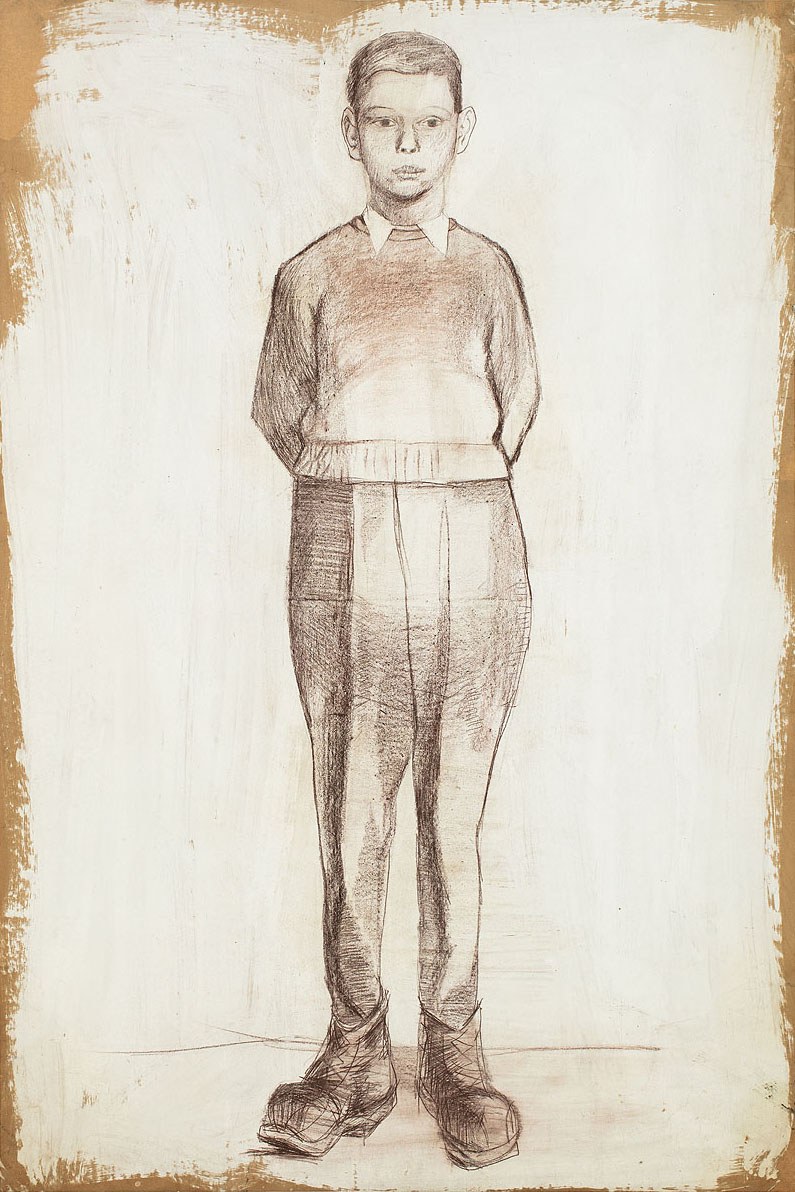
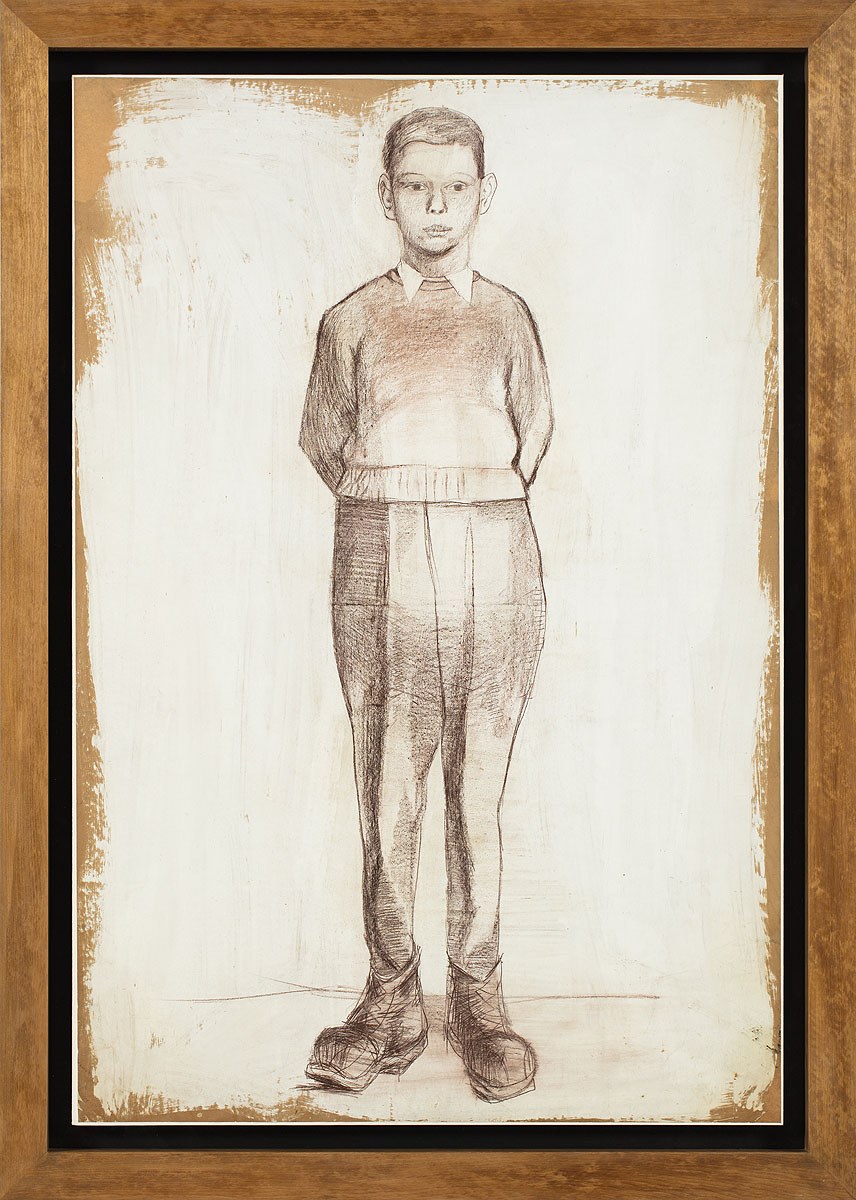
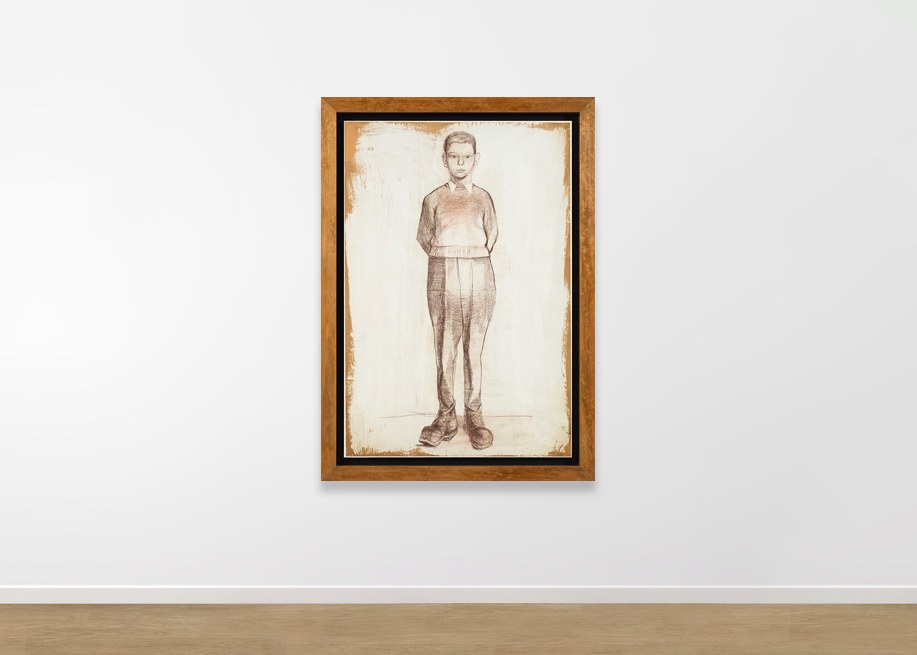
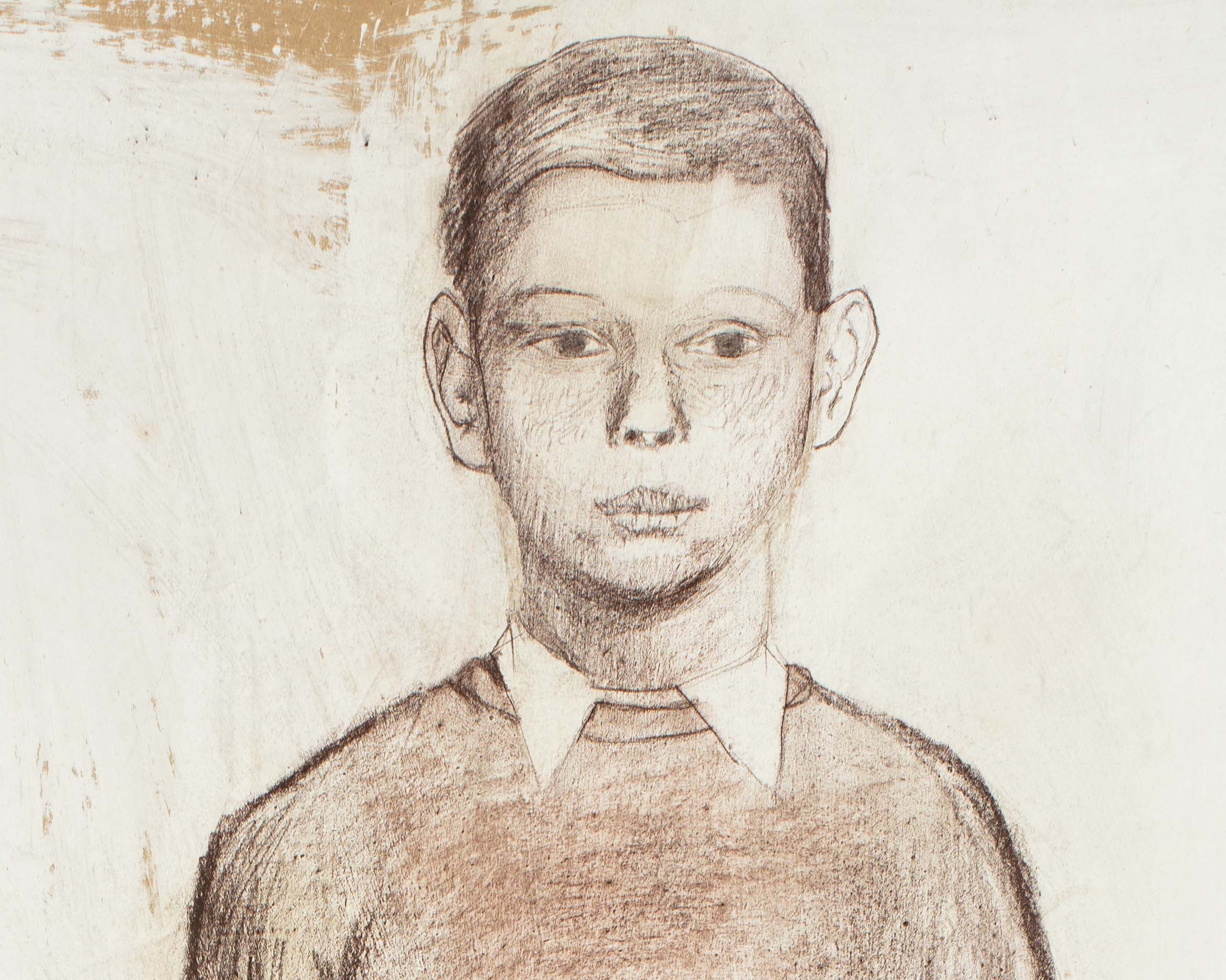
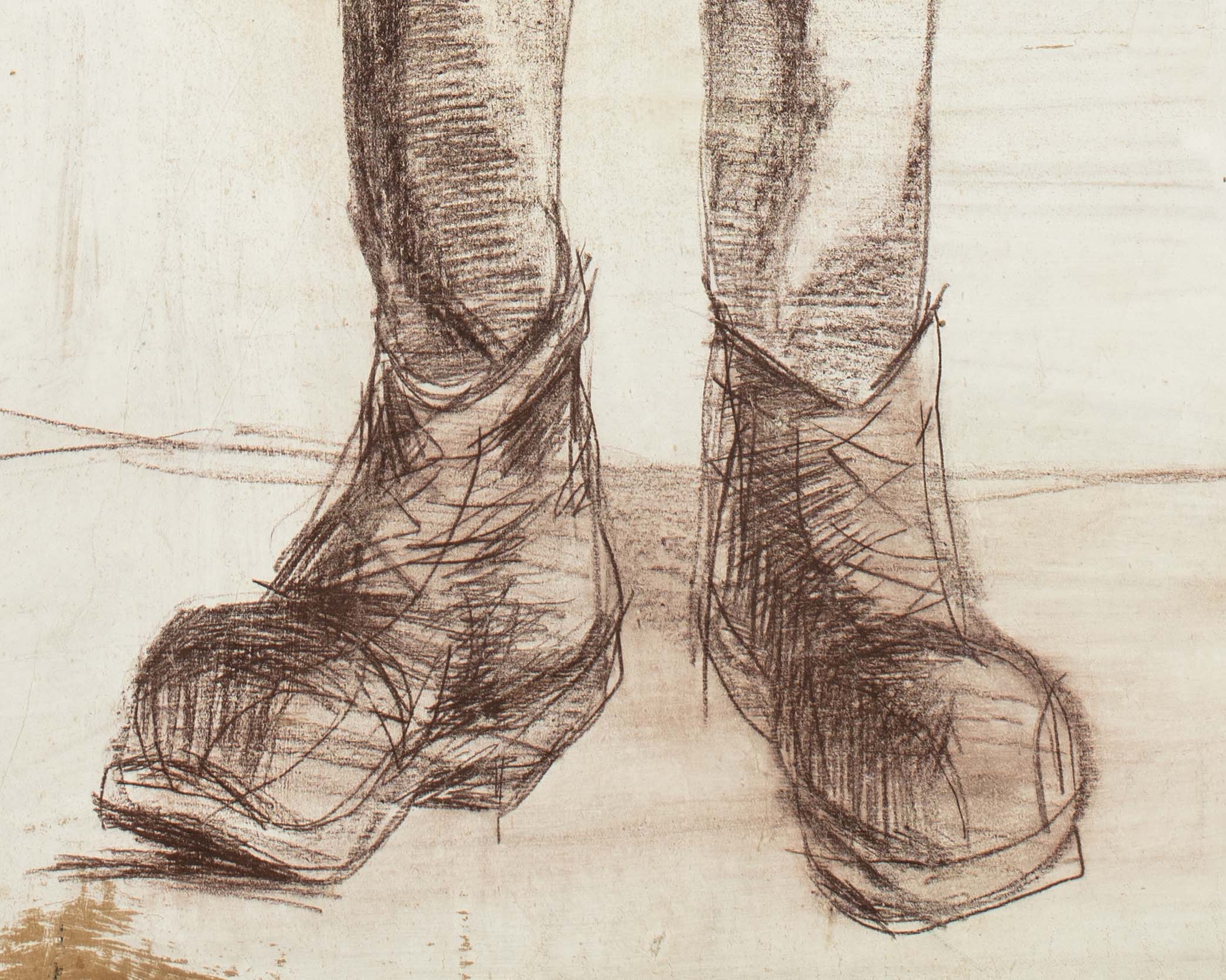
The presented Boy on a White Background, dating from around 1955-56, is one of Wróblewski's largest works realized on paper. The work fits in with the content of the "waiting room mentality," one of the last themes explored by the artist. The painting shows a teenage boy standing with his hands folded back, in an empty space, against a white wall. What draws attention is the model's clean, neat, impeccable clothing - a white collar sticking out from under a sweater and pressed pants, contrasting with massive shoes. He is one of the most mysterious characters in Wroblewski's play. Upright and calm - yet frozen, motionless, lingering in a deafening timelessness, waiting for something, for someone, for a change - for better times?
After 1954, the painter returns to the motif of the teenage boy, present, among other things, in his famous "Rostering" series. He depicts him several times - standing, lying down, accompanied by an ancient sculpture - and uses a variety of techniques: oil, watercolor, gouache, drawing. It is the boy's figure that he chooses to represent the artist at the 1956 "Junge Generation" exhibition in Berlin, also known as the "little Arsenal." At that time, he sends "Boy on a Yellow Background" (1956), a painting that is completely new, implying the perspective of an adolescent boy. "He is a teenager and stands against the yellow wall of the studio, now alone, although he has already appeared in a group of executed people, a family, amidst a scattering of ownerless jackets. He stands at a stop, against the wall, next to the statue of Gudea. Alone. In Wróblewski's work, this is a subject previously unrecognized on such a scale (...)" - reads the introduction to the catalog of the artist's exhibition in Ljubljana (Grzybała W., Ziółkowska M., Poczekalnia jako przedświt, [in:] dz. cyt., p. 4).
The offered work is an important, monumental work, supplementing the knowledge of the artist's oeuvre. It belongs to the still insufficiently explored drawing works of Wróblewski, which he himself called "humble viewing of life" (Wróblewski A., Introduction to the exhibition of my drawings, [in:] Exhibition of works by Andrzej Wróblewski, catalog no. 28, Polish Writers' Club Warsaw 1956, n.p.). The composition in a sublime way, sparing in painterly means, exposes to the foreground a young man and all his uncertainties and problems.


![Andrzej Wróblewski (1927 Wilno - 1957 Tatry), Pieta [szkic do Dziewczyny z misiem], przed 1946](https://img1.one.bid/img/9405/2906905_1w.webp?1770315196)


![Andrzej Wróblewski (1927 Wilno - 1957 Tatry), [Kompozycja ze skrzypcami 52] oraz [Martwa natura nr 52] - praca dwustronna](https://img1.one.bid/img/8677/2606337_1w.webp?1757524167)