


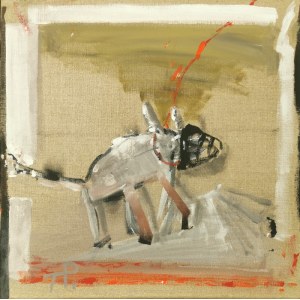
oil, canvas; 50 x 50 cm;
Signed l. d.: TP. (initial bound);
Inscribed on the back: TERESA PĄGOWSKA 1996, II/96 / 50 x 50 cm, "PIES ON A SNURK".
"Let's start from the beginning. From nailing the canvas onto the stretcher. It must be stretched perfectly. When a painting is to be so ascetic, every last detail counts. The gray linen canvas is covered with glue, but even then the color can appear. There will be no backing, because the gray of the canvas is a great and desirable property of the resulting painting. Let's begin again, starting with the painter herself. The most important thing is simplicity. Simple dress and the way of expressing thoughts - this is how Boguslaw Deptuła begins the essay in the catalog of Teresa Pągowska, and it is summed up by the author of the paintings herself: I think longer than I paint."
Teresa Pągowska's description of the world in her figurative paintings is preceded by a deep analysis of the subject, often simplified to an anonymous figure, and then the form. The form both in the form of a stencil used for the initial development of the composition or its analysis, as well as the choice of the appropriate painting form, a glaze, a delicate, almost invisible brushstroke, or, as in the case of the offered canvas of earth colors, an accent of the favorite black and white.
About the creative process, which in the case of Teresa Pągowska's works is not marked on the canvas, for example, in aggressive brushstrokes, but remains only in the artist's consciousness as her internal struggle, measuring herself against the subject, imagination, reason. Boguslaw Deptula writes: "There are paintings that are born in the course of the artist's fierce struggle with resistant matter and bear the stamp of the struggle. Burdened with layers of paint, with traces of corrections, sometimes even holes, they carry the burden of existence. Pągowska does not allow herself to do so. What can be seen is pure essence. Traces of the sublimation process are not revealed. They are left in it. When something finally appears on the canvas, it apparently irrevocably should have been there."
The impulse for Teresa Pągowska to create is an experience, which she calls a reason. In an interview with Elżbieta Dzikowska, she says: "There is an experience that I call a reason. And since I have nothing of the reporter in me, I have to deepen this outline of experience in myself, live with it for a long time, so that it takes on flesh, so that it becomes a must. And immediately I look for a form. Because, after all, with us painters, everything is born from the eye and the head at the same time. The imagination sees and gives shape to the experience."










Paskutiniai peržiūrėti
Prisijunkite, jei norite pamatyti pozicijų sąrašą
Mėgstami
Prisijunkite, jei norite pamatyti pozicijų sąrašą