Dimensions: 50 x 40 cm
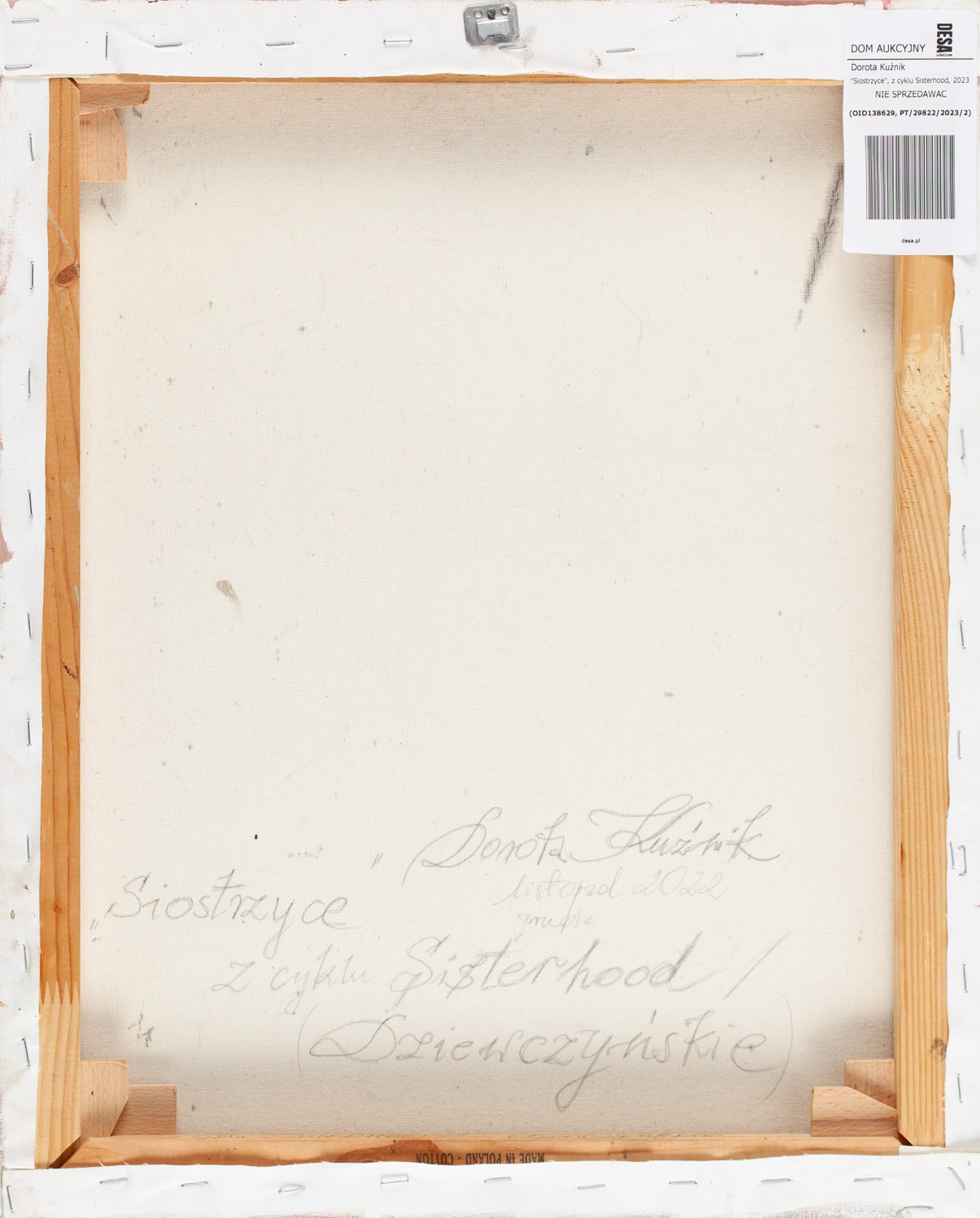
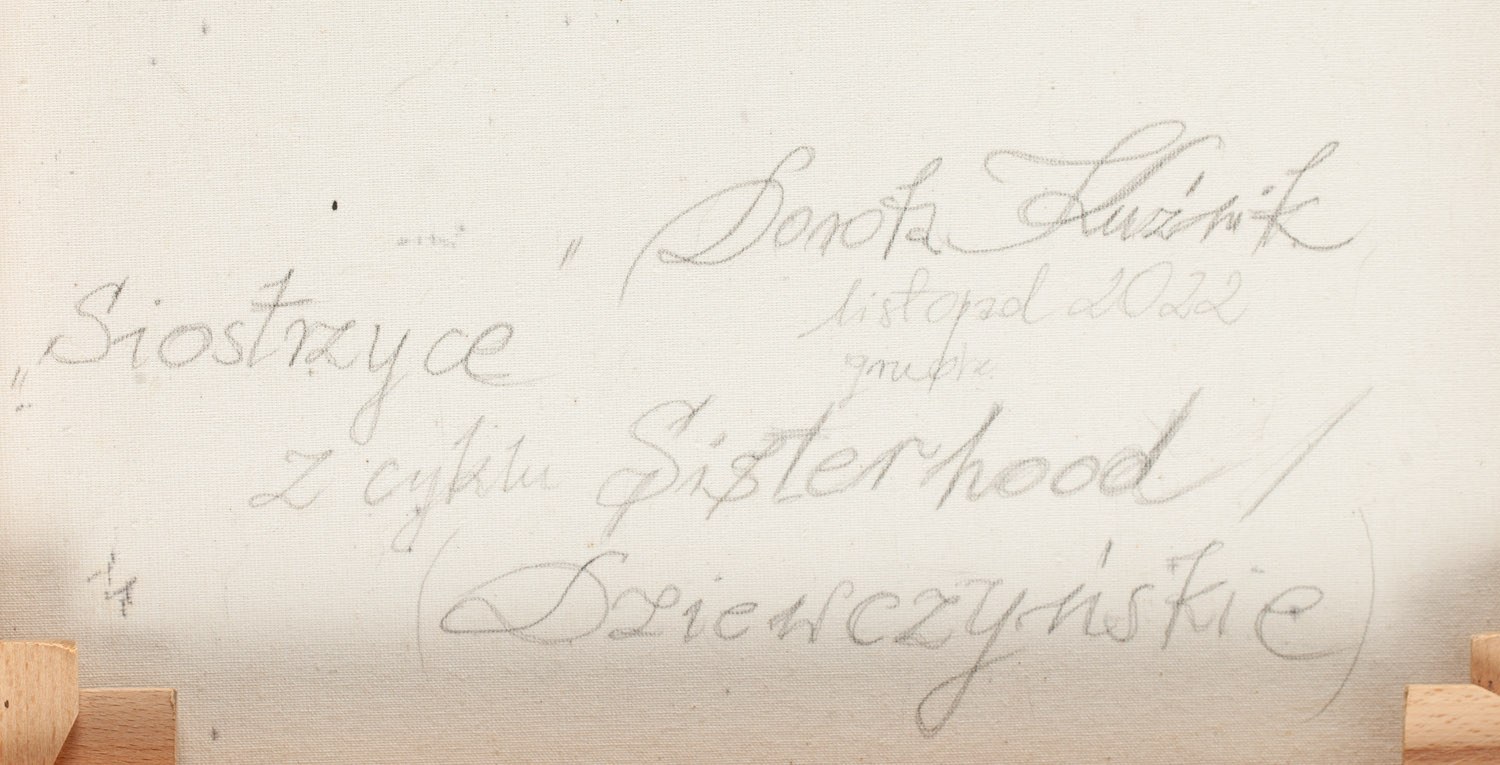
signed, dated and described on the reverse: 'Dorota Kuźnik | November 2022 | "Sisterhood" | from the series Sisterhood | (Girlhood)'.
Literature
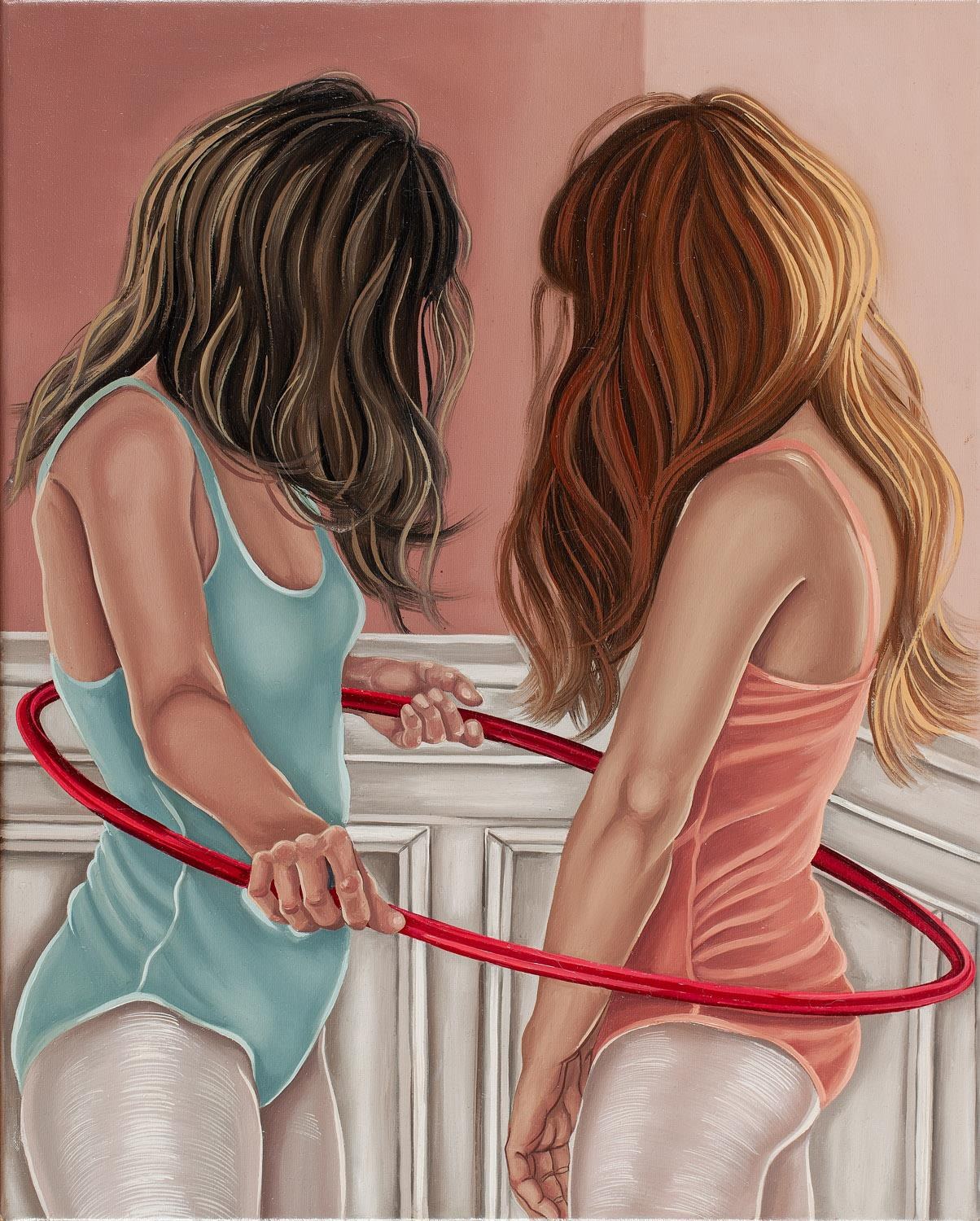
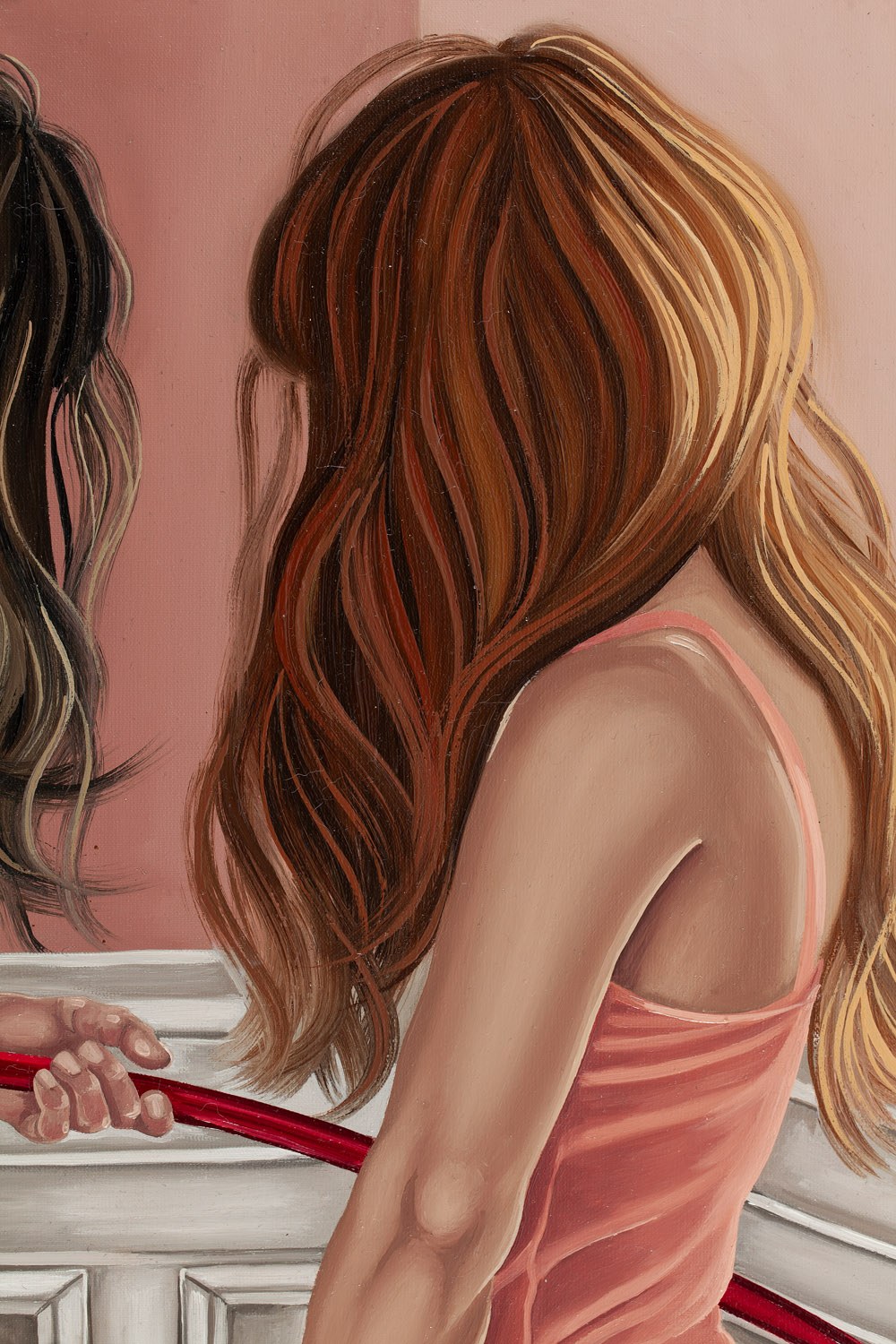
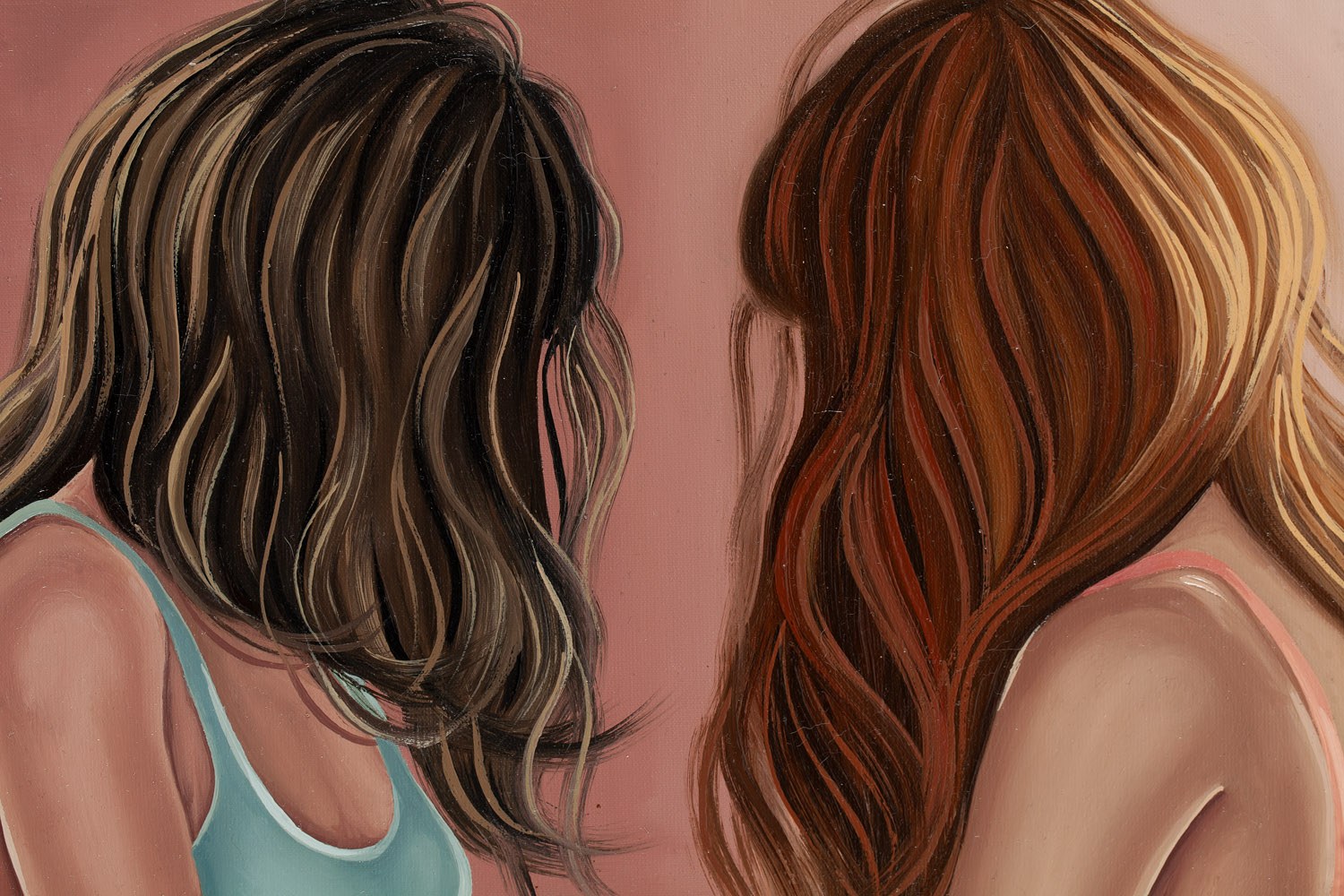
The painting "Sisterhood" is a work from the SISTEHOOD series - a series about the idea of sisterhood, togetherness, understanding, support and solidarity between women, and at the same time about the intimacy of girlish relationships, tender relationships of little girls, but also about bittersweet relationships between them. In them, I reach for the motif of children's game and play, as a metaphor for adult life on a diminished scale. The motif of children's game and play is only a pretext for illustrating certain universals of women's reality, the condition, role and status of women in contemporary society.
In it, I show how restrictive and crippling cultural patterns, familiar to us from our earliest childhood games, rules, conventions and principles of social functioning, internalized and internalized by women in the process of socialization, symbolized here by innocent childish play, prepare us for future social roles and rules of social functioning in a competitive culture. The image can be read as an expression of resentment and disagreement with the systemic oppression of women in a culture constituted on principles derived from the patriarchal symbolic order, as an ironic commentary on the training and subjugation already potentially present in the bodies of little girls and young girls, adult women.
On the one hand, the painting expresses a longing for female circles and sisterhood - symbolized by the figure of the circle, circles and here in the painting, in a literal way, a circular hoop used as a hula hoop toy and a gymnastic exercise device - on the other hand, I point to a certain utopianism of the project and the idea of sisterhood. The above image also says that relationships between women are much more transformative, teaching closeness and allowing for greater solidarity than male-female relationships. However, I am under no illusion that the idea of sisterhood at the level of mere declaration is insufficient and needs to be made a reality by seeking good practices of sisterhood in everyday life.
Sisterhood, women's circles and community is a project and idea that is difficult to realize in a culture based on competition, in a world that seeks to divide women rather than unite them, and urges and socializes them to compete and compete with each other. I don't mean to idealize reality by reaching back to concepts of female community that belong to the past, sitting in the circles of women in rural communities, which were also far from ideal and sincere relationships based on solidarity, rather doomed to each other forced to accept each other. I am more concerned with such a realistic community, in which there is room for non-ideal women, with different worldviews, coming from different, often antagonized backgrounds.
A good, proper circle of women's community is based on difference, diversity, acceptance, understanding and trust. This is not an idealized, facade image of gorgeous sisters chanting, meditating and performing their rituals of womanhood by moonlight. It's about working on reality and the mundane of life and not tinkering about how it's ideal women uniting under the common banner of sisterhood in unison and with one tone proclaiming hype slogans and principles of sisterhood at the level of proud and hype declarations. Building real relationships is difficult, far from idealized models, because everyday life and reality verify the slogans of common cause proclaimed at the level of declarations ("Sisterhood is Powerfull". "Sisterhood is Global". "Sisterhood is Forever"). The difficulty in practicing sisterhood is that women in our culture are socialized to compete. It is not a matter of repeating and mantraing the noble slogans of sisterhood as a political idea, but realizing them on a practical level, implementing them and embodying them as everyday practices of ordinary daily life.
Although the word sisterhood, which is being pronounced in every way in the social debate and is gaining popularity, is only just paving its way in the practice of everyday life, and the need for women to support each other is not so obvious. Changes and breakthroughs, however, seem to be increasingly visible on the street, but also in the public, political and social area of women's functioning. The longing for sisterhood, for fellowship among other women, should be satisfied in a conscious way by way of common concrete goals. The point is to show that sisterhood is not a utopia because here and now there are environments and worlds where it is more often practiced, it is also about learning to practice it. We all have experiences of being in women's circles - in social bubbles where they are only declarative, everyone has an apparent sense of belonging declared.
It is important to expand the practice of sisterhood toward other women, not just to practice it in small bubbles and local communities of women of different social and financial status and to build role models. The idea of sisterhood can be developed, expanded, practiced more often, not only at the declarative level but through the application of good sisterhood practices and the possibility of drawing ready patterns of cooperation from mothers, aunts, grandmothers. The practice of sisterhood is a cognitive effort, it requires tolerance, attentiveness, control, forbearance in the way we think about women and perceive and treat them, it requires self-reflection and self-criticism."
DOROTA KUŹNIK
Biography
Works mainly in oil painting on canvas and board. Graduate of the Faculty of Painting and Sculpture at the Academy of Fine Arts in Wroclaw, where in 2016 she received a master's degree with distinction in the painting studio of Prof. A. Dymitrowicz and multimedia studio of Prof. W. Pukocz. Graduate of German Philology and Postgraduate Studies at the W. Brandt Center for German and European Studies at the University of Wroclaw. Author of many solo exhibitions, and participant in group exhibitions. Nominated in 2015 to the second stage of the Painting Contest "POSITIONS" for the most interesting artistic attitude among students of the faculty: Painting at the Eugeniusz Geppert Academy of Fine Arts in Wroclaw. She is a laureate of Honorable Mention in the 27th National Youth Painting Review "Promotions" in Legnica and a finalist in the 5th Triennale of Contemporary Painting "Autumn Confrontations", Rzeszów 2019, where she was among 15 artists nominated for the award. Laureate of the honorable mention of the Podkarpackie Society for the Encouragement of Fine Arts 6th Triennale of Contemporary Painting "Autumn Confrontations", Rzeszów 2022. Two-time finalist of the 4th and 5th All-Polish Leon Wyczółkowski Painting Competition in Bydgoszcz in 2020 and 2022 , finalist of the 1st All-Polish Krzysztof Grzesiak Painting Competition, Pressure Tower, branch of the Museum in Lębork. She has participated in the YICCA International Contest of Contemporary, as well as the 16th Warsaw Art Fair in Kubicki Arcades and the 18th and 19th Warsaw Art Fair in EXPO XXI Warsaw-International Fair and Congress Center.
The main subject of Dorota Kuźnik's paintings is a woman. The essence of these female images is an attempt to depict what makes up femininity, defines it, determines its status, social and cultural condition and the roles it plays in the contemporary world. In the wide range of female images, the figure of the androgynous woman occupies next to the mother woman and the theme of motherhood and the idea of sisterhood and sisterhood. In addition to the subject matter depicting motherhood, she also creates a positive model of femininity realized outside of motherhood. In the images of seemingly silent women, shown in stolid poses, there seems to be hidden an attitude opposing being a victim of destiny, a vocation to fulfill the social role of mother and motherhood ascribed to them, as the only legitimate possibility of realizing and manifesting their femininity.
The embodiments of femininity present in her paintings are portraits of women, in which she does not focus on rendering a vision of conventional beauty, but rather on shedding attributes considered feminine. Entering into dialogue with post-feminist discourse, she attempts to reinterpret the concept of femininity in painting based on model representations of femininity, ideal, objectified representations of woman traditionally depicted in images of women in painting, thus redefining the position of women functioning in their traditional socially and culturally assigned role. She willingly reaches for subversive strategies. However, this is not extreme feminist interventionism and activism.
By establishing a dialogue with the legacy of ancient art, she reinterprets the language of iconographic patterns of painting of the past. In her paintings, she creates an image of women, inspired stylistically and formally by medieval and early Renaissance painting and the iconographic language of painting of the past. He also refers to the traditions of coffin portraiture, double portraiture and the conventions of photographic portraiture of the Victorian era. Using the motif of the double portrait, she refers to the DUALISM of body and soul, beauty and ugliness, bloom and decay, youth and old age, and finally life and death - a motif that invariably appears in my work. Dorota Kuźnik's work is characterized by the idea of combining established formulas, schemes and conventions of ancient painting imagery with contemporary iconography. Kuznik creates visual connections between classical European painting and the visual sphere of the 21st century. The artist tells how this strategy is reflected in her painting technique: "Over time, I became increasingly fascinated with painting that emphasizes the plane, its flatness, devoid of allusion and illusion, without classically built illusionistic space, without perspective that evokes the illusion of depth. Entering into a dialogue with the hallowed centuries-old Albertan tradition, the post-Renaissance convention of easel painting, I created a series of paintings inscribed in the trend of painting with modernist origins, focused on its inherent constitutive features, such as flatness, painterly matter, abstractness linked to optical illusion. The affirmation of the objectivity of the painting, the focus on its condition and status, and its liberation from conventional thinking about its essence became the starting point of my reflections on the possibilities of pictorial modes."
References to the canons of ancient painting are made on the principle of "letting go" to the grandmaster form, playing with and juggling conventions and patterns of imagery. The artist often enters into a dialogue with them, based on a reflective and sometimes even witty concept or postmodern joke, a playful transformation of tradition, which stems from a conscious creative attitude: "In painting, I am not only concerned with aesthetic values, but with pushing the image as a problem. In the creative process, I am constantly accompanied by the reflection whether the image in contemporary art is already only a response to the condition of contemporary painting and is only part of the current of activities that are a reaction to the crisis of the representation of painting and the old conventions of imaging, to the crisis of the ways of imaging sanctioned by centuries of tradition. I wonder whether in the present times, in the post-artistic, post-modern era, in the era of post-media painting, imaging in the era of electronic media, painting can only be a reaction to the revaluation and exhaustion of the old formula of representation and be reduced to a mere sum of self-reflection?" In this dialogue, he evokes historical forms of painting, motifs, topoi of ancient art, refers to philosophical reflections on the nature, status, possibilities and limitations of painting and image (board painting on a board covered with chalk mortar, icon technology, the post-Albertian tradition of painting understood as fenestra apperta, the polysemy of the mirror, Duchamp's ready mades, object trouve, Gadamer's reflections on the essence of art as a game), transforms their meaning in altered contexts. By inscribing "quotations" from the history of painting art into new narratives, I set in motion an open-ended yet precisely defined game of meanings.