


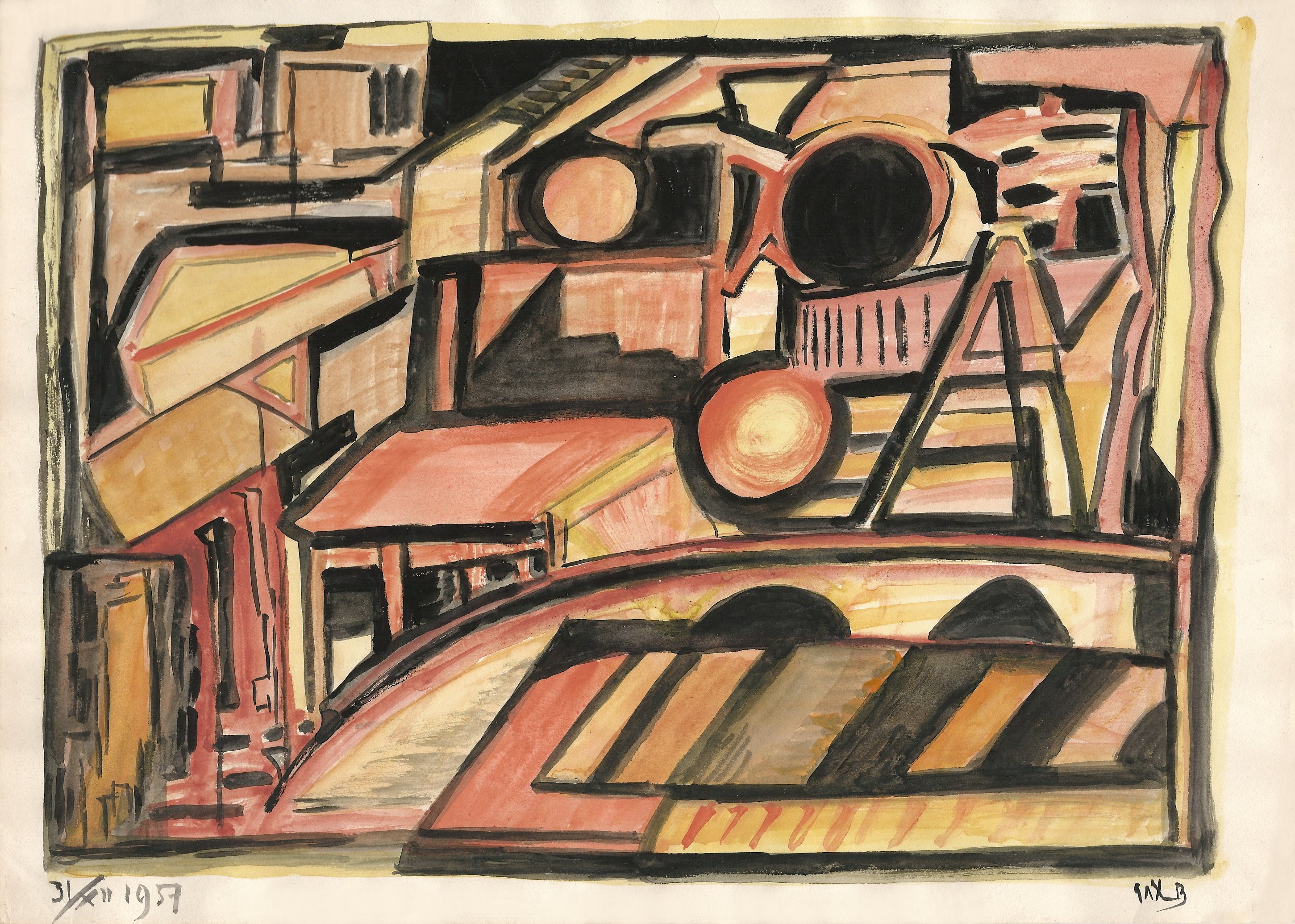
Wanda Ładniewska-Blankenheim (1903–1995)
Untitled, 1957
gouache on paper, 26.5 x 37 cm
dated lower left: 31/XII 1957; signed lower right: WŁB
She was born in Lviv in 1903, although later documents list the year as 1905. Starting in 1913, she attended the Juliusz Słowacki Gymnasium in Lviv, and later the Jewish Society’s Elementary and Secondary School. After receiving her high school diploma in 1922, she began her studies at the Faculty of Philosophy at Jan Kazimierz University. She studied Germanic philology and art history. During her studies, she met her future husband, Zygmunt Blankenheim, whom she married in 1928. She furthered her education in art history at the universities of Vienna and Graz, as well as at the Faculty of Architecture of the Lviv Polytechnic. In September 1932, she began working as a teacher of German language and literature at junior high schools in Lviv (the Jan Długosz Junior High School, the Śniadecki Junior High School, and the Dr. Adela Karp-Fuchsowa Junior High School).
When the war broke out, Ładniewska continued working as a teacher, while Zygmunt worked at the municipal power plant. They left Lviv in 1942, changed their last name, and settled in Rzeszów, from where they were forced to flee to Zakopane. On January 17, 1943, they were arrested, and in mid-March they were transported to Auschwitz. Wanda Ładniewska was held at Birkenau; thanks to her artistic talents, she worked as a draftswoman at a rubber cultivation laboratory in nearby Rajsko. When the decision was made to liquidate the camp, she was transported to Ravensbrück, Malchow, and finally Leipzig, from where she escaped and remained in hiding until the Americans arrived.
Although Ładniewska had lost all her relatives who lived in Lviv, and Zygmunt had died in Auschwitz in 1944, she decided to return to Poland and settle in Warsaw. On June 1, 1945, she began working at the Ministry of Education, but after a year she asked to be dismissed. In mid-1946, she left Poland and traveled to Paris, having previously applied for a visa to Ecuador—which she was granted—but she did not reach South America until 1951. She stayed there for no more than two months.
In Paris, she worked at *Gazeta Polska*, initially as a proofreader; over time, she became a critic in the culture section (she wrote reviews of exhibitions and films, conducted interviews, and kept the Polish community in France informed about artistic events in Poland). In 1950, she began studying sculpture at the Académie de la Grande Chaumière, specializing in clay sculpture and medal making. She participated in numerous exhibitions: at the Musée Rodin (1950), the Société des Artistes Indépendants (1958–60), the Salon de la Jeune Sculpture (1961–1963), the Union des Femmes Peintres et Sculpteurs (1965), and the Salon d’Art Sacré et d’Expression Spirituelle (1967–1971), the Daberkow Gallery in Frankfurt (1973), the Gutenberg Gallery in Strasbourg (1975), and on numerous occasions at the Paris Salon d’Automne (1963–1982). She had two solo exhibitions: at the Woodstock Gallery (1964) and at the Lambert Gallery (1969). The artist’s prints were exhibited at the Galerie de Villiers (1975).
Ładniewska was a member of all the major associations and organizations bringing together artists: Amicale des Artistes des Pays du Drouais, Association des Artistes Peintres et Sculpteurs Juifs de France, Fédération française des sociétés d'art graphique et plastique, Federation Internationale de la Médaille, Salon d’Automne, Société des Artistes Indépendants, and Syndicat National des Sculpteurs Statuaires Professionnels Créateurs.
The artist died in Paris in 1995. Her archive is housed in the collections of the Polish Library in Paris.











