


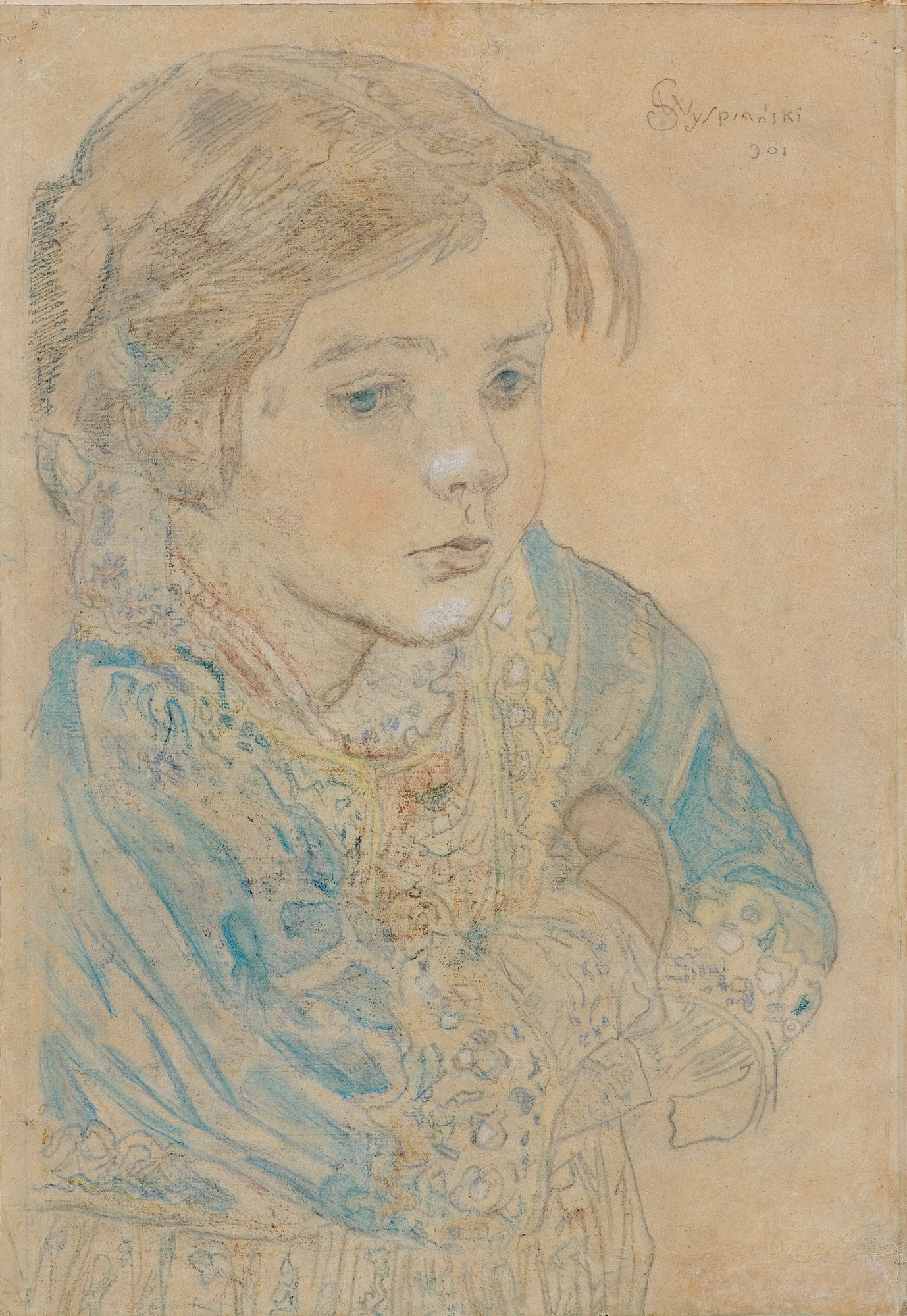
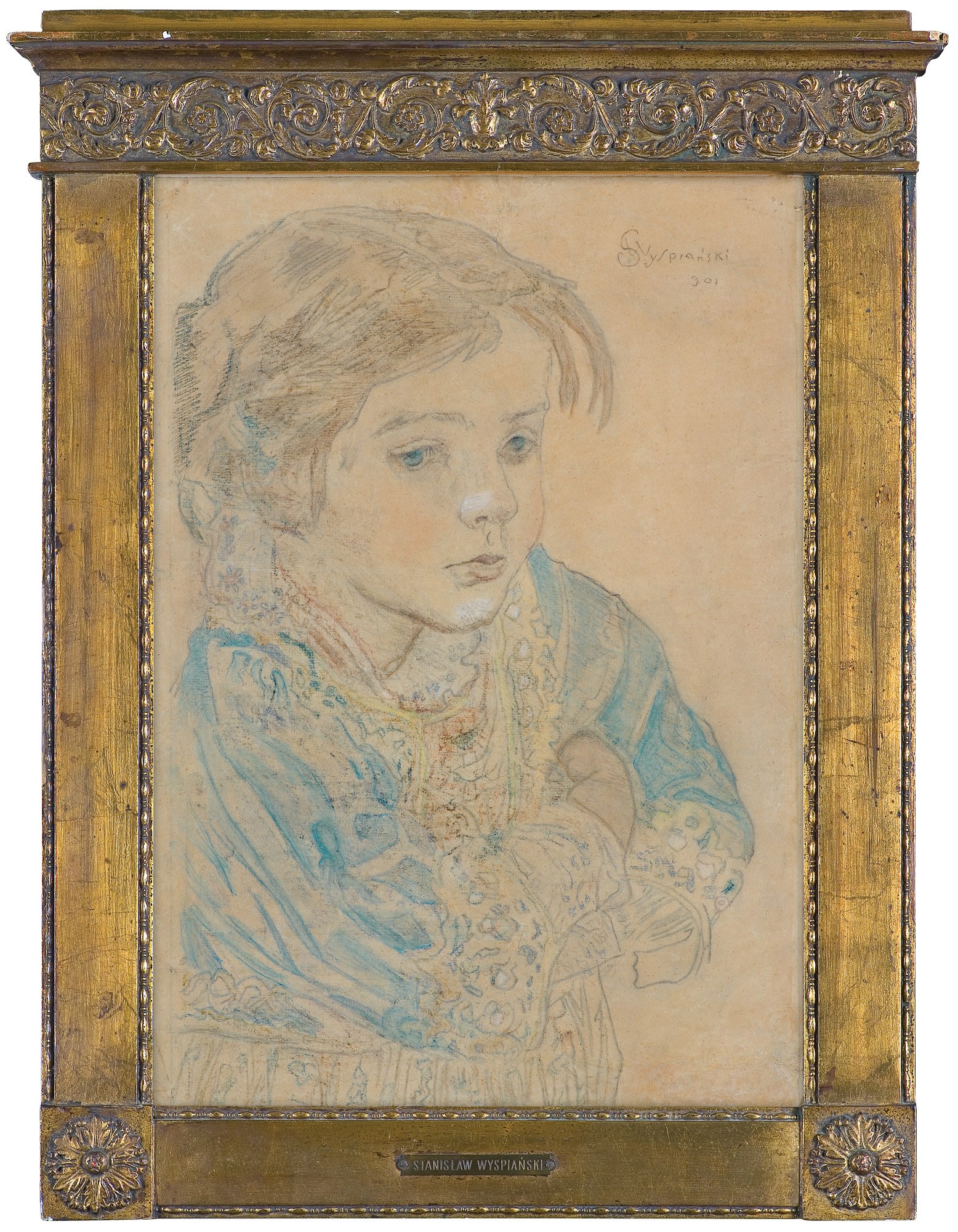
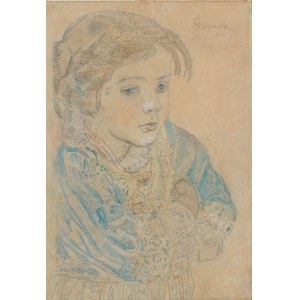
46.2 x 32.7 cm — pencil, pastel, paper glued to cardboard
signed lower left: SWyspiański | 901 [linked initials]
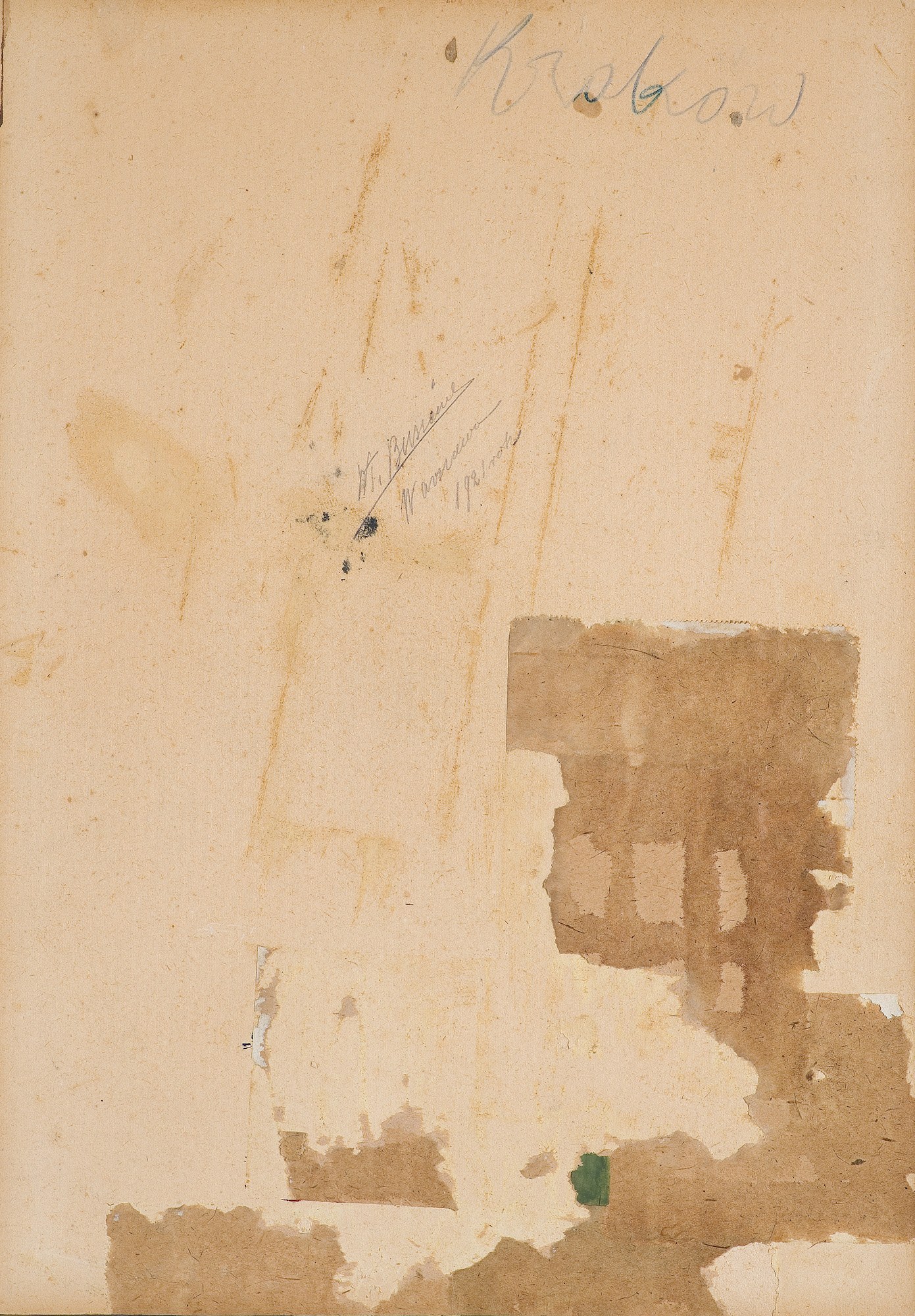
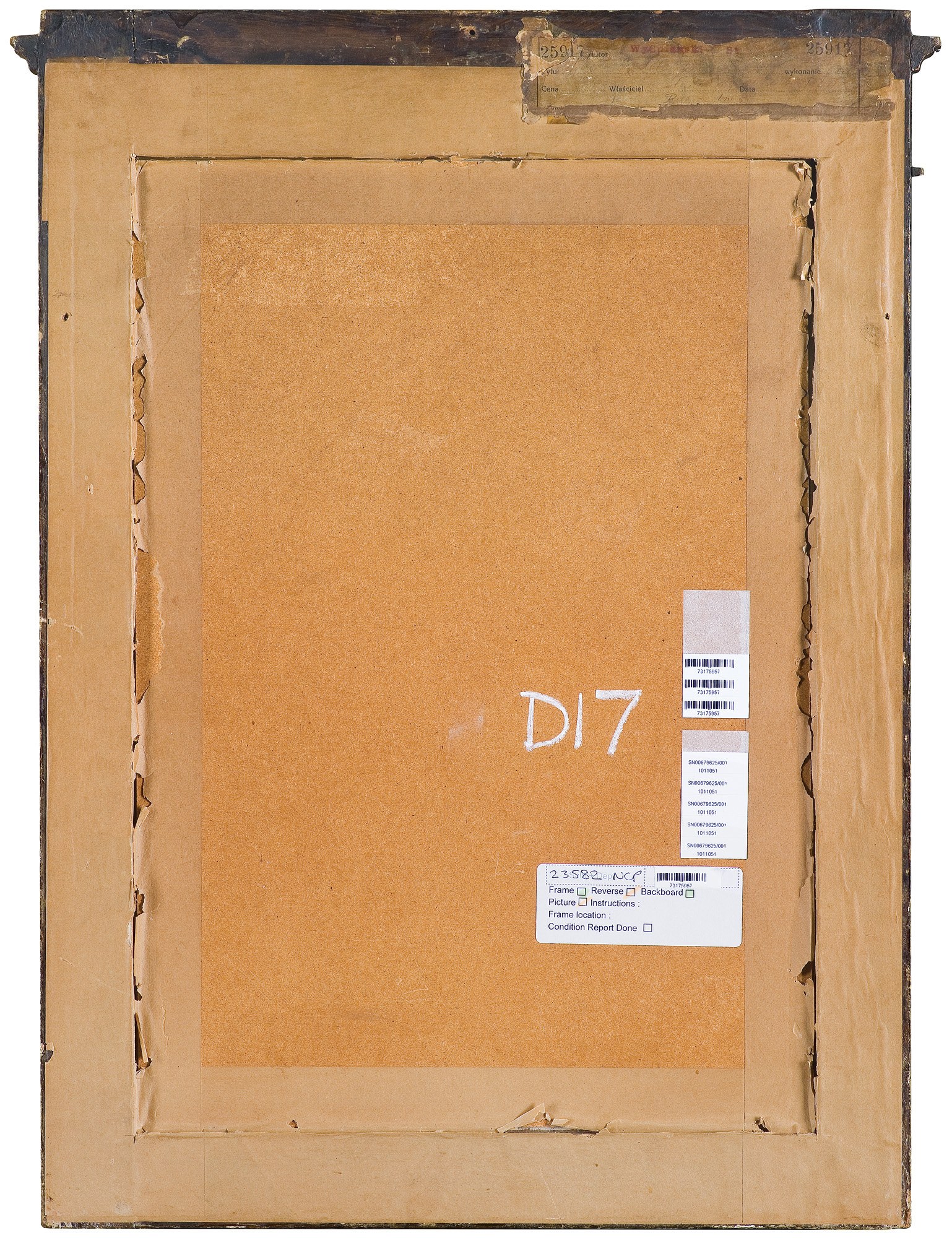
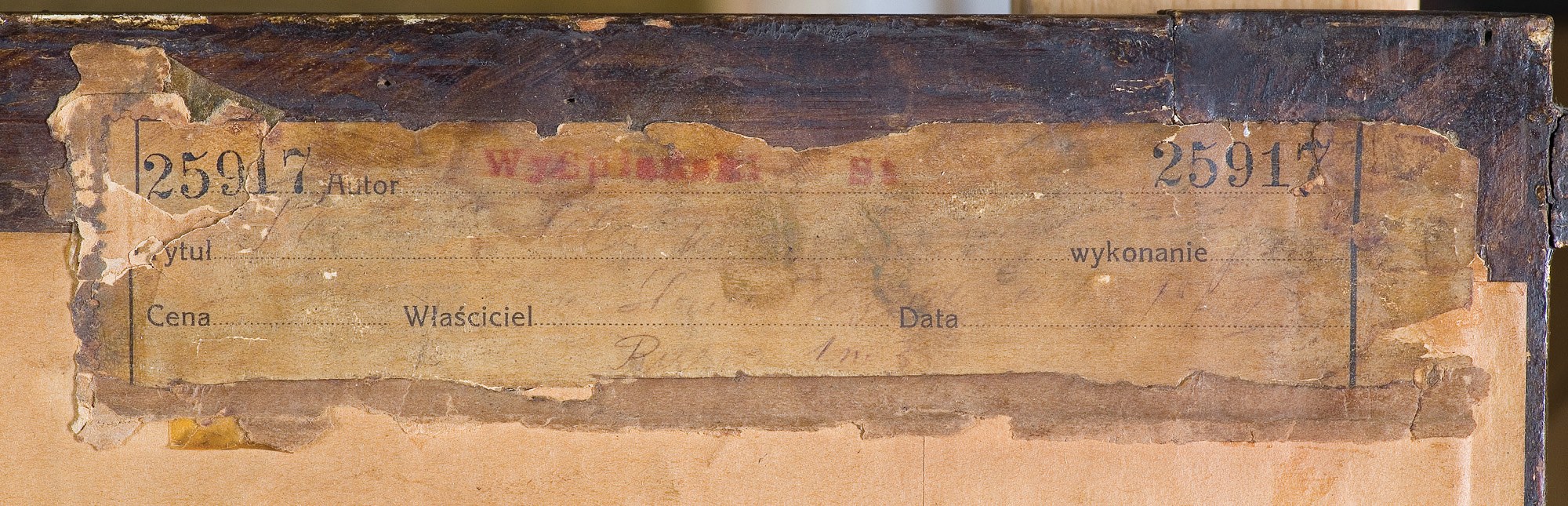
On the reverse, lower right (in blue crayon): Kraków; centered (in pencil): Owned by Bussoni | Warsaw | 1921; bottom right: traces of stickers; additionally, on the upper frame rail, a sticker from Warsaw’s Zachęta (print, ink, typewritten text, stamp): 25917 Artist Wyspiański St. 25917 | Title Portrait of Helenka | Price | Owner Stanisław [...] | Date [...]/V 33 | Ru[...] 1 m. 3.
Provenance:
– Władysław Bussoni in Warsaw;
– Stanisław Zakrzewski;
– since the 1980s, a private collection and its heirs in London.
The painting has been exhibited and mentioned in:
– S. Przybyszewski, T. Żuk-Skarszewski, S. Świerz, Stanisław Wyspiański. Paintings, Biblioteka Polska, Kraków, Warsaw-Bydgoszcz 1925, p. 120, no. 369 (Portrait of Helenka, owned by Władysław Bussoni);
– Stanisław Wyspiański. Jan Stanisławski and His Students, Society for the Encouragement of Fine Arts in Warsaw, May 1933, p. 29, cat. no. 62 (“Bust of a Girl in a Corset” [Study of Helenka—a very rough, smudged version], owned by Stanisław Zakrzewski);
– Report of the Committee of the Society for the Encouragement of Fine Arts for the Year 1933, Warsaw 1934, p. 33 (Bust of a Girl in a Corset).
Portraits of children occupy a special place in Wyspiański’s oeuvre, and they appeared as early as his student years in Paris. The portraits of the artist’s own children, however, rank among the most personal and moving works in his body of work. They combine the characteristics of a modernist psychological portrait, extraordinary sensitivity in drawing, a deliberate use of color, and the intimacy of family bonds. Scenes of family life began to appear in the artist’s work with the birth of his first child—his daughter Helena.
She was the result of a romance Wyspiański had with Teodora Teofila Pytko—his aunt’s maid. The couple did not marry until September 1900, after the birth of their second child, Mietek. They had three children together, whom the artist painted on numerous occasions. Among the best-known works in Wyspiański’s entire oeuvre are *Sleeping Staś* and *Sleeping Mietek* from 1904, as well as *Helenka’s Head* from 1900, depicting a girl roused from sleep.
The artist, who was allergic to zinc white, decided to use pastels, which allowed him to quickly capture the scenes he observed on paper; and when portraying children, time was of the essence. The artist always strove to depict his young models in natural, unposed poses. Wyspiański’s portraits were not meant to be studied images; they were meant to capture the mood of the moment in which they were created. Wyspiański closely observed gestures, glances, the way a child sat, and moments of concentration.
A special place in this group is held by the Study of Helenka, the artist’s daughter. It is in her portrait that the combination of painterly observation and an emotional connection to the subject is most fully revealed. For Wyspiański, Helenka is not an anonymous model. She is a child he knows from everyday life, observed in natural situations, outside the rigid rules of official portraiture. Thanks to this, her depiction has an exceptionally direct quality.
The Study of Helenka transcends the conventions of formal portraits. The girl is depicted in a tight frame, and her pose is very natural and authentic. Wyspiański did not create an idealized image. His daughter is not smiling and is not looking directly at the painter. She appears pensive, even worried, and absorbed in her own world. This manner of depiction gives the portrait a psychological quality, and the viewer feels as though they are “peeking” at Helenka at a specific moment in her life. Wyspiański avoided an excess of detail; the absence of an elaborate background or decorative objects focuses all attention on the child. This is also characteristic of the modernist approach to painting. A work of art does not have to be a faithful reproduction of every detail of reality. What is more important is capturing its essential character.
VAT: * An 8% VAT will be added to the winning bid price in addition to other costs (in accordance with §12, point 3 of the Regulations).
Stanisław Wyspiański (Kraków 1869–Kraków 1907) came from a poor middle-class family with strong patriotic and artistic traditions. He was the son of Franciszek, a sculptor and woodcarver; he lost his mother at the age of seven, and at eleven he was taken in by her family due to his father’s progressive alcoholism.
The patriotic atmosphere of his aunt and uncle’s home, along with their guests—prominent Kraków scholars and artists—influenced his interest in national history and Kraków’s past, and helped shape Wyspiański’s consciousness and outlook.
While still a middle school student, Wyspiański—who showed a talent for painting—enrolled at the School of Fine Arts for the 1884–1885 academic year; he began his studies after graduating from high school and attended from 1887 to 1891, 1892–1893, and 1894–1895 under the guidance of Władysław Łuszczkiewicz, Florian Cynk, and Izydor Jabłoński.
At the same time, he studied art history and literature at Jagiellonian University.
For seven months at the turn of 1889–1890, he worked alongside Jan Matejko on the polychrome decoration of St. Mary’s Church. Thanks to a scholarship, in March 1890 he set out on his first six-month artistic journey through Europe, traveling via Vienna and Italy to Paris, touring Gothic cathedrals in France and Germany, and visiting Munich, Bayreuth, Dresden, Prague, as well as Wrocław, Poznań, and Gniezno. Upon his return, commissioned by Matejko, he designed additions to the Gothic stained-glass windows for St. Mary’s Church. After receiving a new scholarship in May 1891, he left for Paris.
Until the end of that year, he shared a studio with Józef Mehoffer; neither of them was admitted to the École des Beaux-Arts, but they began their studies at the Académie Colarossi — Wyspiański in the studio of Gustave Courtiois, as well as under J. Blanc and L. A. Girardot. Both also entered subsequent competitions for the Rudolfinum in Prague and for a curtain for the Municipal Theater in Kraków, in which they were unsuccessful. In 1892, the friends parted ways on acrimonious terms.
Wyspiański then rented his own studio and began writing his first plays, drawing on mythology. Both he and Mehoffer were invited to participate in a competition for a stained-glass window for the cathedral in Lviv. Wyspiański spent the fall of 1892 and the winter of 1893 in Kraków, and in February he returned to Paris, where he once again lived with Mehoffer until the fall, when he moved into his own studio. In December 1893, Wyspiański visited Kraków, where he presented an exhibition of portraits and Parisian landscapes that critics deemed Impressionist.
In the spring of 1894, he returned to Paris, from where he submitted his completed stained-glass design, *The Wedding of John Casimir*, to a competition in Lviv. He arrived in Kraków in October 1894 and, because his scholarship was not renewed, settled there permanently.
His two-and-a-half-year stay in Paris had a decisive influence on the development of Wyspiański’s Symbolist art; during this time, he broadened his worldview by familiarizing himself with the then-fashionable theosophical concepts of Édouard Schürer, the philosophical ideas of Friedrich Nietzsche, delving into ancient drama and mythology, and developing a fascination with contemporary theater. From 1895 to 1897, he worked on the designs and execution of a monumental complex of polychromes and stained-glass windows for the Franciscan church in Kraków, the interpretation of which is seen as rooted in the system of hermetic cosmogony; at the same time, he created a series of illustrations for the *Iliad* and began a series of symbolic paintings inspired by Polish legends.
The year 1898 marked the artist’s literary and theatrical debut: the play *Legenda I* was published, and the Municipal Theater staged the play *Warszawianka*. Wyspiański was among the founders of the “Sztuka” Society of Polish Artists, and in 1898 he became the artistic director of the magazine “Życie.” Although he worked in relative isolation and kept his distance from those around him, during this time he became much more involved with the artistic community; he frequented “Paon,” where he created a series of superb portraits of the venue’s regulars.
In 1900, he began work on the play *November Night* and sketches for stained-glass window designs for Wawel Cathedral; on September 18, he married Teofila Pytko, his aunt’s maid and the mother of his three children; On November 20, he attended the wedding of his friend, the writer Lucjan Rydel, to Jadwiga Mikołajczykówna, as well as their famous wedding reception at Włodzimierz Tetmajer’s manor house in Bronowice.He immortalized this event in his scathing stage drama *The Wedding*, which premiered in Kraków on March 16, 1901.
In 1902, he was appointed assistant professor in the Department of Decorative and Ecclesiastical Art at the Academy of Fine Arts. Despite his deteriorating health, in 1903 he directed productions of his own plays at the Kraków theater, and in 1904 he designed the interior of the Doctors’ Department Store, furnished the so-called “Common Room of the Polish Artists’ Society ‘Sztuka,” and—together with architect Władysław Ekielski—on a project to restore the splendor of Wawel Hill, which had been abandoned by the Austrian authorities, intending to elevate it to the status of a symbolic Wawel Acropolis; he continued to expand his portrait gallery of prominent figures, painted family portraits, and in December—persuaded by Feliks Jasieński—began a series of pastel landscapes depicting the view from his studio window. In 1905, he applied for the position of director of the Municipal Theater, but the unfavorable attitude of the artistic community forced him to withdraw his candidacy.
A serious venereal disease was progressing rapidly, and the artist spent a brief time in a sanatorium for the mentally ill. In the summer of 1906, he moved into his own home in the village of Węgrzce near Kraków and was also appointed professor at the Academy. In 1907, his plays on historical, mythological, and contemporary themes were published. After a brief improvement in his health during the summer, the artist died on November 28 at a Kraków clinic, surrounded by family and friends; after a solemn funeral Mass at St. Mary’s Church, his coffin was laid to rest in the Crypt of the Distinguished at the Pauline Church on Skałka.
Subordinated to the imperative of artistic synthesis of the arts, Wyspiański’s oeuvre—spanning the years 1889–1907—includes 17 dramatic works and rhapsodies, as well as poetic vignettes dedicated to friends, hundreds of portraits, dozens of landscapes, countless studies and drawings for stained-glass and polychrome projects, costume studies, and designs for stage sets, furniture, book covers, vignettes, interludes, and inventory drawings. What is striking is the artist’s unparalleled passion and creative power, despite having been under the pressure of a terminal illness for many years.
His art, like the entire era, is built on contradictions. In creating his own artistic vision of the world and humanity, Wyspiański strives in his literary and painterly works to reconcile tradition with modernity, the realities of historical facts and everyday life, and the observation of nature.
(written by: Elżbieta Charazińska)













Paskutiniai peržiūrėti
Prisijunkite, jei norite pamatyti pozicijų sąrašą
Mėgstami
Prisijunkite, jei norite pamatyti pozicijų sąrašą