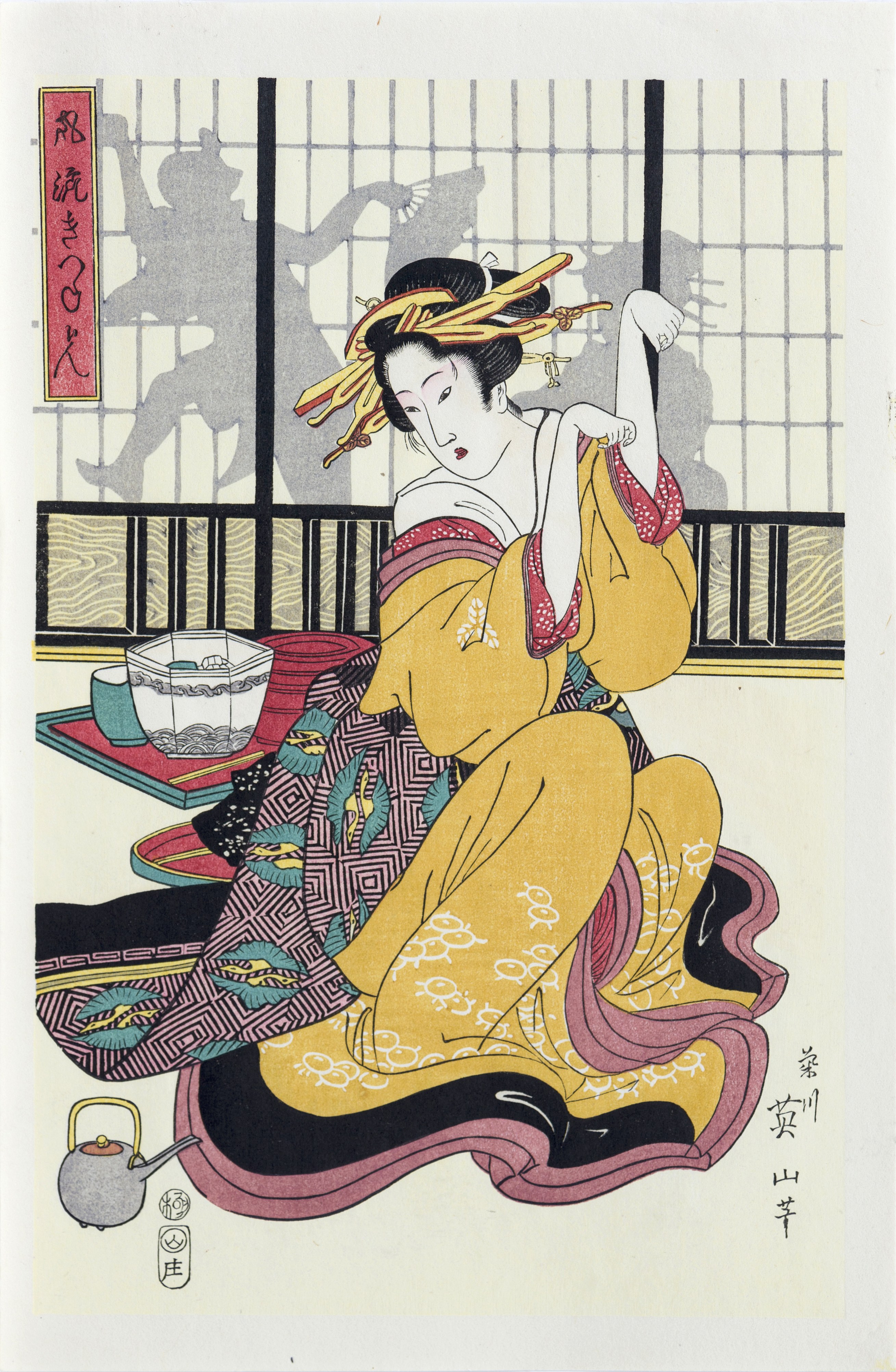
Color woodcut, ink, paper, 30x19 cm, artist's signature
Part of a triptych depicting three beauties in a teahouse playing "kitsune," a variation of a hand game similar to "rock, paper, scissors." In this game, the loser must take a sip of sake. A beauty in a yellow kimono takes a pose with her hands raised like fox paws, looking over her shoulder with a rather disgruntled expression. On the shoji windows behind her can be seen silhouette-shadows, presumably of customers and artists, one of whom is dancing and waving a folding fan.
Kikukawa Eizan (1787-1867) was born in Edo as Toshinobu Omiya. He was the son of Kikukawa Eiji, an artisan making decorative fans, and a local painter of the Kanō school. He took his first steps in artistic fields under his father's tutelage. He later studied under Suzuki Nanrei (a representative of the realist Shijō school) and Totoy Hokkei, an outstanding student of Katsushiki Hokusai himself. This diversity influenced his excellent technical skill. When the great master of female beauty Kitagawa Utamaro died in 1806, the ukiyo-e market sought his successor. Eizan, although never a formal disciple of Utamaro, began to create in his aesthetics and quickly became the most important continuator of this trend. Critics initially accused him of plagiarizing Utamaro. Over time, however, Eizan developed his own unique style - abandoning the fleeting, ethereal delicacy of his predecessor in favor of more down-to-earth, sweet and realistic images of women. In the 1820s, younger artists such as his own pupil Keisai Eisen and Utagawa Kunisada entered the market . Their style became more expressive and dynamic, so that Eizan's classic elegance began to lose popularity. Around 1830. Eizan made a radical decision to almost completely abandon the demanding and commercial woodcut technique. For the rest of his life, he focused exclusively on traditional, unique brush painting on silk and paper.
In the second half of the 20th century, Japanese artists and publishers collaborated to reproduce famous woodblock prints for interested collectors looking for rare designs. New blocks were created, and the prints were painstakingly printed by artisans using the same method as the 19th century originals - one block for each color. Reissues of woodblock prints are an opportunity to collect and enjoy the famous designs by renowned Japanese artists.