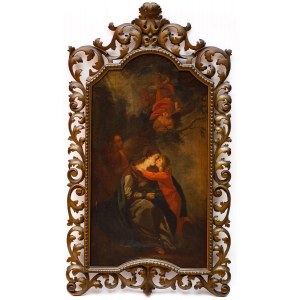
Oil, canvas; 82 x 45 cm
woodcarving frame
Scene depicting the Holy Family returning from exile in Egypt. In the foreground is Mary with a bunch of grapes in her lap being kissed by little Jesus. Behind them St. Joseph gazes into the distance and quite young, and above them in the branches of the trees are 3 putti - one holding a basket of apples, one reaching for the fruit, and the third holding an apple in his hand. The painting is modeled on a lost work by Michael Leopold Willmann, circa 1682 (169 x 104 cm., standing rectangle format until 1945 in the Silesian Museum of Fine Arts in Wroclaw, inv. no. SM 297, signed with the monogram MW and the date 1682 on the stone in the l.d. corner; which is listed in the catalog of war losses under card no. 11742). However, it differs from it in some elements (besides its format and dimensions, as well as its painting technique, which differs from Willmann's). First of all, it lacks a clearly marked boulder on which the stick is supported. Mary's mantle has been reduced in size. The vegetation surrounding the scene is also different, although the tree on which the putti stand still forms the background of the scene. Joseph is much younger than in the lost Willmann painting (although in other, earlier, versions of the Trinity of Creation by Willmann, Joseph is not an old man either) and he is not looking into the crown of the tree at the putti - but somewhere in the distance. The heads of Mary and Jesus are at a minimally different angle (and both figures seem to have plumper lips). The group of 3 putti are more loosely spaced (e.g., the apple the putto is reaching for has also been moved away), and their faces (except for the putto with the apple) are very sketchy.
History of iconography.
Scenes depicting the Kiss of Mary, the Kiss of Joseph or the Kiss of Mary with the mystical nuptials of St. Joseph to God (all being depictions of the so-called "Trinity of Creation" or "Earthly Trinity") were iconographic motifs made for the Counter-Reformation brotherhood of St. Joseph. The fraternity of St. Joseph, founded at the Cistercian abbey in Krzeszow (the center of St. Joseph's cult, where there is also a fraternity church dedicated to him) in 1669 and active in Silesia (until 1810) and Bohemia, Moravia, Austria. Bavaria and other German-speaking countries. The Brotherhood was also active in other Silesian Cistercian monasteries - Jemielnica, Trzebnica, Henryków and Kamieniec Ząbkowicki. The author of their theological basis (kissing the lips as a mystical union of the human soul with God - from the Sermons of the Cistercian founder Bernard of Clairvaux) was the abbot of the Krzeszów monastery - Bernhard Rosa, which he included in the 1678 prayer book of the brotherhood.
Both large-format paintings for church interiors and smaller ones were created for the private devotions of the brotherhood's members, since among their duties (first published in the 1669 prayer book) was to have an image of St. Joseph (either alone or with Mary and Jesus) for prayer purposes. And at the height of its popularity, the Krzeszh brotherhood had 100,000 members. Willmann painted small devotional representations on a fairly large scale for members of the St. Joseph brotherhood. The cheapest cost 20-22 ducats, while larger, more elaborate, or with elaborate elements more luxurious - were more expensive (80-100 thalers). One of the paintings with the Trinity of Creation was given by the Abbot Rosa of Krzeszów as a gift to Emperor Leopold I in 1672. About 60 repetitions of Mary's Kisses and Joseph's Kisses have survived in Central Europe.
The first chronologically mystical depictions of the Trinity of Creation were "The Kiss of Mary with the scene of the mystical nuptials of St. Joseph with God the Father," related to the mystery of the nuptials of the "soul" with the Trinity of Creation, and "The Kiss of Joseph." Willmann designed prints with these scenes (circa 1678), which were later executed by Johann Tscherning. "The Kisses of Mary with the Mystical Nuptials of St. Joseph" were also created in oil versions - painted by Willmann and his workshop (Jemielnica circa 1700, lost from the Upper Silesian Museum in Gliwice, lost from the post-Cistercian church in Kamieniec Ząbkowicki circa 1705, or from the National German Museum in Nuremberg, circa 1682) and in numerous paintings by other painters modeled mainly on the above-mentioned graphics. In addition to Silesia, such images were also found in Bohemia, Greater Poland or Pomerania. "Joseph's Kisses" are also known in 3 pieces by the author (Luboradz, and in the National Museums in Warsaw and Wroclaw), and numerous copies in Silesia or Bohemia. Here, in turn, the iconography also referred to an apocryphal episode from the Gospel according to Pseudo-Matthew about the Holy Family's sojourn in the city of Sotinen (true: Syene/Assuan or Tanais) in Egypt, where at the appearance in the temple of Mary and Jesus all the statues of Egyptian deities fell to the ground and shattered.
As for the third iconographic type of the Trinity of Creation (Earthly) - that is, the Kiss of Mary, to which the painting presented at the auction belongs - no print has survived (as in the case of the above 2 other depictions). However, the number of surviving copies and repetitions of the author's and imitators testifies to its existence. The earliest known (author's) image is a lost painting from the Silesian Museum in Wroclaw, dated 1682. A drawing of the same scene, attributed to Willmann (previously from the same museum in Wroclaw), is kept in the collection of the National Museum in Warsaw - there are discrepancies as to whether this is an author's preparatory sketch or a drawing depicting the finished painting.
It is believed that Willman received an honorarium for The Kiss of Mary from the abbot of Krzeszów on September 3, 1682. The painting came to Breslau in 1811 after the Prussian authorities secularized the monastery. The painting from the Breslau museum was probably considered by Kloss to be identical to the one mentioned in G. Büsching's painting in the Krzeszów monastery library. E. Kloss claimed that Büsching lists 8 known copies of the 1682 painting. According to Kloss, the best version of "The Kiss of Mary" was a) a painting from the parish (formerly Franciscan) church of St. Martin in Jawor (187x94), which he considered to be a late workshop reproduction (he presumed it to be identical to the painting found in Wroclaw at the prelate Blaeschke). Since Willmann's signature and the date 1688 were discovered on one of the paintings still in Jawor during restoration work in 2010, so presumably this now-lost variant was also an author's work involving the workshop. Kloss also mentioned b) a repetition from the Prince-Bishop Jansky Vrch castle in Javornik, which according to him was a poor copy from the early 19th century, as well as earlier replicas found in the 20th century at c) Erna Loewe in Berlin-Lichterfelde and d) in Jelenin, Szprotawa district (ob. Żagań municipality).