


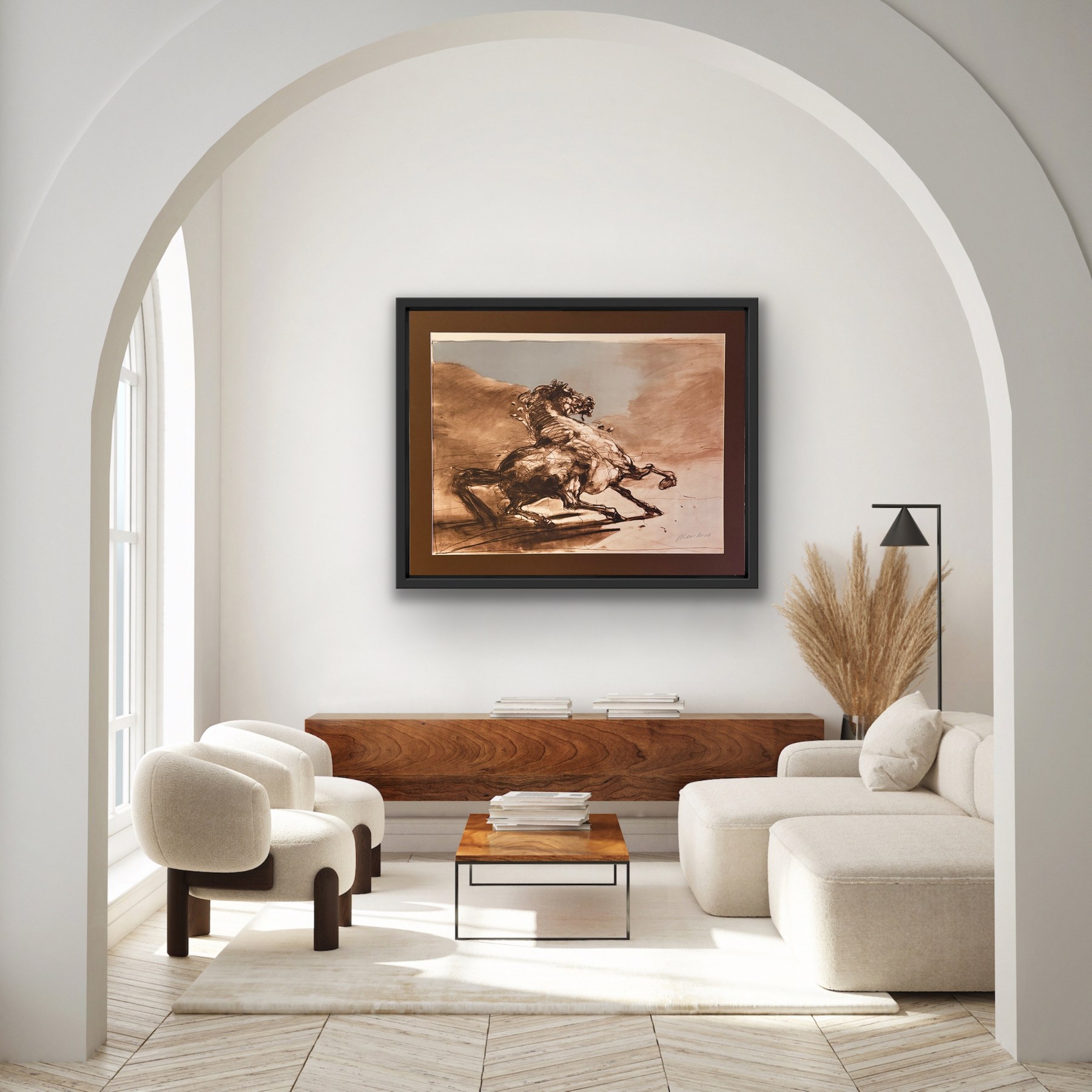
Artistic lithograph on Arches handmade paper, 56 x 76 cm,
Limited edition, numbered in pencil 81/250;
Signed in pencil lower right "Weisbuch"
Publisher: Éditions Vision Nouvelle (Paris), printed at Atelier Desjobert (Paris) —one of the most famous and highly regarded lithographic printing houses in Paris, where a significant portion of Weisbuch’s lithographs were produced.
Claude Weisbuch is considered one of the greatest masters of printmaking and drawing of the 20th century. A genius of the line and the capture of movement: Weisbuch developed a completely unique style in which the line not only outlines a shape but literally “comes to life.” Instead of a static, smooth finish, he employed multiple, rapid, and expressive strokes. This creates the illusion of stop-motion movement, vibration, and a unique sense of momentum. In addition to musicians and theater figures, horses were one of Weisbuch’s most important subjects. In his depiction, the horse is a symbol of untamed strength, elemental energy, and elegance. Weisbuch deliberately limited his palette to shades of sepia, ochres, warm browns, and velvety black against a cream-colored background. This style clearly draws on the sketches and drawings of masters such as Rembrandt, Honoré Daumier, and Leonardo da Vinci.
He created inthe “Non Finito” (unfinished sketch) aesthetic: The artist himself used to say, “I like a sketch, something unfinished, a painting full of mystery.” The starkness of the background, combined with a dense network of dynamic lines, creates an incredible atmosphere of drama and elegance. As a result, Weisbuch’s lithographs are highly prized by collectors around the world for their dynamic form, masterful craftsmanship, and refined, timeless aesthetic.
Don Quixote and dynamic equestrian scenes were among the most recognizable and cherished motifs in Weisbuch’s work. The artist created them with great expressiveness, characterized by dynamic, sketchy lines and the powerful movement of the figures and horses. The series of works dedicated to characters from Cervantes’ novel was created mainly at the turn of the 1960s and 1970s (particularly intensively around 1970–1972).
Weisbuch’s works are held in the collections of the Centre Georges Pompidou in Paris, the Stedelijk Museum in Amsterdam, the Museum of Modern Art in New York, and the Staatliche Graphische Sammlung in Munich.
The framing shown in the renderings is for illustrative purposes only and does not constitute a commercial offer.










