


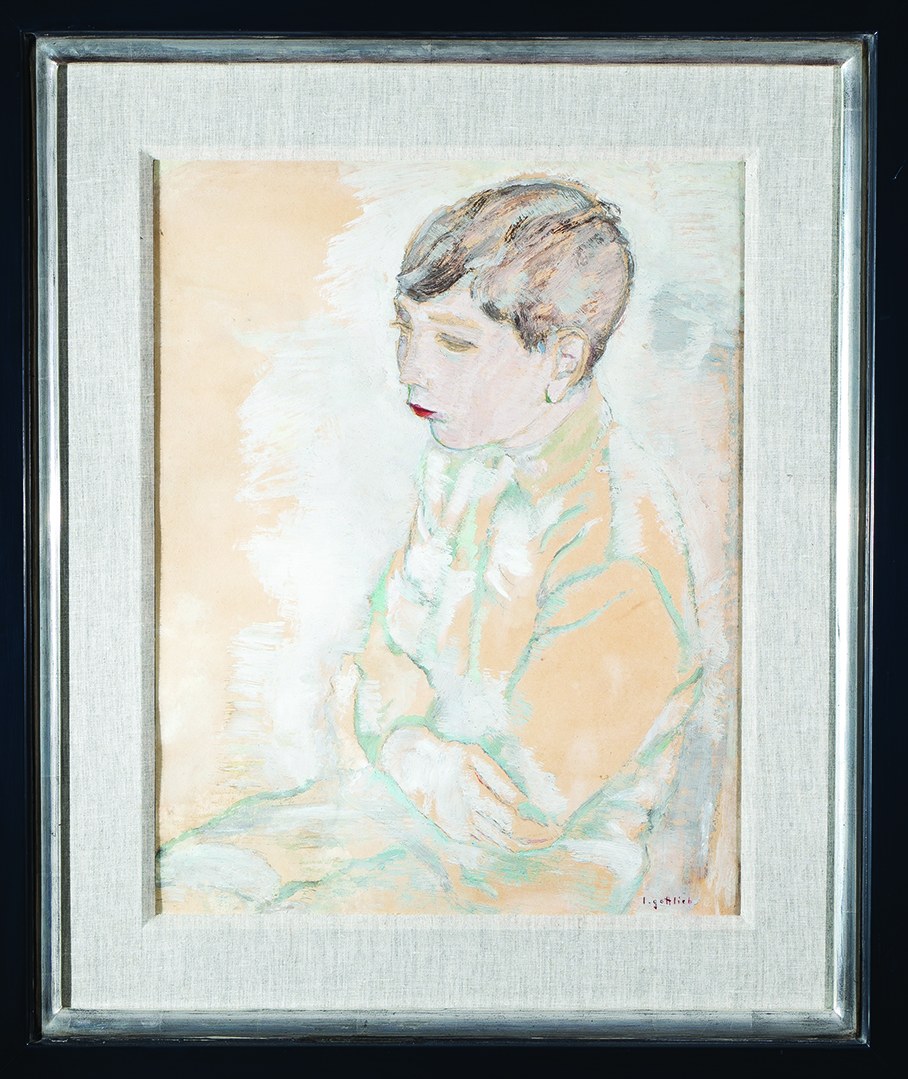
oil/ cardboard, 58.5 x 45.5 cm in light passe-partout
signed p.d.: l. gottlieb
described on the back: l. gottlieb | No 264 | 6184
LITERATURE:
- Artur Tanikowski, Wizerunki człowieczeństwa, rytuały powszedniości. Leopold Gottlieb and his work, Cracow 2011, p.269, pos.120
- Outstanding Jewish Artists from the Collection of David Malek and the Signum Foundation, Lodz 2004, p.152, cat. 37
Younger brother of Maurycy, studied at the Kraków Academy of Fine Arts (1896-1902) in the studios of Jacek Malczewski and Teodor Axentowicz (the art of the Young Poland period strongly influenced his work), then stayed in Munich (in the studio of Anton Ażbe), and settled in Paris in 1904. In 1905, he was a member of the Group of Five (alongside Witold Wojtkiewicz and Tymon Niesiolowski), whose activities contributed to the development of Expressionism in Polish art. In 1906-1908 he was a professor of painting at the Bezalel School of Arts and Crafts in Jerusalem. He exhibited works in Paris salons and exhibitions of the Vienna Secession and was also a member of the Hagenbund. In 1914-1917, he was a member of the Polish Legions (including in the First Brigade under Jozef Pilsudski), where he created artistic documentation of military life (drawings and prints were shown at the Ljubljana Exhibition of the Polish Legions in 1917). 1917-19 member of the Polish Expressionists (later Formists, the first avant-garde grouping of Polish art). After 1920 he stayed in Vienna and Germany, and from 1926 permanently in Paris, co-founding the École de Paris milieu (he was friends with Moses Kisling, Mela Muter and Eugene Zak). His art was promoted by leading French critics André Salmon and Adolf Basler. In 1929 and 1930 he participated in exhibitions of the Association of Polish Artists Rhythm representing the moderate modern trend (drawing on the traditions of ancient art and classicism), whose ambition was to create a national style.
Portrait of a Boy is a work characteristic of the artist's work. The extremely subtle and refined line leading and the delicate use of color make the anonymous figure very clearly depicted. We become witness to the almost physical presence of a person about whom we know nothing, and yet he is intriguing and invites intellectual reflection. Gottlieb is a painter of concentration and silence, the characters in his paintings exude tranquility, having a dose of timelessness. In communing with them, we are touched by a certain mystery.










Paskutiniai peržiūrėti
Prisijunkite, jei norite pamatyti pozicijų sąrašą
Mėgstami
Prisijunkite, jei norite pamatyti pozicijų sąrašą