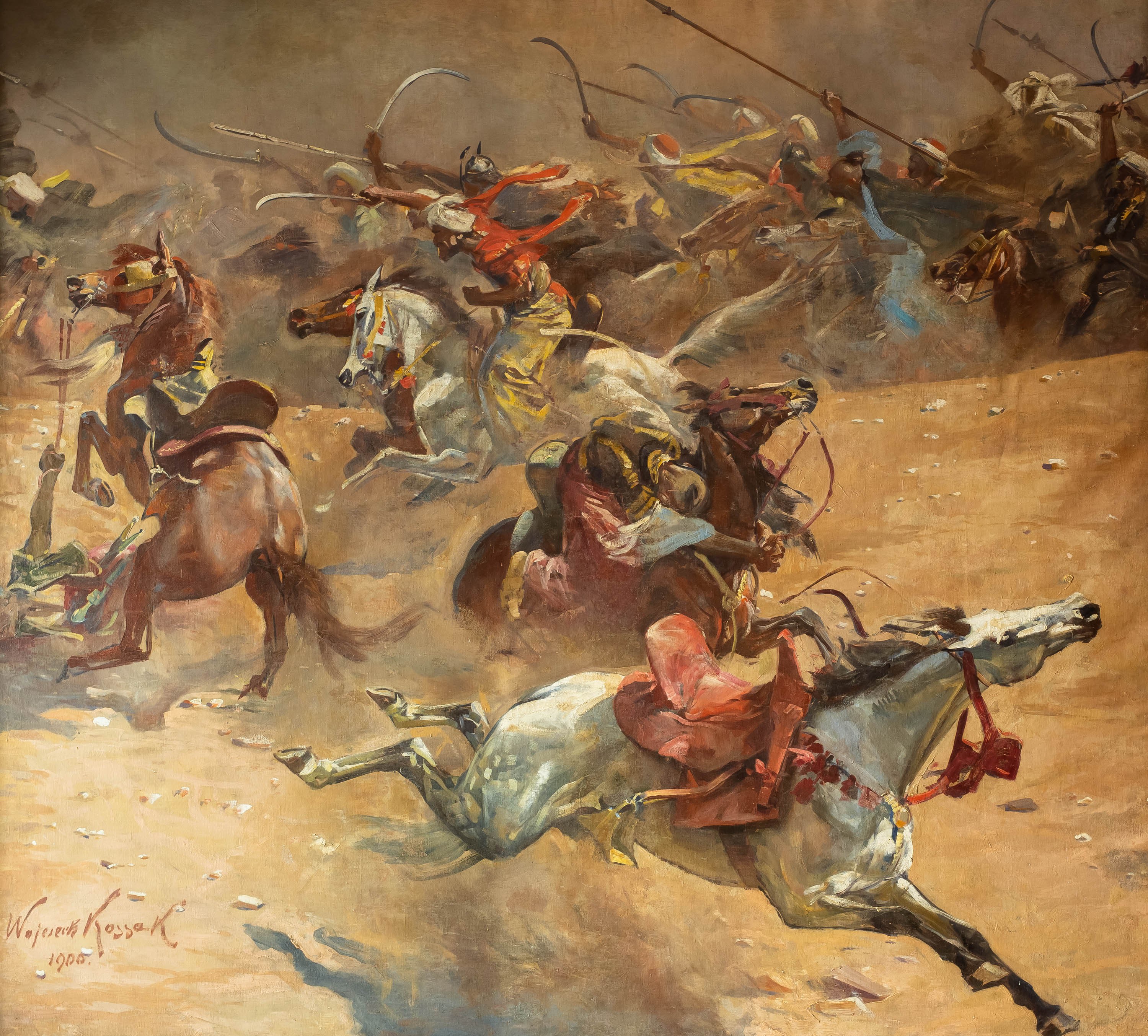
Signed and dated l. d.: "Wojciech Kossak/1900."
On the back inscription: "MUSEUM IN PRZEMYŚLU/MR-H-1530".
Provenance:
- Property of Henryk Lgocki and Henryk Boletale (purchase of the entire panorama between 1902 and 1905).
- Collection of the Długosz family in Siary (until 1947).
- the collection of the Skrzyński and Sobański families in Zagórzany
- deposit of the National Museum of the Przemysl Region in Przemyśl (until 2001)
- private collection, Poland
Reproduced in:
- K. Olszański, "Niepospolity ród Kossaków", Krakow 1994, p. 174, il. 395
- P. Jędryczak, R. Nowak, "The Battle of the Pyramids," Wrocław 2021, p. 11.
- K. Łomnicka, "Wojciech Kossak and the bravura charge under the pyramids", in Culture and Business, Łódź 2022, no. 77, p. 11.
"Maniuchna, I tell you that the Pyramids will have worldwide fame [...] Well, today, developing in detail the main sketch of the four, where the most difficult and violent action, I built a thing so truly brilliant, so incredibly rich, so many episodes, so many fantasies, so many completely new ideas."
Wojciech Kossak in correspondence to his wife, November 1900.
"Eureka! The panorama will be fabulous!!! I got tired yesterday and came up with it, because the composition is not easy, but I'm already home and now I wouldn't be driven away from sketching with a stick (...) Wojciech was particularly fond of this type of painting, because he had a phenomenal ease of composing battle scenes, operating masses of troops on huge spaces of canvas, like a general commanding a battle !!!
Kazimierz Olszanski
The panorama "Battle of the Pyramids" was Wojciech Kossak's third undertaking of this type, right after the Battles of Racławice and Berezina. The subject appeared in Wojciech Kossak's work, as if forced by the artist to change the subject of the planned panorama. Initially, the painter intended to show the Battle of Samosierra. However, the Tsar's governor in Warsaw, Alexander Imeretinsky, ultimately did not give his permission for such a depiction for fear that the panorama in such a form could arouse patriotic and liberationist thoughts in the hearts of Poles. It was necessary to change the subject to a more "safe" one from the point of view of the partitioning authorities, especially since the artist had already rented a rotunda in Warsaw for the presentation of the panorama at the turn of 1900 and 1901.
The panorama referred to historical events that took place during Napoleon's campaign in Egypt (l. 1789-1801). This expedition, according to the officially circulated narrative, was supposed to liberate the Egyptian people from Mameluke rule and give them access to the achievements of Western civilization, while in fact Napoleon's aspirations were focused on taking over the British colony in India (P. Jędryczak, R. Nowak, "The Battle of the Pyramids", Wroclaw 2021, p. 5). The artist chose the battle fought on July 21, 1798 at the village of Embabech (now Imbaba) as the main subject. Preparatory work included studies in Paris of the costumes and weapons used by the Mamelukes - Zygmunt Rozwadowski (one of the painters invited to cooperate) was delegated to this task, as well as topographical studies conducted by Kossak himself together with Michal Wywiórski in the vicinity of Embabech with the plan of the battle, reconstructed by Adolphe Thiers in his study "L'expedition de Bonaparte en Egypte" of 1900 (Ibid, pp. 7-8). The artist wanted to portray as faithfully as possible the region where the battle had been fought more than a century earlier: "As always in these incidents, so now I decided to go to the battlefield at the same time of year, even in the same month in which it took place (...) At our feet Cairo with its minarets and domes of mosques and the Nile along which, like haystacks along the Berezina, pyramids and pyramids as far as the eyes can reach." (W. Kossak, "Memories," compiled by K. Olszanski, p. 185). After returning to the country, the artists set to work intensively and prepared oil sketches. Kossak wrote: "Eureka! The panorama will be fabulous. I got tired yesterday and came up with it, because the composition is not easy, but I'm already home and now I wouldn't be driven away from sketching with a stick." Kazimierz Olszanski, in a study devoted to the painter, stated: "Wojciech was particularly fond of this type of painting, as he had a phenomenal ease of composing battle scenes, operating masses of troops on huge spaces of canvas, like a general commanding a battle, and possessed considerable technical proficiency." November 7, 1900. Wojciech Kossak began to apply figural parts to the four 150 × 290 cm canvases previously painted with landscape parts by Wywiórski. The official start of work on painting the panorama in the rotunda on Karowa Street in Warsaw took place on November 20. In addition to the aforementioned Rozwadowski and Wywiórski, five more artists were responsible for the progress of the work, in the persons of Kazimierz Pulaski, Czeslaw Tanski, Wladyslaw Jasienski and Jozef Ryszkiewicz. Jacek Malczewski, who was supposed to take on the task of painting the female figures, was also invited to cooperate, but he did not show up for work (P. Jedryczak, R. Nowak, op. cit., p. 8). After a record pace of four and a half months, the panorama was completed. It measured 15 × 115 meters and was publicly displayed on April 2, 1901. Although very well received by critics, it was not as popular as Panorama Racławicka. Perhaps the theme of the battle from the Napoleonic campaign did not touch the hearts of the Polish public to such a great extent. Kazimierz Olszanski described the panorama as follows: "On a sandy plain, against the distant background of the pyramids, a foursome of French infantry with cannons on their horns repels the Mameluk cavalry charging with fury and contempt of death. (...) This <
(P. Jedryczak, R. Nowak, op. cit., p. 8).
With the end of the rotunda lease in September 1902, the panorama was rolled up and stored in the warehouses of the Warsaw-Petersburg Railway. Between 1902 and 1905. The Battle of the Pyramids was acquired by the Cracow lawyer Henryk Lgocki, who already owned two rotundas in Czestochowa and Warsaw and several other panoramas, and the Kharkiv merchant Henryk Boletale. It is known from the surviving documentation that the buyers planned to exhibit the panorama in Lviv, but the presentation ultimately did not take place. Further developments of the Battle of the Pyramids included an exhibition in the rotunda on Color Boulevard in Moscow (from January 1906), in the rotunda on Ekaterinskaya Street in Odessa (from December 1906 to mid-1907) and in Kharkov from August 19, 1907 to March 1908 (Ibid., pp. 10-11). Subsequently, The Battle of the Pyramids shared the fate of the panorama with its depiction of the Battle of the Berezina River, and was cut by Wojciech Kossak into smaller fragments. There are three fragments in the museum's collections. These canvases are part of the collection of the National Museum in Poznan (285 × 510 cm, signed and dated l. d.: "Wojciech Kossak/1900", the Ivanovo Regional Museum of Art in Ivanovo (257 × 577 cm, signed and dated: "Wojciech Kossak/1900") and the Zofia Kossak-Szatkowska Museum in Górki Wielkie (133 × 83 cm, signed and dated: "Wojciech Kossak 1898-1922").
"First in line, the Mamelukes fight fiercely; they are assisted in the battle by noble animals, as if aware that they are trashing their enemies... Unfortunately, a wall of steel bayonets breaks their fervor; a moment more and they will lie pierced by the invaders' weapons." "The Battle of the Pyramids", Warsaw 1901, p. 11
The offered painting, by virtue of its history, is unquestionably a museum-class work. The monumental dimensions of the fragment of the panorama allow one to imagine the scale of the entire undertaking. What is worth emphasizing, this fragment was located in the central part of the composition. The depicted scene appeals to the viewer with the power of expression expressed in dynamism and painterly freedom in the depiction of horses and riders. At one time the painting decorated the interior of the palace in Siary, which was the estate of the Długosz family. It is currently waiting for a new owner, a seasoned collector, who will take care to preserve for future generations this historical trace of the impressive undertaking that was the realization of the "Battle of the Pyramids" panorama.


![Wojciech KOSSAK (1856-1942), Piekło karpackie - Dolor et Caritas, [Wielka Wojna], 1915](https://img1.one.bid/img/6660/1884054_1w.webp)