


69 x 53.6 cm - oil on canvas
signed lower right: WBłocki. [linked initials]
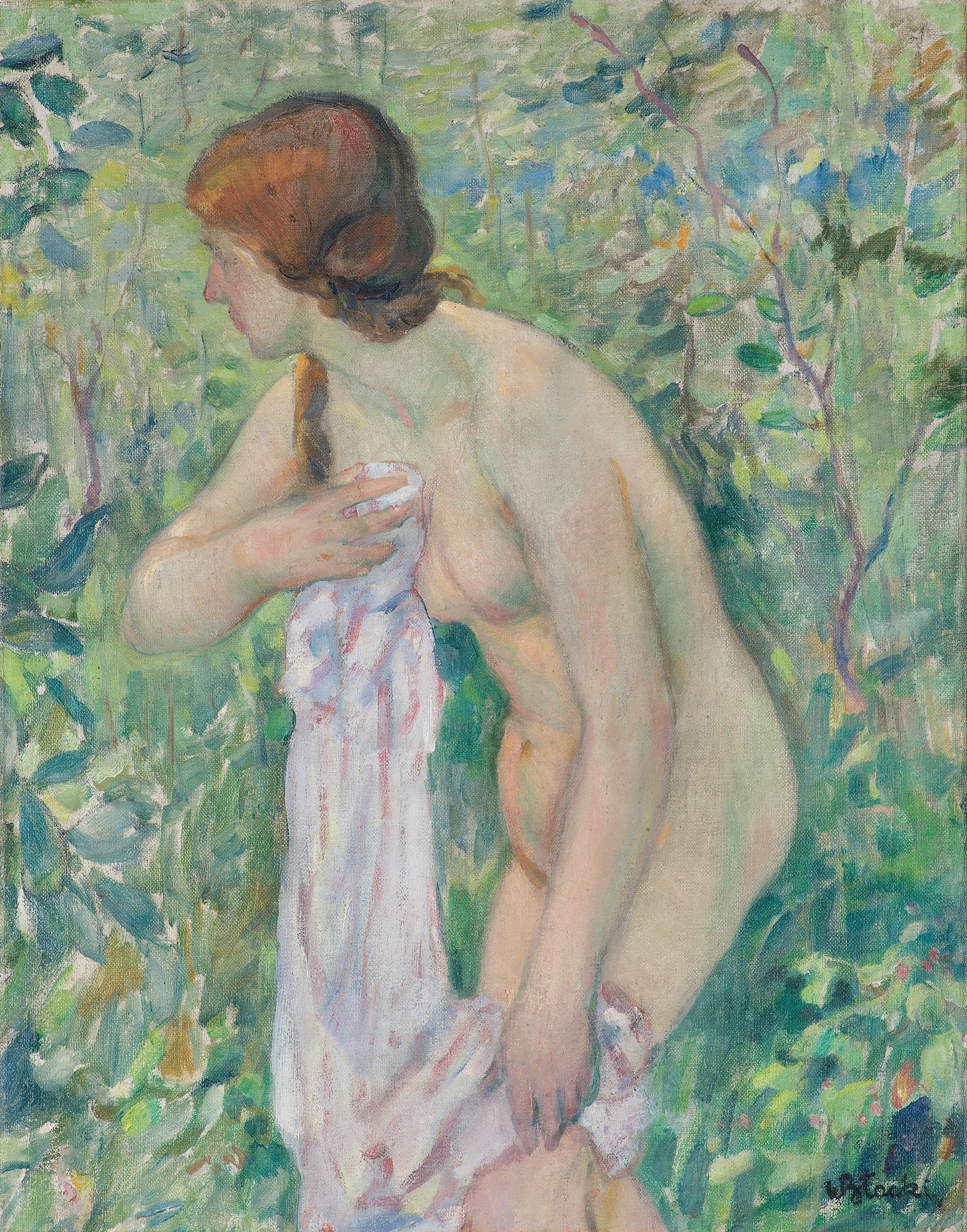
Canvases by this Lviv-based painter, who lived only 35 years and is considered one of the most interesting artists of his generation, are extremely rare on the auction market. That is why the presented Nude of the Artist’s Wife deserves special attention.
Tadeusz Dobrowolski described Błocki as an artist ahead of his time with a modern approach to color. He won numerous awards and distinctions even during his studies and graduated from the Academy of Fine Arts in Kraków with a silver medal. Between 1905 and 1910, he studied under Konstanty Laszczka, Józef Pankiewicz, but above all, Leon Wyczółkowski. From his mentor, he acquired excellent drawing skills and a unique sensitivity to color and tone, while maintaining his own individual style.
In the early period of his career, Błocki created mainly oil portraits, grotesque figure studies, and compositions whose central motif was the female nude. A turning point came during the artist’s brief stay in Paris in 1914. From that time on, the influence of French Impressionism became clearly evident in his painting. He increasingly turned to plein air subjects, focusing on light, atmosphere, and subtle color relationships.
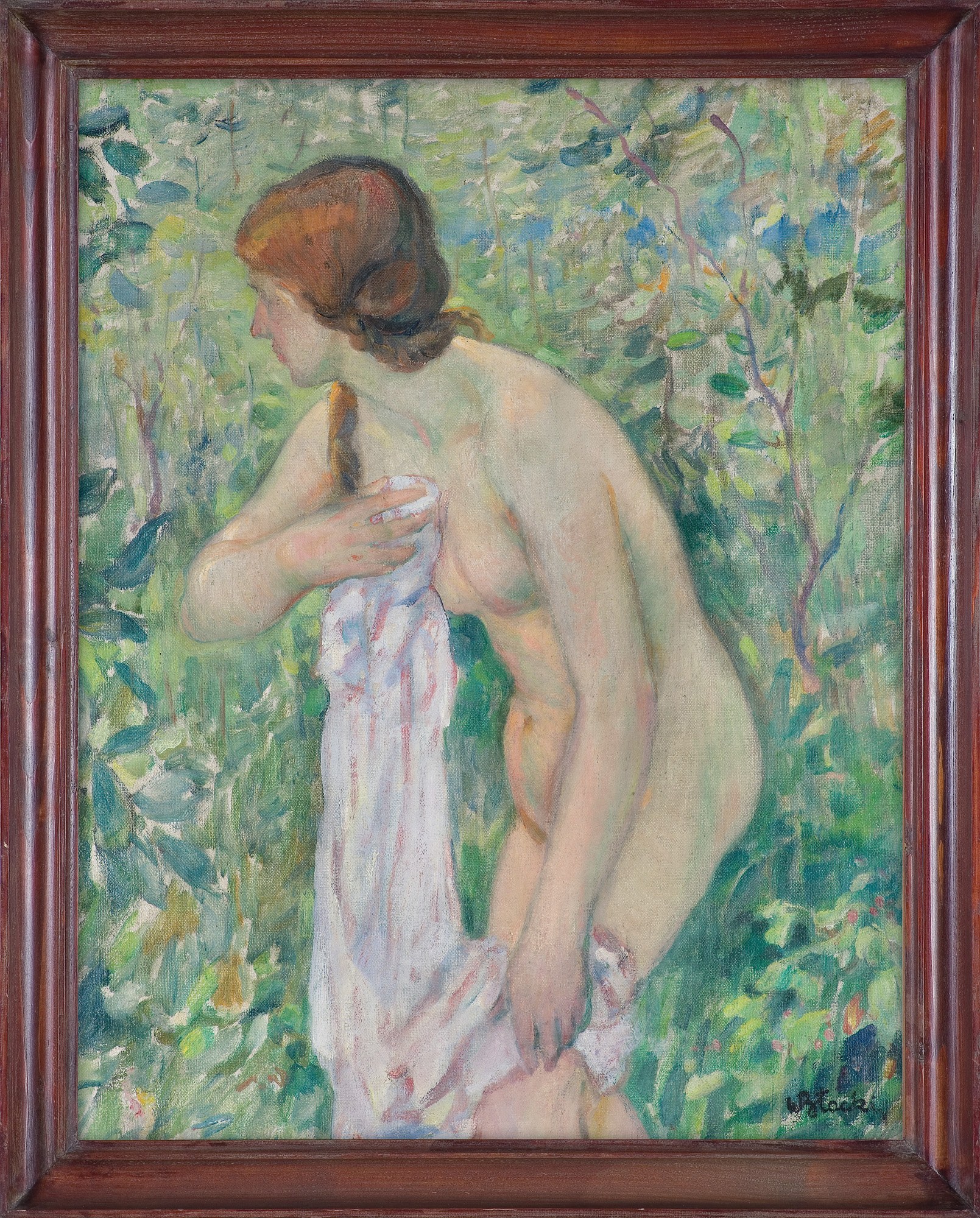
The nude on display bears distinct characteristics of Impressionist painting. Błocki painted it using almost pointillist brushstrokes, limiting the color palette to muted shades of green, blue, and white, achieving the effect of a classic Impressionist composition. The scene, painted in the diffused, soft light of the sun filtering through the leaves of the trees, evokes the shimmering summer air. The woman is depicted in a delicate turn of the body, partially concealing her nudity with a light fabric. This gesture, full of subtle elegance, recalls the classic motif of Venus pudica, originating in ancient art and very popular during the Renaissance. At the same time, the painting style reveals a fascination with Impressionism and Post-Impressionism. As in Renoir’s work, the model’s body is not sharply separated from nature but softly blends into the surrounding landscape. The pastel color palette and subtle transitions of light create an atmosphere of sensuality and intimacy. Renoir’s late nudes, in which the female body becomes part of an illuminated landscape, seem particularly close here. One can also see parallels to the work of Edgar Degas, especially his bathing scenes and intimate depictions of women captured in seemingly unposed moments. Degas often depicted models during everyday activities—combing their hair, drying off, or stepping out of the bath—avoiding the academic idealization of the nude. A similar effect is also present in the painting on display. The artist’s wife appears to have been captured spontaneously, as if observed surreptitiously amidst the greenery. The naturalness of her pose and her slightly bent silhouette lend the composition a sense of transience.
In this nude, Błocki combines the classical ideal of feminine beauty with an Impressionist interest in light and color. As a result, the composition balances between the ancient and Renaissance traditions of the nude, Impressionist observation of nature, and the modernist mood of the early 20th century. The vibrating patches of color, the impressionistic treatment of the background, and the subtle pastel color palette indicate that the artist did not directly copy Renaissance models but consciously reinterpreted the classical motif through the experiences of painting at the turn of the 19th and 20th centuries. As a result, the composition combines the classical ideal of beauty with the decorativeness and moodiness of modernist art.
Provenance: – Owned by the artist’s wife, Janina Błocka (née Pazirska).
– Owned by the above-mentioned’s son.
– Private collection, purchased from the above.
Włodzimierz Błocki (Lviv 1885 – Zakopane 1920) – painter and graphic artist – considered “one of the leading artists of his generation” (SAP), according to T. Dobrowolski, “the creator of [paintings] that anticipated modern colorism.” From 1904, he studied at the Academy of Fine Arts in Kraków, initially under Florian Cynk and Konstanty Laszczka, and above all under Leon Wyczółkowski (1905–1910). During his studies, he received numerous awards and honors. In 1911, together with Teodor Grott, he traveled to Italy, visiting Florence, Rome, Naples, and Sicily. In 1914, he stayed in Paris, and from then on, the influence of French Impressionism became evident in his painting. He lived permanently in Lviv, where the first exhibition of his works took place in 1911. He painted portraits, genre scenes, nudes, landscapes, and still lifes. He was an avid user of watercolor. Even during his studies, he also worked in printmaking, particularly lithography, etching, and aquatint. In 1908, he published a portfolio of erotic prints titled Złote storczyki. In 1911, together with T. Grott, he published a portfolio of etchings from Florence and contributed to the collective portfolio Kraków 1911. Suffering from tuberculosis, he spent the last year of his life in Zakopane. His paintings are extremely rare on the antique market.













Paskutiniai peržiūrėti
Prisijunkite, jei norite pamatyti pozicijų sąrašą
Mėgstami
Prisijunkite, jei norite pamatyti pozicijų sąrašą