


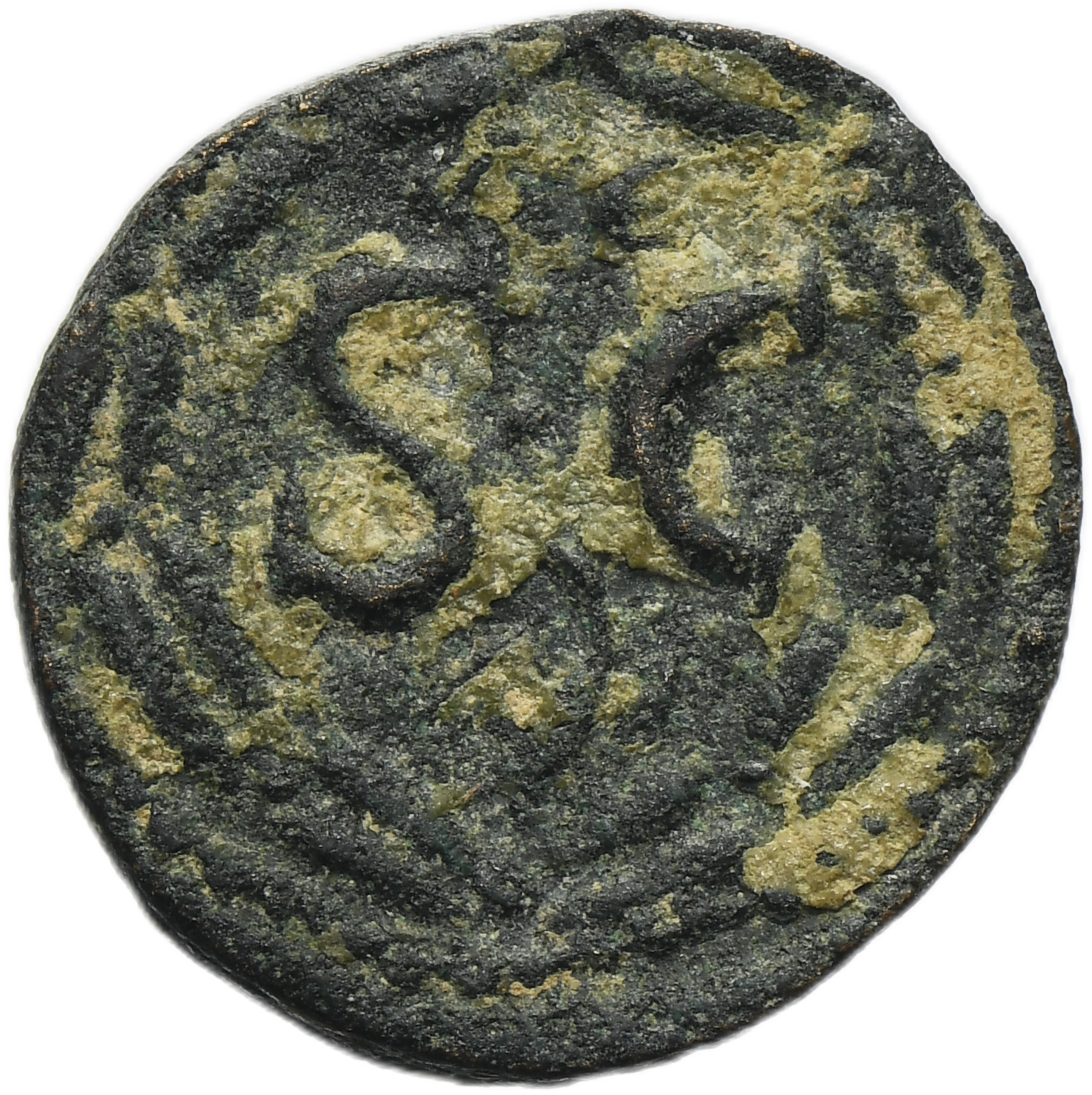


Provincial bronze issue of Diadumenian (AD 217–218), struck at Antioch in Syria, belongs to a short-lived series produced during his elevation to the rank of Caesar alongside Macrinus. The coinage of Antioch in this period reflects the specific character of the eastern monetary system, combining Greek epigraphy with established Roman imperial symbolism.
The obverse presents a bust of the young Caesar, draped and cuirassed, facing right, with the legend ΚΑΙ Μ Ο Δ ΑΝΤΩΝΙΝΟϹ, identifying him as Marcus Opellius Antoninus (Diadumenian). The letters S–C appear in the fields; although derived from the Roman formula senatus consulto, in the context of Antiochene provincial coinage they function as a traditional element without indicating actual senatorial control.
The reverse shows a wreath enclosing SC, with the mark ΔΕ above and an eagle standing right below. The eagle (aquila) is one of the principal symbols of imperial authority and the Roman army, while the wreath signifies victory and prosperity. This combination of elements belongs to a recognizable typological group within the output of the Antioch mint during the early 3rd century.
Provincial Rome
Syria, Antioch, Diadumenian (217-218), AE
Obverse: bare, draped and cuirassed bust right
ΚΑΙ Μ Ο Δ ΑΝΤΩΝΙΝΟϹ
Reverse: SC within wreath, above ΔΕ, eagle to right below
Diameter 19 mm, weight 5.42 g











