


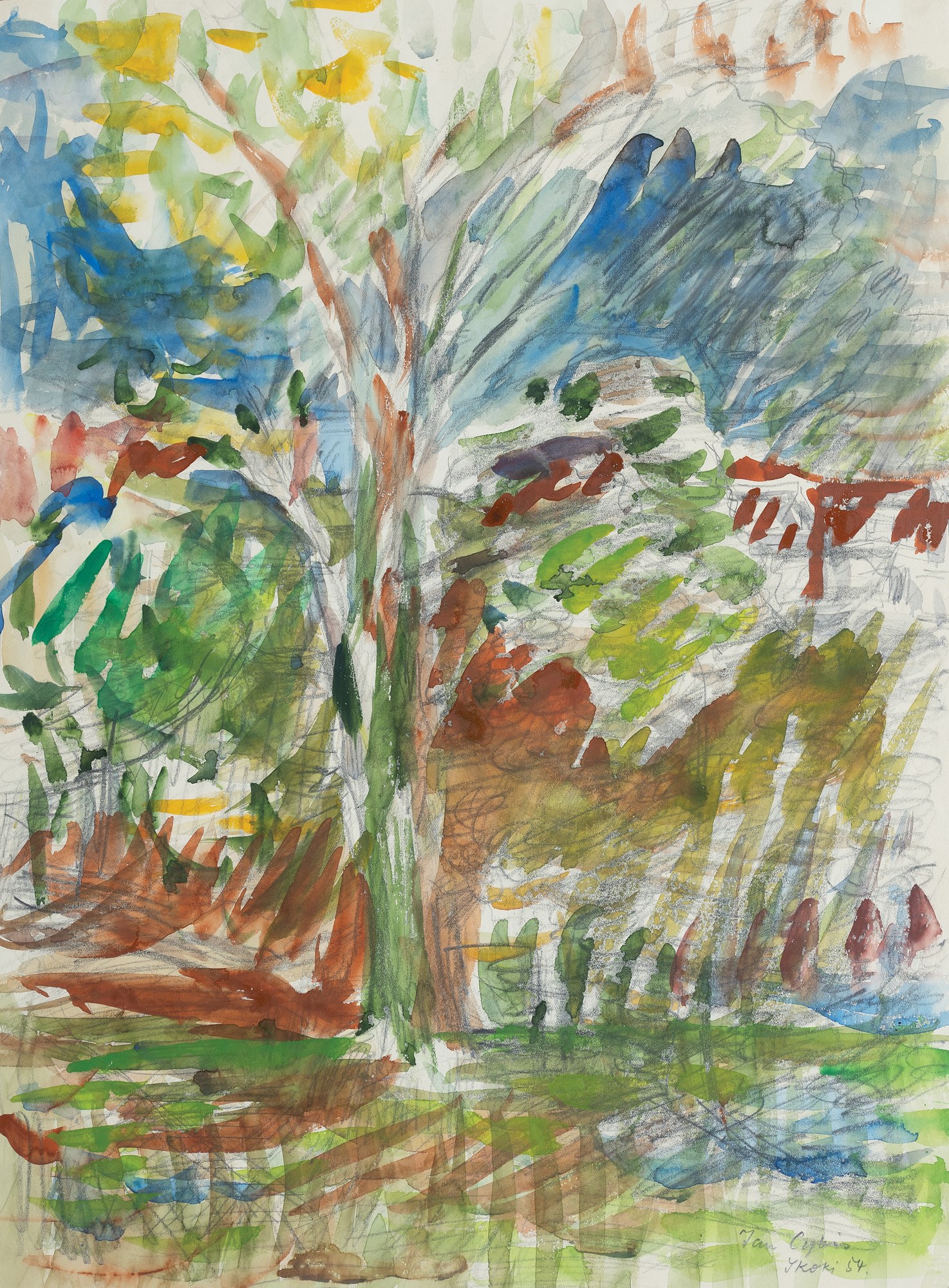
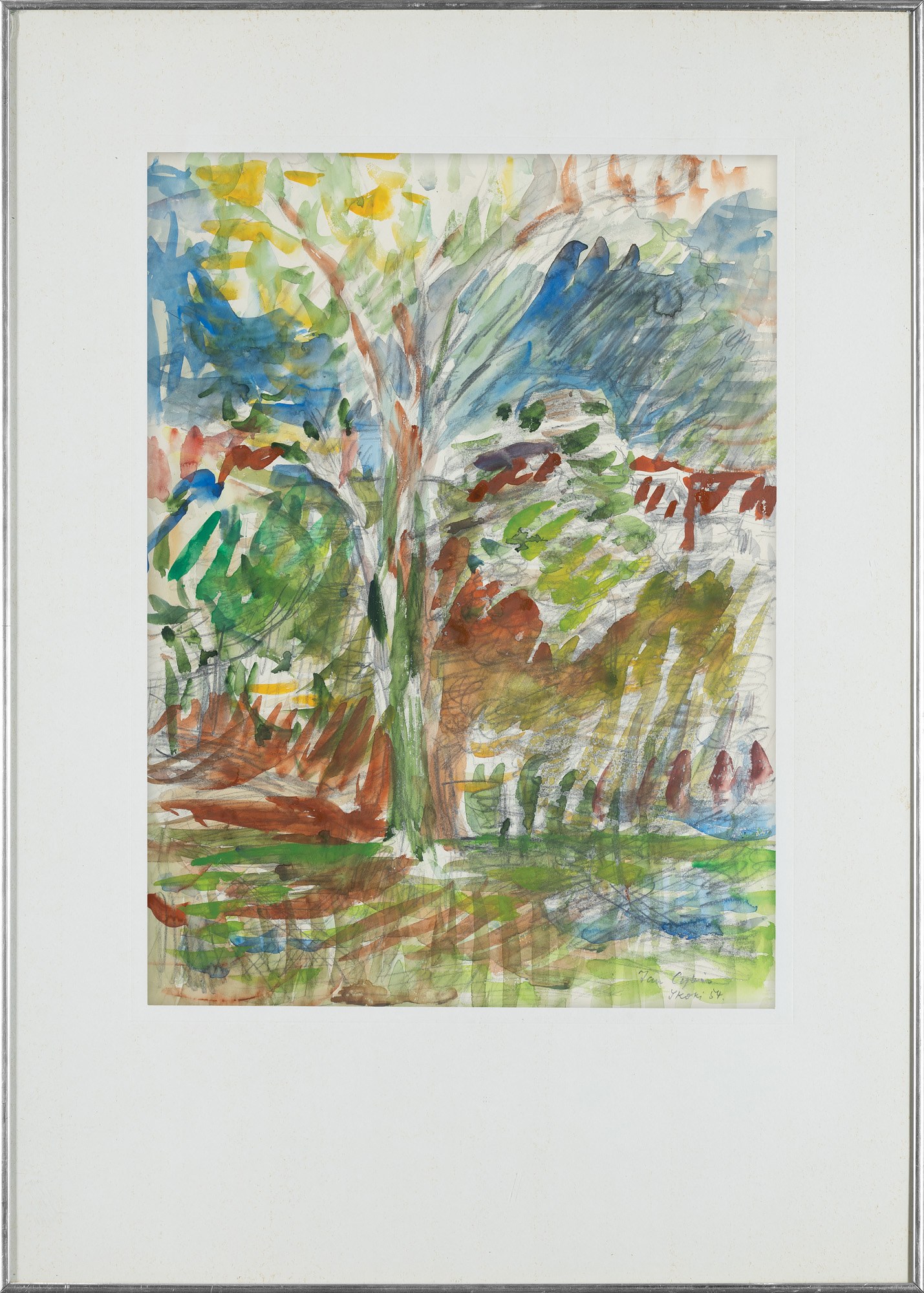
46.5 x 34.3 cm - watercolor, pencil, paper
signed in pencil, lower right: Jan Cybis | Skoki 54.
Skoki is a town located north of Poznań. The palace and park complex housed the Warsaw Academy of Fine Arts’ plein air studio, shared with the State Higher School of Fine Arts in Poznań (now the Magdalena Abakanowicz University of Arts), which currently manages the facility. At the time this watercolor was created, Jan Cybis was not a professor at the Academy in Warsaw (he had been forcibly removed in 1948), but he was able to use its plein air center privately.
His stay in Skoki was recorded in the chronology of the artist’s life and work: 1954. August. He is staying at an open-air workshop in the town of Skoki in Greater Poland. Among the 35 known paintings from that year, the series of landscapes from Skoki and depictions of flowers hold a special place. Contemplating the captivatingly colorful, ever-changing world of bouquets gives rise to pure painterly emotions. (Teresa Sowińska, Chronology, in: Jan Cybis 1897–1972. Retrospective, Dec. 1997 – Feb. 1998, Zachęta Gallery of Contemporary Art, Warsaw 1997, p. 364)
Provenance: Grażyna Kulczyk Collection.
The painting has been exhibited, mentioned, and reproduced, among others, in: The work has been exhibited and reproduced in:
– GK Collection #1, Art Stations Gallery, Poznań, March 18 – June 17, 2007, cat.: Paweł Leszkowicz, GK Collection #1. Grażyna Kulczyk’s Art Collection, Poznań 2007, ill. p. 210.
♣ Droit de suite: ♣ An additional fee will be added to the Purchase Price, arising from the right of the artist and his heirs to receive remuneration in accordance with the Act of February 4, 1994, on Copyright and Related Rights (droit de suite).
Jan Cybis (Wróblin in Opole Silesia, 1897 – Warsaw, 1972) began his studies in painting at the Academy of Art and Artistic Industry in Wrocław (1920–1921). He then studied at the Academy of Fine Arts in Kraków under the guidance of Józef Pankiewicz. In 1924, together with a group of colleagues forming the so-called Paris Committee (abbreviated as “KP”; hence the group’s name, “Kapists”), he left for Paris, where he continued his studies, initially in contact with Pankiewicz and later on his own. In 1930, he took part in the first Kapists’ exhibition at the Galerie Zak in Paris, later in a joint exhibition in Geneva, and after returning to Poland in 1931, also in a group exhibition at the Polish Artists’ Club in Warsaw. In 1932, he held his first solo exhibition in Kraków. He was the leading figure of the group and a proponent of the principles that placed the issue of color at the forefront—color that “was both the content and the form” of his painting. His most recent exhibition at the Zachęta in Warsaw provided an opportunity to trace his highly consistent artistic trajectory. Rejecting any form of anecdote, he created paintings “for artistic reasons”—landscapes, still lifes, and portraits. He was also a translator and art critic, writing articles for publications such as the Kraków-based *Głos Plastyków*, of which he became editor-in-chief in 1937. In 1946, he became a professor at the Academy of Fine Arts in Warsaw, where he taught until 1968 (with a break from 1951 to 1957). In 1955, he also taught at the State Higher School of Fine Arts in Sopot.













Paskutiniai peržiūrėti
Prisijunkite, jei norite pamatyti pozicijų sąrašą
Mėgstami
Prisijunkite, jei norite pamatyti pozicijų sąrašą