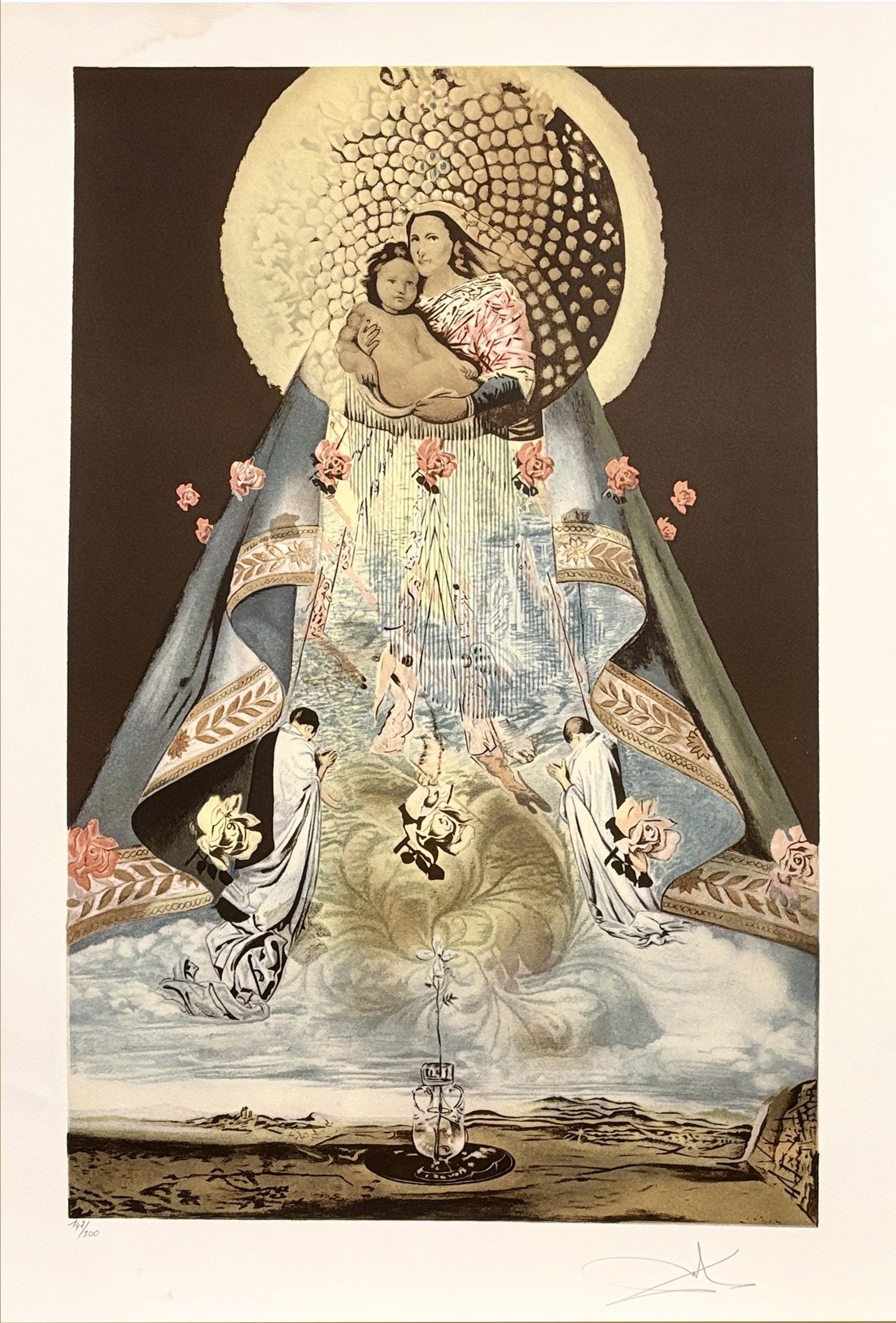
Color lithograph on Arches Paris paper (watermark), 76 x 56 cm.
Limited edition hand numbered numbered 142/300.
Hand signed in pencil p.d.
Publisher: Sidney Lucas (Phyllis Lucas Gallery, New York).
References:
-Cataloque Dali published in collaboration between S.P.A,D.E.M and Salvador Dali, published by Art. Graphic International Paris
- Dali , Bibliotheca Universalis published by Taschen
Salvador Dalí's lithograph depicting Our Lady of Guadalupe (Nuestra Señora de Guadalupe) is a fascinating work that combines traditional religious iconography with the Spanish surrealist's unique style.
Dalí created this work in 1959, which falls in the period of his so-called Nuclear Mysticism. During this time, the artist moved away from pure provocative surrealism to religious, scientific and classical subjects.
After World War II, Dalí experienced a conversion to Catholicism (though always in his own, eccentric way). He began to combine his faith with the discoveries of quantum physics. In "Our Lady of Guadalupe," this is evident through the way the figure is depicted - not as a static image, but as a being emanating cosmic energy.
Dalí often combined the image of Our Lady of Guadeloupe with the symbol of the rose (a reference to the miracle on Tepeyac Hill, where roses bloom in winter). In some versions of this lithograph, the figure of Mary appears to emerge from within the giant flower or is surrounded by it.
For Dali, Our Lady of Guadalupe was a symbol of the merging of the Old and New Worlds and proof that the sacred can manifest itself in matter. The artist believed that modern science (particle physics) only confirms the existence of a divine order, and for him the figure of Mary was the epitome of this "divine geometry."
In 1958, Dalí painted a large-format oil painting of the same title, which is now in the collection of Universal Film Studios (Universal Studios) in the US.
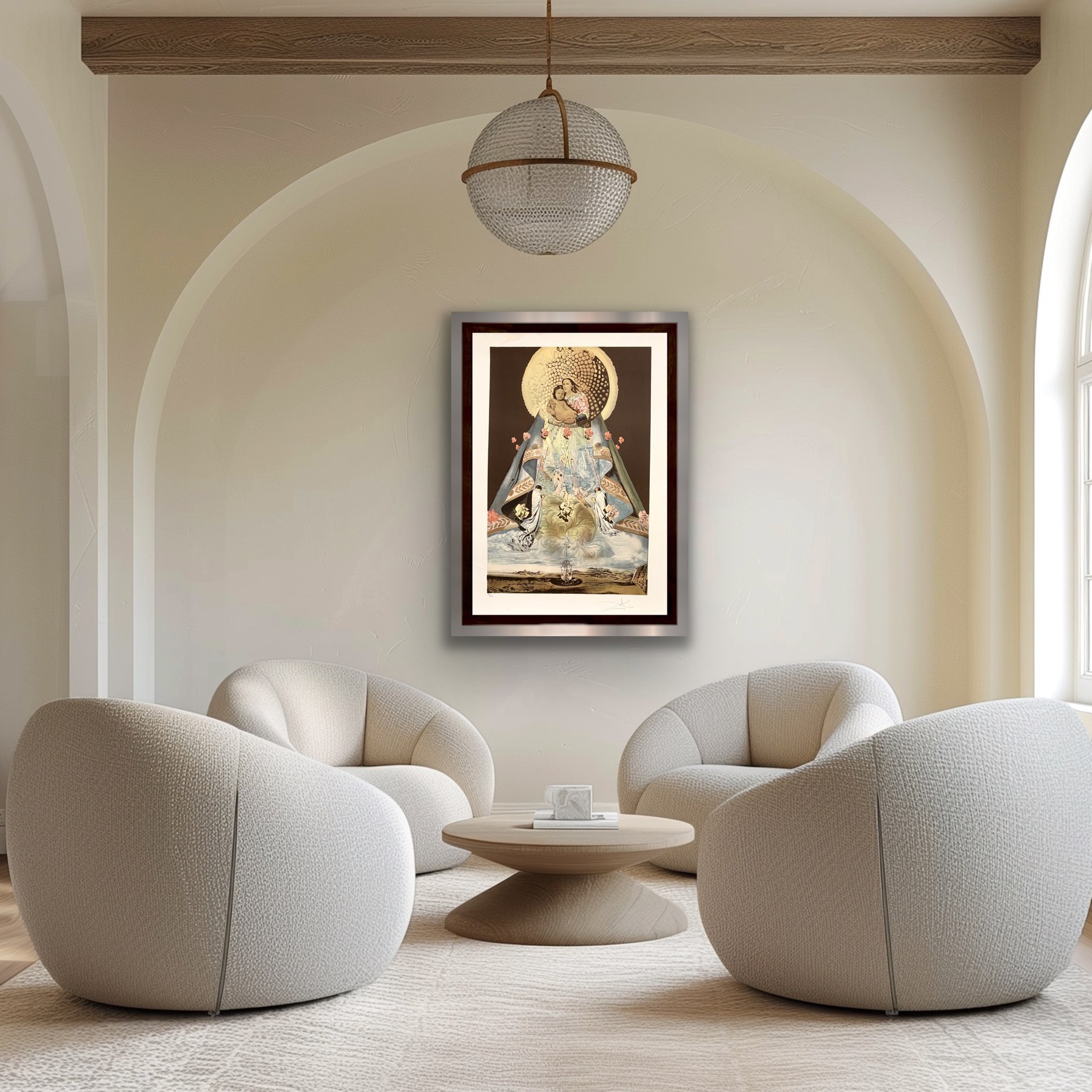
The frames shown in the visuals are for illustrative purposes only and do not constitute a commercial offer.